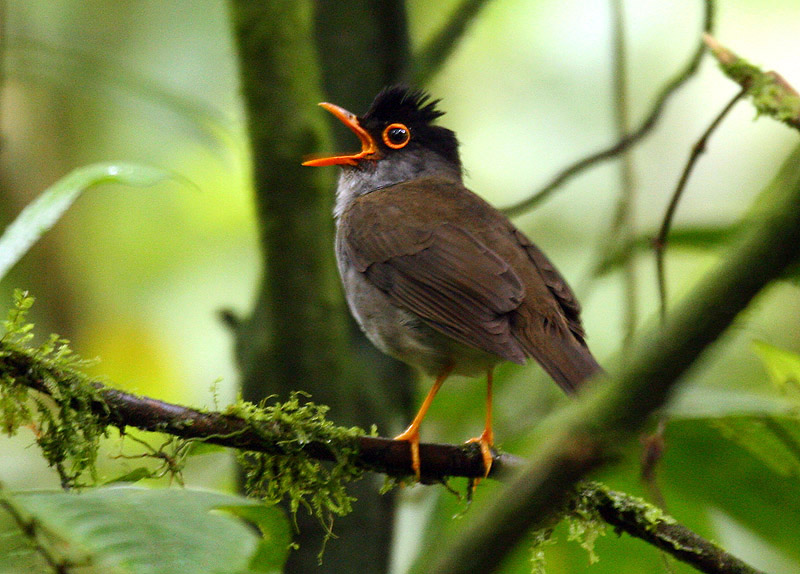
| Appearance | - Adult males of the nominate subspecies have a black crown, dark gray face, bright orange eye-ring, and olive-brown upperparts. English Wikipedia
- Adult males have a white throat with faint dark streaks, pale grayish brown breast and flanks, and a white belly and vent. English Wikipedia
- Adult females have a browner head and breast than adult males. English Wikipedia
- All subspecies have bright orange bills, legs, and feet. English Wikipedia
- The species has a plain breast. ebird.org
- The C. m. cantator subspecies has a grayer face and throat and an olive wash on its breast compared with the nominate subspecies. English Wikipedia
- The C. m. yaegeri subspecies has a pronounced reddish wash on its back. English Wikipedia
- The C. m. carrikeri subspecies has dark reddish upperparts and the darkest gray underparts among the subspecies. English Wikipedia
| - Adults have olive-brown to brownish upperparts and a chestnut-tinged tail. English Wikipedia
- The underparts are off-white, with gray flanks and a buff-tinged breast marked by dusky spots. English Wikipedia
- The species has pink legs, a faint gray eye ring, and gray cheeks. English Wikipedia
- The lower mandible is yellow over approximately two-thirds of its length, while the remaining bill is blackish. English Wikipedia
- Males and females have identical field appearances, although males average slightly longer wings. English Wikipedia
|
|---|
| Size | | - Adults average approximately 17 cm in length and weigh between 26 and 30 g. English Wikipedia
|
|---|
| Habitat | - The species primarily inhabits lowland and montane evergreen forests in tropical and subtropical zones. English Wikipedia
- The species also occurs in pine-oak forests in Guatemala and Honduras. English Wikipedia
- The species inhabits evergreen forests in foothills and highlands. ebird.org
- One reported elevational range for the species is 600–1,800 m. English Wikipedia
- In Guatemala and Honduras, the reported elevational range is 750–1,800 m. English Wikipedia
- In Costa Rica, the species occurs at elevations of 300–1,000 m on the Caribbean slope. English Wikipedia
- In Costa Rica, the species occurs at elevations of 700–1,300 m on the Pacific slope. English Wikipedia
| - During breeding, the species favors high-elevation coniferous forests exposed to strong winds and heavy ice. English Wikipedia
- Its typical breeding nesting elevation is above 915 m. English Wikipedia
- The species also occupies recently disturbed successional forests affected by forestry. English Wikipedia
- During winter, the species inhabits broadleaf forests at various elevations, generally favoring higher elevations. English Wikipedia
- Its breeding habitat includes montane spruce-fir forests at elevations of 915 m or higher. tethys.pnnl.gov
|
|---|
| Diet | | - The species feeds mainly on insects, particularly beetles and ants. English Wikipedia
- It begins consuming wild fruits in mid-July and continues eating them during migration and winter. English Wikipedia
|
|---|
| Behaviour | - The species forages in the forest understory and on the ground by turning over leaf litter. English Wikipedia
- The species is usually elusive and is heard more frequently than it is seen. ebird.org
- The species is mostly resident throughout the year. English Wikipedia
- Individuals in the northernmost part of the range show evidence of moving south during winter. English Wikipedia
- Elevational movements have been recorded in Veracruz. English Wikipedia
- The species sings mainly at dawn, dusk, and during the afternoon. English Wikipedia
- The species produces a rapid, thin, flute-like song with slightly tinny and fuzzy phrases. English Wikipedia
- The species gives harsh, complaining, upward-slurred calls. English Wikipedia
- The species produces a dry rattle or trill when agitated. English Wikipedia
- The species behaves aggressively toward ruddy-capped nightingale-thrushes. English Wikipedia
| - The species generally forages on the forest floor but also catches flies and gleans insects from tree foliage. English Wikipedia
- Its foraging commonly involves pausing and peering, accompanied by hops and short flights. English Wikipedia
- The species vocalizes primarily at dawn and dusk. English Wikipedia
- Its song consists of four phrases of high-pitched, flute-like tones. English Wikipedia
- Its primary call is a descending whistle known as the Beer call. English Wikipedia
|
|---|
| Reproduction | - The breeding season includes April and May in Mexico. English Wikipedia
- The breeding season extends from March through July in Costa Rica. English Wikipedia
- The species constructs a large cup-shaped nest from mosses, bark strips, and rootlets, lined with finer plant material. English Wikipedia
- The nest is typically placed in an understory plant fork approximately 1–3 m above the ground. English Wikipedia
- The species often places its nest near a stream. English Wikipedia
- The clutch contains two or three eggs. English Wikipedia
- The eggs range from pinkish white to bluish white and have reddish-brown speckles. English Wikipedia
| - Pair formation is thought to occur after females arrive at breeding sites in late May. English Wikipedia
- The female builds a bulky cup-shaped nest from twigs and moss near the trunk of a conifer. English Wikipedia
- Nests are usually positioned approximately two meters above the ground. English Wikipedia
- Females typically lay three or four eggs per clutch. English Wikipedia
- Incubation lasts approximately two weeks. English Wikipedia
- Nestlings become fully feathered and adult-sized approximately 12 days after hatching. English Wikipedia
|
|---|
| Distribution | - The species occurs in Costa Rica, Guatemala, Honduras, Mexico, Nicaragua, and Panama. English Wikipedia
- The species has been recorded as a vagrant in Texas. English Wikipedia
- An individual of the nominate subspecies spent much of 2004 in Hidalgo County, Texas. English Wikipedia
| - The breeding range extends from southeastern Quebec to Nova Scotia and includes northern New England, the Adirondacks, and the Catskills. English Wikipedia
- Approximately 90% of individuals winter in Hispaniola, principally in the Dominican Republic and also in Haiti. English Wikipedia
- Wintering populations have been recorded in the Dominican Republic, Haiti, Puerto Rico, Jamaica, and eastern Cuba. English Wikipedia
- The species' overwintering range includes Hispaniola, Cuba, and Jamaica. tethys.pnnl.gov
|
|---|
| Conservation | - The species is classified as Least Concern by the IUCN. English Wikipedia
- The species has a large geographic range, although its population size is unknown and believed to be decreasing. English Wikipedia
- No immediate threats have been identified for the species. English Wikipedia
- The species is considered common in Oaxaca and locally fairly common in Panama. English Wikipedia
- The species is rare and local in Guatemala but common in Honduras. English Wikipedia
- The species is common on Costa Rica's Caribbean slope and uncommon on its Pacific slope. English Wikipedia
| - Populations in northern New England and northeastern New York declined by an average of 3.88% annually since 2010. English Wikipedia
- The species has been extirpated from Massachusetts, where its last recorded occurrence was on Mount Greylock. English Wikipedia
|
|---|
| Similar species | No checked fact yet | - The gray-cheeked thrush is the closest relative of Bicknell's thrush. English Wikipedia
- Bicknell's thrush and the gray-cheeked thrush were formerly considered the same species. English Wikipedia
- The two species diverged approximately one million years ago according to DNA analysis. English Wikipedia
|
|---|