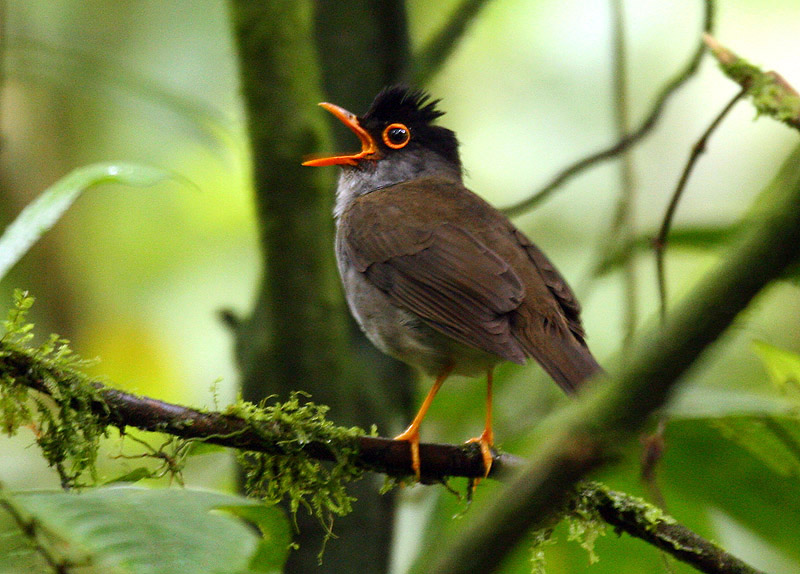
| Appearance | - Adult males of the nominate subspecies have a black crown, dark gray face, bright orange eye-ring, and olive-brown upperparts. English Wikipedia
- Adult males have a white throat with faint dark streaks, pale grayish brown breast and flanks, and a white belly and vent. English Wikipedia
- Adult females have a browner head and breast than adult males. English Wikipedia
- All subspecies have bright orange bills, legs, and feet. English Wikipedia
- The species has a plain breast. ebird.org
- The C. m. cantator subspecies has a grayer face and throat and an olive wash on its breast compared with the nominate subspecies. English Wikipedia
- The C. m. yaegeri subspecies has a pronounced reddish wash on its back. English Wikipedia
- The C. m. carrikeri subspecies has dark reddish upperparts and the darkest gray underparts among the subspecies. English Wikipedia
| - Adults have brown upperparts and white underparts with brown flanks and a lighter brown breast marked by darker spots. English Wikipedia
- The species has pink legs and a light brown eye ring. English Wikipedia
- Eastern populations have more olive-brown upperparts, whereas western populations have more reddish-brown upperparts. English Wikipedia
- The species has the characteristic white-dark-white underwing pattern of Catharus thrushes. English Wikipedia
|
|---|
| Size | | |
|---|
| Habitat | - The species primarily inhabits lowland and montane evergreen forests in tropical and subtropical zones. English Wikipedia
- The species also occurs in pine-oak forests in Guatemala and Honduras. English Wikipedia
- The species inhabits evergreen forests in foothills and highlands. ebird.org
- One reported elevational range for the species is 600–1,800 m. English Wikipedia
- In Guatemala and Honduras, the reported elevational range is 750–1,800 m. English Wikipedia
- In Costa Rica, the species occurs at elevations of 300–1,000 m on the Caribbean slope. English Wikipedia
- In Costa Rica, the species occurs at elevations of 700–1,300 m on the Pacific slope. English Wikipedia
| - Its breeding habitat includes coniferous forests with dense undergrowth across Canada, Alaska, and the northern United States. English Wikipedia
- Its breeding habitat also includes deciduous wooded areas along the Pacific coast of North America. English Wikipedia
- The species uses predominantly native shrublands as foraging habitat during fall migration. pmc.ncbi.nlm.nih.gov
|
|---|
| Diet | | - The species mainly consumes insects, fruits, and berries. English Wikipedia
- The species forages both on the forest floor and in trees. English Wikipedia
- Its diet during fall migration includes both insects and berry-producing shrubs. pmc.ncbi.nlm.nih.gov
- Actively migrating individuals consume more fleshy-fruiting plants than individuals undergoing moult. pmc.ncbi.nlm.nih.gov
- A higher proportion of moulting individuals consume arthropods compared with actively migrating individuals. pmc.ncbi.nlm.nih.gov
- The species consumes more native plants than non-native plants later in the fall migration season. pmc.ncbi.nlm.nih.gov
|
|---|
| Behaviour | - The species forages in the forest understory and on the ground by turning over leaf litter. English Wikipedia
- The species is usually elusive and is heard more frequently than it is seen. ebird.org
- The species is mostly resident throughout the year. English Wikipedia
- Individuals in the northernmost part of the range show evidence of moving south during winter. English Wikipedia
- Elevational movements have been recorded in Veracruz. English Wikipedia
- The species sings mainly at dawn, dusk, and during the afternoon. English Wikipedia
- The species produces a rapid, thin, flute-like song with slightly tinny and fuzzy phrases. English Wikipedia
- The species gives harsh, complaining, upward-slurred calls. English Wikipedia
- The species produces a dry rattle or trill when agitated. English Wikipedia
- The species behaves aggressively toward ruddy-capped nightingale-thrushes. English Wikipedia
| - The species produces a hurried sequence of flute-like notes that spiral upward. English Wikipedia
- The species is described as a foliage gleaner. allaboutbirds.org
- Some individuals interrupt their fall migration at stopover locations outside their breeding grounds to undergo moult. pmc.ncbi.nlm.nih.gov
- The species migrates between North American breeding grounds and wintering grounds farther south in the Americas. nationalzoo.si.edu
|
|---|
| Reproduction | - The breeding season includes April and May in Mexico. English Wikipedia
- The breeding season extends from March through July in Costa Rica. English Wikipedia
- The species constructs a large cup-shaped nest from mosses, bark strips, and rootlets, lined with finer plant material. English Wikipedia
- The nest is typically placed in an understory plant fork approximately 1–3 m above the ground. English Wikipedia
- The species often places its nest near a stream. English Wikipedia
- The clutch contains two or three eggs. English Wikipedia
- The eggs range from pinkish white to bluish white and have reddish-brown speckles. English Wikipedia
| - The species builds a cup-shaped nest on a horizontal tree branch. English Wikipedia
- The species typically places its nest in the crotch of a willow, alder, or similar cover. nrm.dfg.ca.gov
|
|---|
| Distribution | - The species occurs in Costa Rica, Guatemala, Honduras, Mexico, Nicaragua, and Panama. English Wikipedia
- The species has been recorded as a vagrant in Texas. English Wikipedia
- An individual of the nominate subspecies spent much of 2004 in Hidalgo County, Texas. English Wikipedia
| - The species breeds across Canada, Alaska, and the northern United States. English Wikipedia
- The species migrates to southern Mexico and reaches as far south as Argentina. English Wikipedia
- Coastal populations winter from Mexico to Costa Rica after migrating along the Pacific coast of North America. English Wikipedia
- Continental populations migrate south through Florida and winter from Panama to Bolivia. English Wikipedia
- The species is a very rare vagrant in western Europe. English Wikipedia
|
|---|
| Conservation | - The species is classified as Least Concern by the IUCN. English Wikipedia
- The species has a large geographic range, although its population size is unknown and believed to be decreasing. English Wikipedia
- No immediate threats have been identified for the species. English Wikipedia
- The species is considered common in Oaxaca and locally fairly common in Panama. English Wikipedia
- The species is rare and local in Guatemala but common in Honduras. English Wikipedia
- The species is common on Costa Rica's Caribbean slope and uncommon on its Pacific slope. English Wikipedia
| - The species is classified as Least Concern by the IUCN. English Wikipedia
- Its population decreased by approximately 38% between 1966 and 2014. English Wikipedia
- Habitat loss, climate change, and window collisions negatively affect the species. English Wikipedia
- Managing urban greenspaces with native plants and diverse food sources can support the nutritional needs of migratory individuals. pmc.ncbi.nlm.nih.gov
|
|---|