Comparison
Brazilian Guinea Pig vs Montane Guinea Pig
Brazilian Guinea Pig (Cavia aperea) and Montane Guinea Pig (Cavia tschudii) both belong to the genus Cavia (cavy) and part ways below it. Both are recorded in 3 countries.
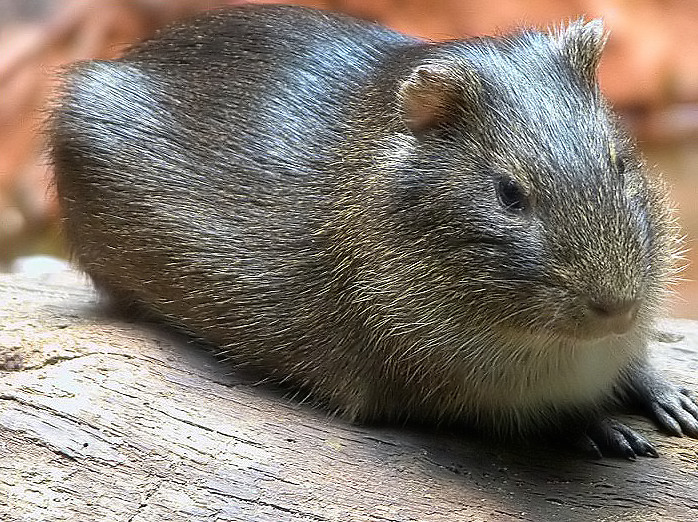
Brazilian Guinea Pig
Cavia aperea
Petra Karstedt (= PetraK; www.Tiermotive.de), CC BY-SA 2.0 de, via Wikimedia Commons


Side by side
| Brazilian Guinea Pig | Montane Guinea Pig | |
|---|---|---|
| Scientific name | Cavia aperea Erxleben, 1777 | Cavia tschudii Fitzinger, 1857 |
| English name | Brazilian Guinea Pig | Montane Guinea Pig |
| Group | Mammals | Mammals |
| Class | Mammalia Mammal | Mammalia Mammal |
| Order | Rodentia Rodent | Rodentia Rodent |
| Family | Caviidae Maras | Caviidae Maras |
| Genus | Cavia Cavy | Cavia Cavy |
| Named in | 1777 | 1857 |
| Red List category | Least Concern | Least Concern |
| Environment | Not recorded | terrestrial |
| Countries on record | 11 countries | 4 countries |
| GBIF occurrence records | 8,944 records | 446 records |
Rows where the two agree are shown in grey.
Where each is found
Both recorded in 3 countries
Only Brazilian Guinea Pig (8)
Only Montane Guinea Pig (1)
From Catalogue of Life checklists and GBIF occurrence records. A country missing from a list means no record is held, which is not proof of absence.
Checked facts
| Brazilian Guinea Pig | Montane Guinea Pig | |
|---|---|---|
| Appearance |
|
|
| Size |
|
|
| Habitat |
|
|
| Diet |
|
|
| Behaviour |
|
|
| Reproduction |
|
|
| Distribution |
|
|
| Conservation |
| No checked fact yet |
| Other | No checked fact yet |
|
In brief
Brazilian Guinea Pig
Cavia aperea occurs in Argentina, Brazil, Bolivia, Colombia, Ecuador, Guyana, Paraguay, Uruguay and Venezuela. It has dark olive-brown dorsal fur mixed with brown and black, pale grey or yellowish-grey underparts, and an almost absent tail. Full profile
Montane Guinea Pig
Cavia tschudii is native to the high Andes of South America, with a documented range extending from Peru to the Tarapacá Region of Chile and Tucumán Province of Argentina. It is considered a likely principal ancestor of the domestic guinea pig, Cavia porcellus. Full profile
Compare something else
Page built on 29 November 2026 from the data on the two species pages, where every source is listed.
Cite this page
ScientificNames.org. (2026). Brazilian Guinea Pig vs Montane Guinea Pig. Retrieved November 29, 2026, from https://scientificnames.org/compare/brazilian-guinea-pig-vs-montane-guinea-pig
“Brazilian Guinea Pig vs Montane Guinea Pig.” ScientificNames.org, 2026, scientificnames.org/compare/brazilian-guinea-pig-vs-montane-guinea-pig. Accessed 29 Nov. 2026.
ScientificNames.org. “Brazilian Guinea Pig vs Montane Guinea Pig.” Accessed November 29, 2026. https://scientificnames.org/compare/brazilian-guinea-pig-vs-montane-guinea-pig.
@misc{scientificnames_brazilian_guinea_pig_vs_montane_guinea_pig,
  author = {{ScientificNames.org}},
  title = {Brazilian Guinea Pig vs Montane Guinea Pig},
  year = {2026},
  url = {https://scientificnames.org/compare/brazilian-guinea-pig-vs-montane-guinea-pig},
  note = {Accessed 2026-11-29}
}