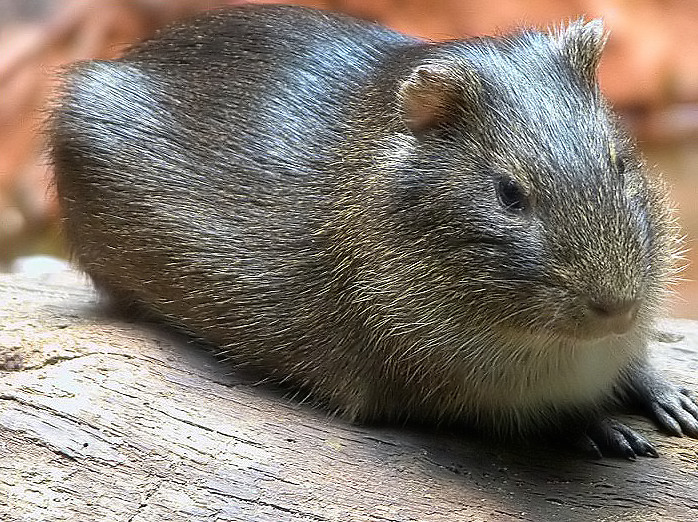
| Appearance | - Its dorsal fur is dark agouti brown, while its underparts are reddish brown. English Wikipedia
- The species has particularly long neck fur that forms a crest. animaldiversity.org
- Greater guinea pigs have stocky bodies and legs that are short relative to their body length. English Wikipedia
- They have four digits on their forefeet and three digits on their hind feet. English Wikipedia
- The species has interdigital membranes connecting its toes, an adaptation associated with its semiaquatic lifestyle. animaldiversity.org
- Greater guinea pigs lack canine teeth and have a toothless gap between their incisors and molars. animaldiversity.org
- Their incisors grow continuously and require gnawing on hard materials such as wood for maintenance. English Wikipedia
- Greater guinea pigs are larger than Brazilian guinea pigs and Santa Catarina's guinea pigs. English Wikipedia
| |
|---|
| Size | No checked fact yet | |
|---|
| Habitat | - Its typical habitats include moist grasslands, marshes, woodland edges, and small valleys. English Wikipedia
- The species commonly inhabits wetlands near rivers, lakes, and oceans. animaldiversity.org
- It frequently occurs near saline soils, including areas around lagoons and estuaries. English Wikipedia
- Greater guinea pigs use giant sea holly (Eryngium pandanifolium) for shelter and protection in wetlands. animaldiversity.org
- The species moves to drier locations within its home range during wet seasons when its usual habitat becomes inundated. animaldiversity.org
| |
|---|
| Diet | - The greater guinea pig is an herbivore that consumes grasses, sedges, and other vegetation. English Wikipedia
- Plants in the family Poaceae constitute most of its diet. English Wikipedia
- Paspalum urvillei is a commonly consumed plant with high nutritional content and low fiber content. English Wikipedia
- The species consumes Juncus acutus in abundance, particularly during winter. English Wikipedia
- Young greater guinea pigs can begin eating solid food within their first week of life. animaldiversity.org
| - The Brazilian guinea pig is herbivorous and eats grasses and other herbs. English Wikipedia
|
|---|
| Behaviour | - Greater guinea pigs are generally solitary, although individuals can have overlapping home ranges. animaldiversity.org
- The species is non-burrowing and lives above ground. English Wikipedia
- Greater guinea pigs are primarily active during the early morning and late afternoon. English Wikipedia
- Individuals sometimes aggregate while foraging, but territorial behavior has not been observed. English Wikipedia
- Greater guinea pigs use freezing and flight responses to avoid predators. English Wikipedia
- Their foraging activities take place within four meters of dense vegetation. English Wikipedia
- Males and females have overlapping home ranges, with male ranges generally showing lower fidelity. English Wikipedia
- The mating system is promiscuous, with males mating with females whose home ranges overlap their own. animaldiversity.org
| |
|---|
| Reproduction | - Greater guinea pigs generally reproduce most actively between September and December. animaldiversity.org
- Females can produce as many as three litters in one year. English Wikipedia
- The gestation period is approximately 64 days. English Wikipedia
- Gestation lasts between 53 and 77 days according to reported population averages. animaldiversity.org
- Litters typically contain one to three pups. English Wikipedia
- Newborns weigh approximately 18% of their mother's body weight. English Wikipedia
- Newborns are precocial, with open eyes, fully developed fur, and the ability to run shortly after birth. English Wikipedia
- Female greater guinea pigs can reach reproductive maturity at an average age of 29.5 days. animaldiversity.org
- Females can gain up to 42% of their body weight during pregnancy. animaldiversity.org
- Young remain close to their mothers for three to five weeks while the mothers continue lactating. animaldiversity.org
- Males have been observed providing paternal care through grooming and social play. English Wikipedia
| - Breeding can occur throughout the year, although it is most frequent during the austral summer. English Wikipedia
- The gestation period lasts approximately 62 days. English Wikipedia
- Females can produce as many as five litters annually. English Wikipedia
- Litters contain an average of two offspring, with a range of one to five. English Wikipedia
- Young individuals can reach breeding age at a minimum of 30 days. English Wikipedia
- Cavia aperea has been successfully crossed with the domestic guinea pig, although many female offspring become infertile in successive generations. English Wikipedia
|
|---|
| Distribution | - The greater guinea pig is native to the coastal regions of southeastern Brazil and eastern Uruguay. English Wikipedia
- Its native range extends from Criciuma, Brazil, south to the Department of Rocha, Uruguay. animaldiversity.org
| - Cavia aperea occurs in Argentina, Brazil, Bolivia, Colombia, Ecuador, Guyana, Paraguay, Uruguay and Venezuela. English Wikipedia
|
|---|
| Conservation | - The greater guinea pig is classified as Least Concern by the International Union for Conservation of Nature. English Wikipedia
| - The species has a stable population. English Wikipedia
- No particular threats have been identified for the Brazilian guinea pig. English Wikipedia
- The Brazilian guinea pig is classified as Least Concern by the International Union for Conservation of Nature. English Wikipedia
|
|---|
| Similar species | - The species is morphologically and genetically similar to the Brazilian guinea pig (Cavia aperea) and Santa Catarina's guinea pig (Cavia intermedia). English Wikipedia
| No checked fact yet |
|---|