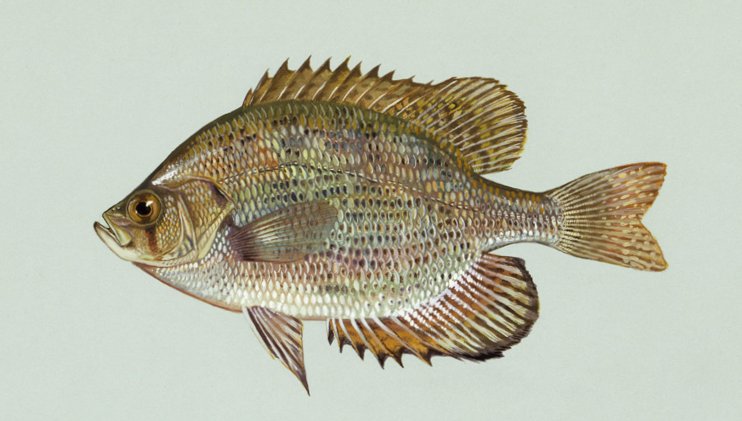
| Appearance | - The flier has a strongly compressed body and a moderately sized oblique mouth. English Wikipedia
- The dorsal fin has 11–13 spines and 12–14 soft rays. English Wikipedia
- The anal fin has 7–8 spines and 13–15 soft rays. English Wikipedia
- The flier has olive upperparts, a pale underside, and scattered dark spots along its flanks. English Wikipedia
- A dark vertical marking extends through the eye and continues below it in a teardrop pattern. English Wikipedia
- Individuals shorter than approximately 45 mm standard length have a dark dorsal-fin eyespot with a reddish margin. English Wikipedia
- The pectoral and pelvic fins are dusky and have paler reticulations. English Wikipedia
| - The bluegill typically has a yellowish breast and abdomen, while breeding males have a bright orange breast. English Wikipedia
- The bluegill has three anal fin spines and six to thirteen dorsal fin spines. English Wikipedia
- The bluegill has ctenoid scales and an anteriorly upward-arched lateral line. English Wikipedia
- Adult bluegills usually have a dark blotch at the rear of the dorsal fin, which is absent in young juveniles. English Wikipedia
|
|---|
| Size | | |
|---|
| Habitat | - Flier inhabit clear, acidic waters in swamp ponds, sloughs, oxbows, and slow-flowing creeks and streams. English Wikipedia
- Flier habitats generally have heavy vegetation and average water temperatures of 23–29 °C. English Wikipedia
- In Virginia, flier commonly occupy dark, tannic, acidic backwaters in coastal swamps, creeks, ponds, and canals. dwr.virginia.gov
- Flier in Virginia are associated with low-gradient tributaries in the coastal plain. dwr.virginia.gov
- Flier in Virginia thrive in areas with thick vegetation and can tolerate low dissolved oxygen levels. dwr.virginia.gov
- Riparian protection and vegetation cover are optimal habitat features for Virginia's swamp-dwelling flier. dwr.virginia.gov
| - The bluegill inhabits freshwater streams, rivers, lakes, ponds and wetlands. English Wikipedia
- The bluegill prefers shallow water containing abundant aquatic plants. English Wikipedia
- The bluegill commonly shelters near fallen logs, water weeds and submerged structures. English Wikipedia
- During summer, adult bluegills move into deep open water and suspend just below the surface. English Wikipedia
- Bluegills generally occupy water temperatures between 16 and 27 °C. English Wikipedia
- The bluegill has been recorded in water with salinity up to 1.8%. English Wikipedia
|
|---|
| Diet | - Flier feed primarily on invertebrates, including insects, snails, worms, and leeches. English Wikipedia
- Flier also consume smaller fishes and some phytoplankton. English Wikipedia
- The diet of flier in Virginia includes insect larvae, small crustaceans, worms, small fishes, and algae. dwr.virginia.gov
| - Adult bluegills consume aquatic insect larvae, including mayflies, caddisflies and dragonflies. English Wikipedia
- The adult bluegill diet can include terrestrial insects, zooplankton, shrimp, crayfish, leeches, worms, snails and small fish. English Wikipedia
- Young bluegills feed on rotifers, copepods, water fleas and insects, particularly chironomids. English Wikipedia
- Bluegills may consume aquatic vegetation and algae when animal food is scarce. English Wikipedia
- Bluegills generally feed during daylight, with feeding peaks in the morning and evening. English Wikipedia
- During summer, bluegills generally consume approximately 3.2% of their body weight daily. English Wikipedia
|
|---|
| Behaviour | No checked fact yet | - Bluegills commonly form schools containing approximately ten to twenty fish. English Wikipedia
- Bluegills frequently shelter around submerged tree stumps and other underwater structures. English Wikipedia
- Bluegills use suction feeding to capture prey. English Wikipedia
- Bluegills can rapidly change direction through synchronized fin movements. English Wikipedia
|
|---|
| Reproduction | - Flier breeding normally takes place between March and May when water temperatures reach 14–17 °C. English Wikipedia
- Breeding has been recorded as early as February. English Wikipedia
- Gravid females have been collected from debris-filled ditches with soft bottoms, gravel-bottomed streams, and vegetated sand and gravel pits. English Wikipedia
- Flier spawn in conditions ranging from clear or turbid flowing water to stagnant ditches and pools. English Wikipedia
- Flier construct nests among rocks or gravel and enclose their eggs in a round adhesive envelope. English Wikipedia
- Flier are colonial nesters and establish closely spaced nests in aggregations. English Wikipedia
- Flier reach sexual maturity at approximately one year of age and 70 mm in length. English Wikipedia
- Male flier guard eggs and newly hatched fry. English Wikipedia
- In Virginia, flier spawn in spring, sometimes beginning in February when water temperatures reach 55°F. dwr.virginia.gov
- Male flier build nests and defend nesting sites and newly hatched young territorially. dwr.virginia.gov
| - The bluegill spawning season generally extends from late May through August. English Wikipedia
- Bluegill spawning usually peaks in June at water temperatures of 19–27 °C. English Wikipedia
- Male bluegills construct spawning beds approximately 15–30 cm in diameter in shallow water. English Wikipedia
- A small female bluegill can produce approximately 1,000 eggs, while a large healthy female can produce up to 100,000. English Wikipedia
- Bluegill fertilization occurs externally in the water. English Wikipedia
- Male bluegills guard their nests until the larvae can hatch and swim independently. English Wikipedia
- Bluegill parental males construct nests and aggressively defend them while caring for their offspring. English Wikipedia
|
|---|
| Conservation | No checked fact yet | |
|---|
| Uses | No checked fact yet | |
|---|
| Similar species | No checked fact yet | - The bluegill is most closely related to the orangespotted sunfish and redear sunfish. English Wikipedia
|
|---|
| Other | | No checked fact yet |
|---|