Comparison

Grey Warbler-finch vs Green Warbler-finch

Grey Warbler-finch (Certhidea fusca) and Green Warbler-finch (Certhidea olivacea) both belong to the genus Certhidea (warbler-finch) and part ways below it. Both are recorded in 1 country.

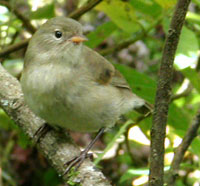
Grey Warbler-finch

Grey Warbler-finch

Certhidea fusca

Unknown author, CC BY-SA 2.0, via Wikimedia Commons

Green Warbler-finch

Green Warbler-finch

Certhidea olivacea

2000 - Paul McFarling, Charles Darwin Foundation, CC BY-SA 3.0, via Wikimedia Commons

Side by side

Grey Warbler-finchGreen Warbler-finch
Scientific nameCerthidea fusca P. L. Sclater & Salvin, 1870Certhidea olivacea Gould, 1837
English nameGrey Warbler-finchGreen Warbler-finch
GroupBirdsBirds
ClassAves BirdAves Bird
OrderPasseriformes PasserinePasseriformes Passerine
FamilyThraupidae TanagerThraupidae Tanager
GenusCerthidea Warbler-finchCerthidea Warbler-finch
Named in18701837
Red List categoryLeast ConcernVulnerable
Countries on record1 country2 countries
GBIF occurrence records4,371 records3,669 records

Rows where the two agree are shown in grey.

Where each is found

Both recorded in 1 country

Only Green Warbler-finch (1)

From Catalogue of Life checklists and GBIF occurrence records. A country missing from a list means no record is held, which is not proof of absence.

Checked facts

Grey Warbler-finchGreen Warbler-finch
Appearance
  • The grey warbler-finch has brownish-gray plumage. ebird.org
  • The species has a thin, slender bill. ebird.org
  • Adult males have a sandy-brown upper body, whereas females have an olive-brown upper body. English Wikipedia
  • Breeding males have distinctive reddish throat patches. English Wikipedia
  • Its greenish coloration helps it blend into lusher semi-humid forest habitats. English Wikipedia
Size
  • The grey warbler-finch is described as a small bird. ebird.org
Habitat
  • The species is commonly found in shrubland and dry forests on smaller, drier islands. English Wikipedia
  • The species inhabits subtropical or tropical dry forests. English Wikipedia
  • The species inhabits subtropical or tropical moist montane forests. English Wikipedia
  • The species inhabits subtropical or tropical dry shrubland. English Wikipedia
  • The species inhabits subtropical or tropical dry forests. English Wikipedia
  • The species inhabits subtropical or tropical moist montane forests. English Wikipedia
  • The species also inhabits subtropical or tropical dry shrubland. English Wikipedia
  • The species is most abundant in humid areas at higher elevations. English Wikipedia
  • The species is most commonly found in humid highland forest. ebird.org
  • The species forages mainly in the forest canopy but also uses dead plant structures in the understory. pmc.ncbi.nlm.nih.gov
DietNo checked fact yet
  • Its diet consists mainly of seeds, insects, and small fruits. English Wikipedia
  • Its recorded insect prey includes caterpillars, beetles, ants, and spiders. English Wikipedia
  • The species consumes more insects during summer and more seeds, fruits, and berries during winter. English Wikipedia
  • Arthropods are an important food source for the species during chick rearing. pmc.ncbi.nlm.nih.gov
BehaviourNo checked fact yet
  • The species forages either alone or in small groups. English Wikipedia
  • Its sharp beak enables it to access different food sources. English Wikipedia
  • Invasive blackberry growth and its management influence the species' microhabitat use, foraging substrate, and prey choice. pmc.ncbi.nlm.nih.gov
  • The species can continue foraging in dead understory plant structures following invasive plant management. pmc.ncbi.nlm.nih.gov
ReproductionNo checked fact yet
  • The species exhibits monogamous breeding behaviour and often forms long-term pair bonds. English Wikipedia
  • Breeding typically occurs during the hot wet season. English Wikipedia
  • Males construct spherical nests from dry grasses, moss, and lichens. English Wikipedia
  • The species places its nests on small branches. English Wikipedia
  • Females lay approximately three to five white eggs marked with reddish-brown spots. English Wikipedia
  • Females incubate the eggs alone for approximately 12 days. English Wikipedia
  • Young birds leave the nest approximately two weeks after hatching. English Wikipedia
  • Nestlings are vulnerable to blood-feeding larvae of the parasitic fly Philornis downsi. pmc.ncbi.nlm.nih.gov
Distribution
ConservationNo checked fact yet
  • The species was classified as Vulnerable in the document. English Wikipedia
  • Its population on Santa Cruz Island declined by approximately 46% between the 1997–1998 and 2008–2010 survey periods. English Wikipedia
  • The species' population on Santa Cruz Island declined by 45% in humid native forest between 1997 and 2010. pmc.ncbi.nlm.nih.gov
  • Its population on Santa Cruz Island declined by 85% in the agricultural zone between 1997 and 2010. pmc.ncbi.nlm.nih.gov
  • Habitat loss associated with human activities and invasive plants is identified as a major threat to the species. English Wikipedia
  • The invasive blackberry Rubus niveus threatens the humid cloud forest on Santa Cruz Island. pmc.ncbi.nlm.nih.gov
Similar species
  • The grey warbler-finch is closely related to the green warbler-finch. English Wikipedia
  • The grey and green warbler-finches were formerly classified as a single species. English Wikipedia
  • The grey and green warbler-finches differ in appearance, geographic distribution, habitat, and song. English Wikipedia
  • The grey warbler-finch is a closely related species. English Wikipedia
  • The green and grey warbler-finches were formerly considered members of the same species. English Wikipedia
OtherNo checked fact yet
  • The green warbler-finch belongs to the tanager family Thraupidae. inaturalist.org

In brief

Grey Warbler-finch

Certhidea fusca is endemic to the Galápagos Islands in Ecuador. It is distinguished by its brownish-gray plumage and thin, slender bill. Full profile

Green Warbler-finch

The Green Warbler-finch, Certhidea olivacea Gould, 1837, is a bird in the family Thraupidae and order Passeriformes. It is endemic to the Galápagos Islands of Ecuador. Its coloration varies between adult males and females, and breeding males have distinctive reddish throat patches. Full profile

Compare something else

Page built on 28 November 2026 from the data on the two species pages, where every source is listed.

Cite this page

ScientificNames.org. (2026). Grey Warbler-finch vs Green Warbler-finch. Retrieved November 28, 2026, from https://scientificnames.org/compare/grey-warbler-finch-vs-green-warbler-finch