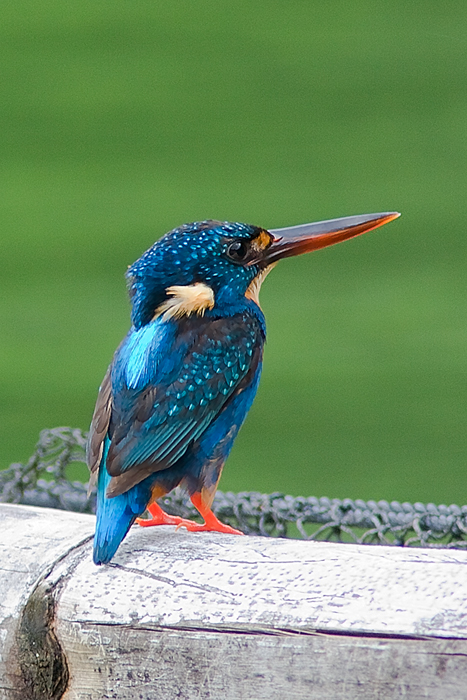
| Appearance | - Southern birds have entirely black bills, whereas Northern birds have red lower bills. English Wikipedia
- Northern birds have more blue coloration on their sides than Southern birds. English Wikipedia
- The species is described as having a pale turquoise band. ebird.org
| - Adults have a black forehead spot, blue and white neck patches, lilac-rufous crown, rump and tail, dark blue back and wings, white chin and throat, pale yellow-orange underparts, dark brown eyes, and red legs, feet and bill. English Wikipedia
- Juveniles have duller plumage with less lilac colouring, white chin, throat and belly, a yellow-orange bill with a pale tip, and blue scapulars and wing-coverts. English Wikipedia
- The species has a red bill and yellow-orange underparts that help distinguish it from other birds in its range. English Wikipedia
- The species has three toes. English Wikipedia
|
|---|
| Size | No checked fact yet | |
|---|
| Habitat | - The species inhabits streams in tropical moist lowland forests. English Wikipedia
- The species' natural habitat extends to elevations of 1,500 metres above sea level, although it usually occurs at lower elevations. English Wikipedia
- The species prefers streams and rivers bordered by densely forested banks. English Wikipedia
- The species shows some tolerance of secondary forests. English Wikipedia
| - The species inhabits deciduous and evergreen primary and secondary forests. English Wikipedia
- Its habitats also include alluvial forests, mangroves, overgrown rubber gardens, and dense groups of palms, bamboos or shrubs. English Wikipedia
- The species generally occupies densely shaded lowland forests near small streams or ponds. English Wikipedia
- The species typically occurs at elevations not exceeding approximately 1,000–1,300 m. English Wikipedia
- Individuals commonly remain close to the forest floor, perching and flying within 1–2 m of it. English Wikipedia
- Although the species generally stays near streams and ponds, its nests are often located well away from water. English Wikipedia
|
|---|
| Diet | | - The species feeds primarily on insects, including mantises, grasshoppers, flies, water beetles, winged ants and mayflies. English Wikipedia
- Its diet also includes spiders, worms, small crabs, fish, frogs and lizards. English Wikipedia
|
|---|
| Behaviour | - The species hunts by perching on rocks, overhanging branches or foliage before diving steeply into water. English Wikipedia
- After catching prey, the species returns to its perch, beats the prey and swallows it. English Wikipedia
| - Individuals forage alone, usually perching in low vegetation or on rocks before capturing prey from the ground or foliage. English Wikipedia
- Individuals can capture spiders directly from their webs and catch insects while flying. English Wikipedia
- The species can dive into water to capture prey at or just below the surface without submerging its body. English Wikipedia
- Individuals typically carry larger prey to a perch and strike it repeatedly with their bills before swallowing it. English Wikipedia
- The species produces high-pitched, shrill calls described as 'tsriet-tsriet' or softer 'tjie-tjie-tjie' sounds during flight. English Wikipedia
- The species is a partial migrant, with northern populations wintering in the southern parts of the breeding range. English Wikipedia
- Northern populations commonly migrate south towards peninsular Malaysia between August and September and return north in March. English Wikipedia
|
|---|
| Reproduction | - The species nests in tunnels excavated into the banks of streams and rivers. English Wikipedia
- The breeding behaviour of the species is poorly documented. English Wikipedia
| - Egg laying occurs between July and September in southwest India. English Wikipedia
- Egg laying occurs between February and July in Sri Lanka. English Wikipedia
- Egg laying occurs between April and May in northeast India. English Wikipedia
- Egg laying occurs between March and July in peninsular Malaysia. English Wikipedia
- Egg laying occurs between December and May in Java. English Wikipedia
- Nesting sites include stream banks, road cuttings, terrestrial termite mounds and soil near the roots of fallen trees. English Wikipedia
- Both parents excavate a horizontal nesting tunnel measuring 15–100 cm in length and 3.8–4.5 cm in diameter. English Wikipedia
- The nesting tunnel ends in an unlined egg chamber. English Wikipedia
- A typical clutch contains three to seven eggs, averaging approximately five. English Wikipedia
- Eggs are laid in the morning at intervals of one day. English Wikipedia
- Incubation begins after the final egg is laid and lasts 17–18 days. English Wikipedia
- Both parents incubate the eggs, but the female performs most of the incubation at night. English Wikipedia
- The fledging period lasts 18–20 days, and chicks typically leave the nest in the morning. English Wikipedia
|
|---|
| Distribution | | - The species is endemic to parts of the Indian Subcontinent and Mainland Southeast Asia. English Wikipedia
- Its breeding range includes eastern Bangladesh, northeastern India, Myanmar, southern China, Laos, Cambodia and Thailand. English Wikipedia
- Disjunct populations occur in the Western Ghats of western India and in Sri Lanka. English Wikipedia
- The subspecies C. e. macrocarus occurs in the Andaman and Nicobar Islands. English Wikipedia
|
|---|
| Conservation | - The species is experiencing population declines associated with habitat loss and degradation. English Wikipedia
- The Northern subspecies is classified as Least Concern, although its population is believed to be decreasing. English Wikipedia
- The global population size of the Northern subspecies has not been quantified. English Wikipedia
- The Northern subspecies is described as generally rather common. English Wikipedia
- The Southern subspecies is considered uncommon within its range. English Wikipedia
- The Southern subspecies is restricted to remnant forests on Negros. English Wikipedia
- The estimated population of the Southern subspecies is between 1,000 and 2,499 mature individuals. English Wikipedia
- The population of the Southern subspecies continues to decline. English Wikipedia
- Deforestation and habitat loss are contributing to declines in both subspecies. English Wikipedia
- Neither subspecies has a targeted conservation programme. English Wikipedia
- Further surveys have been proposed to improve understanding of the population and biology of the more threatened Southern subspecies. English Wikipedia
| - The species is classified as Near Threatened on the IUCN Red List. English Wikipedia
- The species has a decreasing population trend, although the number of mature individuals is unknown. English Wikipedia
- Clearing of forest habitat is identified as the main threat to the species. English Wikipedia
- Continued human-driven loss of critical breeding habitat is expected to reduce population levels. English Wikipedia
|
|---|
| Similar species | - Some taxonomic authorities treat the Northern and Southern populations as two separate species. English Wikipedia
- The Handbook of the Birds of the World treats the Northern and Southern forms as separate species. English Wikipedia
| - The rufous-backed dwarf kingfisher was formerly treated as a colour morph of the black-backed dwarf kingfisher. English Wikipedia
- Molecular genetic studies established that the rufous-backed dwarf kingfisher is a distinct taxon. English Wikipedia
|
|---|
| Other | - The species was previously placed in the genus Alcedo and grouped under the name Alcedo cyanopectus. datazone.birdlife.org
| No checked fact yet |
|---|