Comparison

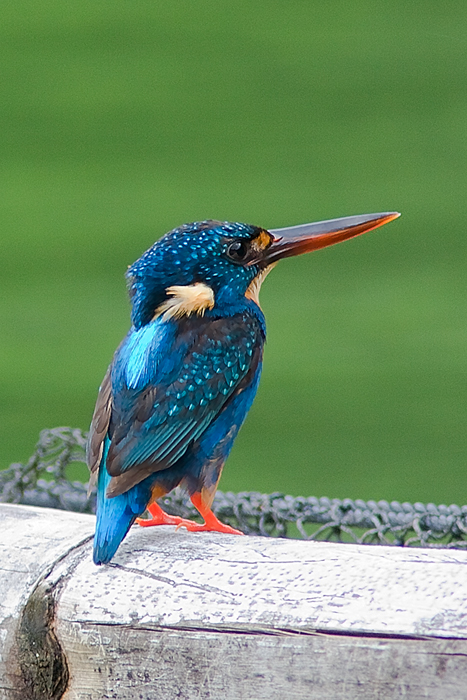
Dimorphic Dwarf Kingfisher vs Indigo-banded Kingfisher

Dimorphic Dwarf Kingfisher (Ceyx margarethae) and Indigo-banded Kingfisher (Ceyx cyanopectus) both belong to the genus Ceyx (dwarf kingfishers and allies) and part ways below it. Both are recorded in 1 country.

Dimorphic Dwarf Kingfisher

Dimorphic Dwarf Kingfisher

Ceyx margarethae

Philippine Postal Corporation, Public domain, via Wikimedia Commons

Indigo-banded Kingfisher

Indigo-banded Kingfisher

Ceyx cyanopectus

Llimchiu at English Wikipedia, CC BY-SA 3.0, via Wikimedia Commons

Side by side

Dimorphic Dwarf KingfisherIndigo-banded Kingfisher
Scientific nameCeyx margarethae W. Blasius, 1890Ceyx cyanopectus Lafresnaye, 1840
English nameDimorphic Dwarf KingfisherIndigo-banded Kingfisher
GroupBirdsBirds
ClassAves BirdAves Bird
OrderCoraciiformes TodiesCoraciiformes Todies
FamilyAlcedinidae KingfisherAlcedinidae Kingfisher
GenusCeyx Dwarf Kingfishers and AlliesCeyx Dwarf Kingfishers and Allies
Named in18901840
Red List categoryLeast ConcernLeast Concern
Countries on record2 countries1 country
GBIF occurrence records460 records1,411 records

Rows where the two agree are shown in grey.

Where each is found

Both recorded in 1 country

Only Dimorphic Dwarf Kingfisher (1)

From Catalogue of Life checklists and GBIF occurrence records. A country missing from a list means no record is held, which is not proof of absence.

Checked facts

Dimorphic Dwarf KingfisherIndigo-banded Kingfisher
AppearanceNo checked fact yet
  • Southern birds have entirely black bills, whereas Northern birds have red lower bills. English Wikipedia
  • Northern birds have more blue coloration on their sides than Southern birds. English Wikipedia
  • The species is described as having a pale turquoise band. ebird.org
Habitat
  • The species inhabits tropical moist lowland forests. English Wikipedia
  • The species is also described as inhabiting subtropical or tropical moist lowland forests. inaturalist.org
  • The species inhabits streams in tropical moist lowland forests. English Wikipedia
  • The species' natural habitat extends to elevations of 1,500 metres above sea level, although it usually occurs at lower elevations. English Wikipedia
  • The species prefers streams and rivers bordered by densely forested banks. English Wikipedia
  • The species shows some tolerance of secondary forests. English Wikipedia
Diet
  • The species is presumed to feed on invertebrates, small reptiles and fish. English Wikipedia
Behaviour
  • The species hunts by perching on rocks, overhanging branches or foliage before diving steeply into water. English Wikipedia
  • After catching prey, the species returns to its perch, beats the prey and swallows it. English Wikipedia
Reproduction
  • A nest of this species was observed on Panay in 2024, attached to the side of a clay cliff. English Wikipedia
  • The observed nestlings took 21 days to fledge. English Wikipedia
  • The species nests in tunnels excavated into the banks of streams and rivers. English Wikipedia
  • The breeding behaviour of the species is poorly documented. English Wikipedia
Distribution
  • The species is endemic to the central and southern Philippines. English Wikipedia
  • The species occurs on Negros, Cebu, Camiguin Sur, Mindanao and other small islands in the central and southern Philippines. English Wikipedia
Conservation
  • The species was assessed as Least Concern by the IUCN. English Wikipedia
  • The population of this species is decreasing. English Wikipedia
  • Habitat loss is identified as the main threat to the species. English Wikipedia
  • Forest clearance associated with logging, agricultural conversion and mining threatens the species within its range. English Wikipedia
  • The species is experiencing population declines associated with habitat loss and degradation. English Wikipedia
  • The Northern subspecies is classified as Least Concern, although its population is believed to be decreasing. English Wikipedia
  • The global population size of the Northern subspecies has not been quantified. English Wikipedia
  • The Northern subspecies is described as generally rather common. English Wikipedia
  • The Southern subspecies is considered uncommon within its range. English Wikipedia
  • The Southern subspecies is restricted to remnant forests on Negros. English Wikipedia
  • The estimated population of the Southern subspecies is between 1,000 and 2,499 mature individuals. English Wikipedia
  • The population of the Southern subspecies continues to decline. English Wikipedia
  • Deforestation and habitat loss are contributing to declines in both subspecies. English Wikipedia
  • Neither subspecies has a targeted conservation programme. English Wikipedia
  • Further surveys have been proposed to improve understanding of the population and biology of the more threatened Southern subspecies. English Wikipedia
Similar species
  • The species was formerly classified as one of 15 recognised subspecies of the variable dwarf kingfisher. English Wikipedia
  • Some taxonomic authorities treat the Northern and Southern populations as two separate species. English Wikipedia
  • The Handbook of the Birds of the World treats the Northern and Southern forms as separate species. English Wikipedia
Other
  • A molecular phylogenetic study published in 2013 found substantial divergence among most insular subspecies of the variable dwarf kingfisher. English Wikipedia
  • The dimorphic dwarf kingfisher was among 12 subspecies elevated to species status following the taxonomic revision. English Wikipedia
  • The former variable dwarf kingfisher was renamed the Moluccan dwarf kingfisher during the taxonomic revision. English Wikipedia
  • The species was listed by the IUCN Red List as assessed in 2024. iucnredlist.org
  • The species was previously placed in the genus Alcedo and grouped under the name Alcedo cyanopectus. datazone.birdlife.org

In brief

Dimorphic Dwarf Kingfisher

Ceyx margarethae is endemic to the central and southern Philippines, occurring on Negros, Cebu, Camiguin Sur, Mindanao and other small islands. Full profile

Indigo-banded Kingfisher

The Indigo-banded Kingfisher is a bird endemic to the Philippines. It occurs on Luzon, Mindoro, Masbate and in the Western Visayas region. Full profile

Compare something else

Page built on 28 November 2026 from the data on the two species pages, where every source is listed.

Cite this page

ScientificNames.org. (2026). Dimorphic Dwarf Kingfisher vs Indigo-banded Kingfisher. Retrieved November 28, 2026, from https://scientificnames.org/compare/dimorphic-dwarf-kingfisher-vs-indigo-banded-kingfisher