Comparison

Little Kingfisher vs Indigo-banded Kingfisher

Little Kingfisher (Ceyx pusillus) and Indigo-banded Kingfisher (Ceyx cyanopectus) both belong to the genus Ceyx (dwarf kingfishers and allies) and part ways below it.

Little Kingfisher

Little Kingfisher

Ceyx pusillus

JJ Harrison (https://www.jjharrison.com.au/), CC BY-SA 3.0, via Wikimedia Commons

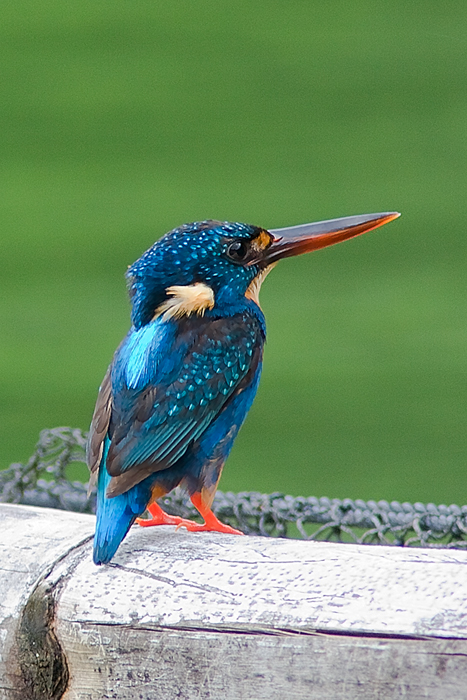
Indigo-banded Kingfisher

Indigo-banded Kingfisher

Ceyx cyanopectus

Llimchiu at English Wikipedia, CC BY-SA 3.0, via Wikimedia Commons

Side by side

Little KingfisherIndigo-banded Kingfisher
Scientific nameCeyx pusillus Temminck, 1836Ceyx cyanopectus Lafresnaye, 1840
English nameLittle KingfisherIndigo-banded Kingfisher
GroupBirdsBirds
ClassAves BirdAves Bird
OrderCoraciiformes TodiesCoraciiformes Todies
FamilyAlcedinidae KingfisherAlcedinidae Kingfisher
GenusCeyx Dwarf Kingfishers and AlliesCeyx Dwarf Kingfishers and Allies
Named in18361840
Red List categoryLeast ConcernLeast Concern
Countries on record4 countries1 country
GBIF occurrence records9,089 records1,411 records

Rows where the two agree are shown in grey.

Where each is found

Only Little Kingfisher (4)

Only Indigo-banded Kingfisher (1)

From Catalogue of Life checklists and GBIF occurrence records. A country missing from a list means no record is held, which is not proof of absence.

Checked facts

Little KingfisherIndigo-banded Kingfisher
Appearance
  • The Little Kingfisher has a glossy deep-blue back and head and a snowy white breast. English Wikipedia
  • The Little Kingfisher has a heavy bill and a short tail. English Wikipedia
  • The Little Kingfisher has dark brown feet, with one rear toe and two forward toes. English Wikipedia
  • Southern birds have entirely black bills, whereas Northern birds have red lower bills. English Wikipedia
  • Northern birds have more blue coloration on their sides than Southern birds. English Wikipedia
  • The species is described as having a pale turquoise band. ebird.org
SizeNo checked fact yet
Habitat
  • The Little Kingfisher inhabits open forests, woodlands, swamps and mangroves. English Wikipedia
  • The Little Kingfisher typically occurs beside rivers, lagoons and waterholes. ebird.org
  • The species inhabits streams in tropical moist lowland forests. English Wikipedia
  • The species' natural habitat extends to elevations of 1,500 metres above sea level, although it usually occurs at lower elevations. English Wikipedia
  • The species prefers streams and rivers bordered by densely forested banks. English Wikipedia
  • The species shows some tolerance of secondary forests. English Wikipedia
Diet
  • The Little Kingfisher feeds on small fish, crustaceans, insect larvae and water beetles. English Wikipedia
Behaviour
  • The Little Kingfisher generally has a sedentary lifestyle. English Wikipedia
  • The Little Kingfisher waits quietly on a branch near water before diving to catch prey and returning directly to its perch. English Wikipedia
  • The Little Kingfisher produces a high-pitched, squeaky call described as 'tzeit-tzeit' while flying. English Wikipedia
  • The Little Kingfisher gives a very thin, high-pitched whistle. ebird.org
  • The species hunts by perching on rocks, overhanging branches or foliage before diving steeply into water. English Wikipedia
  • After catching prey, the species returns to its perch, beats the prey and swallows it. English Wikipedia
Reproduction
  • In Queensland, the Little Kingfisher breeds between October and March. English Wikipedia
  • In the Northern Territory, the Little Kingfisher's breeding season occurs in February. English Wikipedia
  • In Papua New Guinea, the Little Kingfisher breeds from January to April. English Wikipedia
  • The Little Kingfisher excavates small burrows in riverbanks during its mating season. English Wikipedia
  • The Little Kingfisher sometimes nests in decaying mangrove or paperbark roots or in termite mounds. English Wikipedia
  • The Little Kingfisher lays clutches of four to five glossy, rounded, white eggs. English Wikipedia
  • The Little Kingfisher's eggs measure 17 × 14 mm. English Wikipedia
  • The eggs are laid in a chamber at the end of the nesting burrow. English Wikipedia
  • Both Little Kingfisher parents feed their offspring and continue feeding them outside the nest for at least nine days until independence. English Wikipedia
  • The species nests in tunnels excavated into the banks of streams and rivers. English Wikipedia
  • The breeding behaviour of the species is poorly documented. English Wikipedia
Distribution
  • The Little Kingfisher occurs in northern Queensland and coastal Northern Territory in Australia, Indonesia, Papua New Guinea and the Solomon Islands. English Wikipedia
Conservation
  • The Little Kingfisher is classified as Least Concern on the IUCN Red List. English Wikipedia
  • The Little Kingfisher was assessed as Least Concern on the IUCN Red List in 2024. iucnredlist.org
  • The Little Kingfisher's population trend is decreasing. English Wikipedia
  • Some Little Kingfisher subspecies may be adversely affected by mangrove clearance. English Wikipedia
  • The Guadalcanal subspecies Ceyx pusillus aolae has not been recorded for several decades. English Wikipedia
  • The species is experiencing population declines associated with habitat loss and degradation. English Wikipedia
  • The Northern subspecies is classified as Least Concern, although its population is believed to be decreasing. English Wikipedia
  • The global population size of the Northern subspecies has not been quantified. English Wikipedia
  • The Northern subspecies is described as generally rather common. English Wikipedia
  • The Southern subspecies is considered uncommon within its range. English Wikipedia
  • The Southern subspecies is restricted to remnant forests on Negros. English Wikipedia
  • The estimated population of the Southern subspecies is between 1,000 and 2,499 mature individuals. English Wikipedia
  • The population of the Southern subspecies continues to decline. English Wikipedia
  • Deforestation and habitat loss are contributing to declines in both subspecies. English Wikipedia
  • Neither subspecies has a targeted conservation programme. English Wikipedia
  • Further surveys have been proposed to improve understanding of the population and biology of the more threatened Southern subspecies. English Wikipedia
Similar speciesNo checked fact yet
  • Some taxonomic authorities treat the Northern and Southern populations as two separate species. English Wikipedia
  • The Handbook of the Birds of the World treats the Northern and Southern forms as separate species. English Wikipedia
OtherNo checked fact yet
  • The species was previously placed in the genus Alcedo and grouped under the name Alcedo cyanopectus. datazone.birdlife.org

In brief

Little Kingfisher

Ceyx pusillus occurs in northern Queensland and coastal Northern Territory in Australia, Indonesia, Papua New Guinea and the Solomon Islands. It has a glossy deep-blue back and head, a snowy white breast, a heavy bill and a short tail. Full profile

Indigo-banded Kingfisher

The Indigo-banded Kingfisher is a bird endemic to the Philippines. It occurs on Luzon, Mindoro, Masbate and in the Western Visayas region. Full profile

Compare something else

Page built on 27 November 2026 from the data on the two species pages, where every source is listed.

Cite this page

ScientificNames.org. (2026). Little Kingfisher vs Indigo-banded Kingfisher. Retrieved November 27, 2026, from https://scientificnames.org/compare/little-kingfisher-vs-indigo-banded-kingfisher