Comparison

Seaweed Darkling Beetle vs Red Flour Beetle

Seaweed Darkling Beetle (Chaerodes trachyscelides) and Red Flour Beetle (Tribolium castaneum) both belong to the family Tenebrionidae (darkling beetle) and part ways below it. Both are recorded in 1 country.

Seaweed Darkling Beetle

Seaweed Darkling Beetle

Chaerodes trachyscelides

Steve Kerr, CC BY 4.0, via Wikimedia Commons

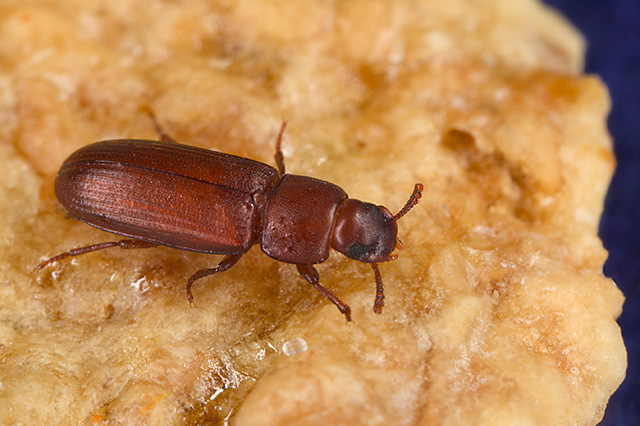
Red Flour Beetle

Red Flour Beetle

Tribolium castaneum

Unknown author, Public domain, via Wikimedia Commons

Side by side

Seaweed Darkling BeetleRed Flour Beetle
Scientific nameChaerodes trachyscelidesTribolium castaneum (Herbst, 1797)
English nameSeaweed Darkling BeetleRed Flour Beetle
GroupInsectsInsects
ClassInsecta InsectInsecta Insect
OrderColeoptera BeetleColeoptera Beetle
FamilyTenebrionidae Darkling BeetleTenebrionidae Darkling Beetle
GenusChaerodesTribolium Flour Beetles
Named inNot recorded1797
EnvironmentNot recordedterrestrial
Countries on record1 country48 countries
GBIF occurrence records586 records5,025 records

Rows where the two agree are shown in grey.

Where each is found

Both recorded in 1 country

Only Red Flour Beetle (47)

From Catalogue of Life checklists and GBIF occurrence records. A country missing from a list means no record is held, which is not proof of absence.

Checked facts

Seaweed Darkling BeetleRed Flour Beetle
Appearance
  • The beetle has three pairs of legs adapted for burrowing into sand. English Wikipedia
  • The underside of adult beetles is pale whitish yellow. English Wikipedia
  • The hardened forewings of this species exhibit colour polymorphism. English Wikipedia
  • Individual beetles have forewing colours that correspond to the sand colour of their habitat. English Wikipedia
  • Approximately 96% of beetles on black-sand beaches have brown-black colouring. English Wikipedia
  • Approximately 98% of beetles on pale-sand beaches have a pale milky colouring. English Wikipedia
  • Spotted and mottled individuals have been observed on beaches with mixed sand types. English Wikipedia
  • The larva is white and U-shaped and resembles a small wireworm. English Wikipedia
  • Adult beetles have a uniform rust, brown, or black coloration, with the head and pronotum sometimes darker than the rest of the body. English Wikipedia
Size
Habitat
  • The species inhabits sandy beaches in New Zealand. English Wikipedia
  • The beetle occupies a narrow coastal band at the upper boundary of the high tidal zone. English Wikipedia
  • During daylight hours, individuals burrow as deep as 30 centimetres beneath the sand surface. English Wikipedia
  • The beetle frequently burrows beneath seaweed and marine algae. English Wikipedia
Diet
  • The beetle feeds on seaweed and marine algae deposited on the shore. English Wikipedia
  • The species attacks flour, cereals, pasta, biscuits, beans, and nuts. English Wikipedia
Behaviour
  • The species is flightless. English Wikipedia
  • The species is nocturnal and emerges after dark to feed. English Wikipedia
  • During the day, the beetle remains buried beneath the sand. English Wikipedia
  • The species is thought to possess an internal biological clock. English Wikipedia
  • The timing of beetle activity changes with tidal cycles even when individuals are kept in total darkness. English Wikipedia
  • Individuals are thought to change their positions along the shore in response to spring and neap tides. English Wikipedia
  • The species can survive being transported offshore on floating seaweed at high tide. English Wikipedia
  • Rafting on seaweed is considered a possible means of movement along the shore. English Wikipedia
  • Adults can disperse considerable distances by flying. English Wikipedia
  • Females can mate with multiple males during a single copulation period. English Wikipedia
  • Females can store sperm from different males in multiple sperm receptacles, allowing subsequent selection of which sperm to use. English Wikipedia
  • Males generally prefer mature females that have not previously mated. English Wikipedia
  • Males can recognize their relatives, whereas females cannot. English Wikipedia
  • Males can remove sperm stored by previous mates during subsequent copulations. English Wikipedia
  • Obstacles affect the beetles' movement more strongly than corridor length or turns. pmc.ncbi.nlm.nih.gov
  • Beetles travel greater distances through obstructed straight corridors than through longer unobstructed corridors. pmc.ncbi.nlm.nih.gov
  • Turns increase movement distances and reduce movement speed. pmc.ncbi.nlm.nih.gov
  • Narrow passage gaps can restrict beetle movement when they fall below a certain threshold. pmc.ncbi.nlm.nih.gov
  • A passage-gap threshold of 1 cm was identified as relevant to movement restriction. pmc.ncbi.nlm.nih.gov
ReproductionNo checked fact yet
  • Females that engage in polygamous mating produce more offspring than females with fewer mates. English Wikipedia
  • Females store more sperm from their first mating than from subsequent matings. English Wikipedia
  • Males that mate last have an advantage in fertilizing a female's eggs. English Wikipedia
  • Matings between related beetles produce significantly fewer offspring than matings between unrelated beetles. English Wikipedia
  • Females may mate with multiple males to increase the likelihood of successful fertilization when genetic diversity is low. English Wikipedia
Distribution
ConservationNo checked fact yet
  • Hermetic storage of wheat and maize flour resulted in complete red flour beetle mortality after 12 days in a reported study. English Wikipedia
UsesNo checked fact yet
  • The species is used as a model organism for studying insect development and functional genomics. English Wikipedia
  • The species is particularly useful for RNA interference experiments because its RNAi response is stronger than that of Drosophila. English Wikipedia
  • The species has been used in experiments involving CRISPR gene editing. English Wikipedia
  • The species serves as a model organism in research investigating how environmental complexity affects insect movement. pmc.ncbi.nlm.nih.gov
OtherNo checked fact yet
  • The species and closely related beetles are worldwide pests of stored products, particularly food grains. English Wikipedia
  • The species is less capable of surviving outdoors than the confused flour beetle. English Wikipedia
  • The species' genome was sequenced, analyzed, and compared with other organisms in 2008. English Wikipedia
  • The species shares approximately 10,000–15,000 genes with the fruit fly. English Wikipedia
  • The species lacks a bicoid orthologue and uses orthodenticle and hunchback instead for anterior patterning. English Wikipedia

In brief

Seaweed Darkling Beetle

Chaerodes trachyscelides inhabits sandy beaches in New Zealand, occupying a narrow coastal band at the upper boundary of the high tidal zone. Its hardened forewings exhibit colour polymorphism corresponding to the sand colour of its habitat. Full profile

Red Flour Beetle

The Red Flour Beetle is a worldwide pest of stored products, particularly food grains. The species infests stored grains and other stored food products. The species is used as a model organism for studying insect development and functional genomics. Full profile

Compare something else

Page built on 27 November 2026 from the data on the two species pages, where every source is listed.

Cite this page

ScientificNames.org. (2026). Seaweed Darkling Beetle vs Red Flour Beetle. Retrieved November 27, 2026, from https://scientificnames.org/compare/seaweed-darkling-beetle-vs-red-flour-beetle