Comparison
Bristle-spined Rat vs Brazilian Porcupine
Bristle-spined Rat (Chaetomys subspinosus) and Brazilian Porcupine (Coendou prehensilis) both belong to the family Erethizontidae (new world porcupine) and part ways below it. Both are recorded in 1 country.
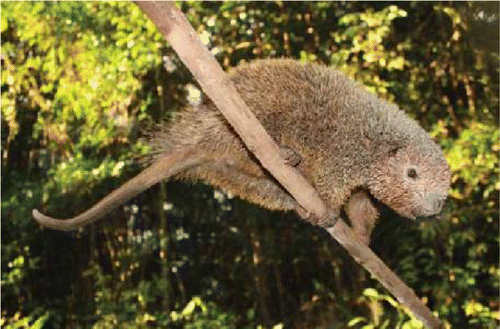


Brazilian Porcupine
Coendou prehensilis
Eric Kilby from Somerville, MA, USA, CC BY-SA 2.0, via Wikimedia Commons

Side by side
| Bristle-spined Rat | Brazilian Porcupine | |
|---|---|---|
| Scientific name | Chaetomys subspinosus (Olfers, 1818) | Coendou prehensilis (Linnaeus, 1758) |
| English name | Bristle-spined Rat | Brazilian Porcupine |
| Group | Mammals | Mammals |
| Class | Mammalia Mammal | Mammalia Mammal |
| Order | Rodentia Rodent | Rodentia Rodent |
| Family | Erethizontidae New World Porcupine | Erethizontidae New World Porcupine |
| Genus | Chaetomys | Coendou Prehensile-tailed Porcupine |
| Named in | 1818 | 1758 |
| Red List category | Vulnerable | Least Concern |
| Countries on record | 1 country | 12 countries |
| GBIF occurrence records | 141 records | 1,152 records |
Rows where the two agree are shown in grey.
Where each is found
Both recorded in 1 country
Only Brazilian Porcupine (11)
- Argentina
- Bolivia
- Colombia
- Ecuador
- French Guiana
- Guyana
- Peru
- Suriname
- Trinidad and Tobago
- United States
- Venezuela
From Catalogue of Life checklists and GBIF occurrence records. A country missing from a list means no record is held, which is not proof of absence.
Checked facts
| Bristle-spined Rat | Brazilian Porcupine | |
|---|---|---|
| Appearance |
|
|
| Size |
|
|
| Habitat |
|
|
| Diet |
|
|
| Behaviour |
|
|
| Reproduction |
|
|
| Distribution | No checked fact yet |
|
| Conservation |
| No checked fact yet |
| Similar species | No checked fact yet |
|
| Other |
| No checked fact yet |
In brief
Bristle-spined Rat
The Bristle-spined Rat (Chaetomys subspinosus) is a mammal in the family Erethizontidae, order Rodentia, and class Mammalia. It inhabits remnant forests and forest edges in Brazil's Atlantic coastal forests. It is distinguished by bristle-like spines on its back and a long, naked, non-prehensile tail. Full profile
Brazilian Porcupine
Coendou prehensilis occurs in Brazil, Argentina, Uruguay, Colombia, Venezuela, Guyana, French Guiana, Peru, Paraguay, Suriname, Bolivia and Trinidad, with one recorded occurrence in Ecuador. It has long dorsal quills and a prehensile tail with an upward-curling tip that helps it grip tree branches. Full profile
Compare something else
Page built on 27 November 2026 from the data on the two species pages, where every source is listed.
Cite this page
ScientificNames.org. (2026). Bristle-spined Rat vs Brazilian Porcupine. Retrieved November 27, 2026, from https://scientificnames.org/compare/bristle-spined-rat-vs-brazilian-porcupine
“Bristle-spined Rat vs Brazilian Porcupine.” ScientificNames.org, 2026, scientificnames.org/compare/bristle-spined-rat-vs-brazilian-porcupine. Accessed 27 Nov. 2026.
ScientificNames.org. “Bristle-spined Rat vs Brazilian Porcupine.” Accessed November 27, 2026. https://scientificnames.org/compare/bristle-spined-rat-vs-brazilian-porcupine.
@misc{scientificnames_bristle_spined_rat_vs_brazilian_porcupine,
  author = {{ScientificNames.org}},
  title = {Bristle-spined Rat vs Brazilian Porcupine},
  year = {2026},
  url = {https://scientificnames.org/compare/bristle-spined-rat-vs-brazilian-porcupine},
  note = {Accessed 2026-11-27}
}