Comparison

Charaxes bupalus vs White-barred Charaxes

Charaxes bupalus (Charaxes bupalus) and White-barred Charaxes (Charaxes brutus) both belong to the genus Charaxes (emperors) and part ways below it.
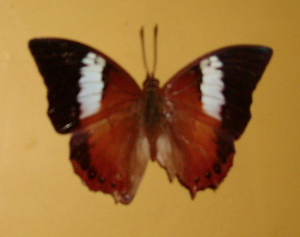
Charaxes bupalus

Charaxes bupalus

Jfi7811, CC BY 3.0, via Wikimedia Commons

White-barred Charaxes

Charaxes brutus

Side by side

Charaxes bupalusWhite-barred Charaxes
Scientific nameCharaxes bupalus Staudinger, 1889Charaxes brutus (Cramer)
English nameNot recordedWhite-barred Charaxes
GroupInsectsInsects
ClassInsecta InsectInsecta Insect
OrderLepidopteraLepidoptera
FamilyNymphalidae PurplesNymphalidae Purples
GenusCharaxes EmperorsCharaxes Emperors
Named in1889Not recorded
Red List categoryNot recordedLeast Concern
Countries on record1 country28 countries
GBIF occurrence records33 records3,920 records

Rows where the two agree are shown in grey.

Where each is found

Only Charaxes bupalus (1)

Only White-barred Charaxes (28)

From Catalogue of Life checklists and GBIF occurrence records. A country missing from a list means no record is held, which is not proof of absence.

Checked facts

Charaxes bupalusWhite-barred Charaxes
Appearance
  • The butterfly has coppery rufous upper wing surfaces, broad brown marginal forewing bands edged with white, and coppery red hindwings. English Wikipedia
  • The hindwings have a submarginal row of brown spots and a small tail. English Wikipedia
  • Male forewings have a white upper band that is more regular and sharply defined than in C. borneensis. English Wikipedia
  • Male forewings lack marked postdiscal spots. English Wikipedia
  • Male hindwings have marked median bars between veins C and R2, while the following bar is vestigial. English Wikipedia
  • The male's underside is tawny russet, with more tawny coloration in the postdiscal interspaces. English Wikipedia
  • Male forewings have continuous median bars between veins R2 and SM2. English Wikipedia
  • Male hindwings have nearly continuous median bars between veins SC2 and M2. English Wikipedia
  • The male has heavy, linear white submarginal spots, except for the third spot. English Wikipedia
  • The female has a white discal band on the upper forewing that is broader than in C. borneensis, particularly toward the front. English Wikipedia
  • The female's upper forewing has white postdiscal interspaces between veins R1 and SM2, partly tinged with tawny. English Wikipedia
  • The female's hindwing median bars between veins C and M1 are almost continuous. English Wikipedia
  • The female's hindwing has a white discal band that is broader than in C. borneensis and becomes tawny olive toward the rear. English Wikipedia
  • The female's upper hindwing has white submarginal spots that are linear and heavy. English Wikipedia
  • The female's forewing median bars between veins R2 and M1 are continuous. English Wikipedia
  • The female's hindwing line of median bars between veins C and M2 is less irregular than in C. borneensis. English Wikipedia
  • The adult butterfly has black or black-brown upper wing surfaces crossed by a white or whitish-yellow discal band. English Wikipedia
  • The forewing's white discal band breaks into spots toward the costal margin. English Wikipedia
  • The hindwing has two to four small blue spots near its distal margin. English Wikipedia
  • The underside of the wings has a continuous white discal band. English Wikipedia
  • The basal underside of the wings is red-brown and bears sharply contrasting black markings edged with white. English Wikipedia
  • The marginal underside is decorated with large triangular black spots bordered distally by pale grey. English Wikipedia
  • The hindwing has a distinct but short tail at vein 3. English Wikipedia
  • The species displays a prominent white stripe on both sides of its wings. micro.magnet.fsu.edu
  • Under brightfield illumination, the wing scales appear smooth, rounded and lightly coloured. micro.magnet.fsu.edu
Size
HabitatNo checked fact yet
DietNo checked fact yet
BehaviourNo checked fact yet
  • Adults often fly high in the tree canopy. micro.magnet.fsu.edu
  • The species is described as one of the world's fastest-flying butterflies, with some individuals reaching almost 40 miles per hour. micro.magnet.fsu.edu
  • Adults can be attracted to screen traps using dung and fermented fruit as bait. micro.magnet.fsu.edu
  • The species has a highly modified first pair of legs used for tasting rather than walking. micro.magnet.fsu.edu
  • The adult flight period extends throughout the year. English Wikipedia
ReproductionNo checked fact yet
Distribution
  • The species occurs in Africa. English Wikipedia
  • The nominate subspecies occurs in Senegal, Guinea-Bissau, Guinea, Sierra Leone, Liberia, Ivory Coast, Ghana, Togo and western Nigeria. English Wikipedia
  • The subspecies Charaxes brutus alcyone occurs east of the Rift Valley in Kenya and in northern and eastern Tanzania. English Wikipedia
  • The subspecies Charaxes brutus angustus occurs in eastern Nigeria, Cameroon, the Central African Republic, Gabon, Congo, northern Angola, Zaire, western Uganda and southern Chad. English Wikipedia
  • The subspecies Charaxes brutus natalensis occurs in South Africa, Zimbabwe, Botswana, Mozambique, Malawi and Tanzania. English Wikipedia
  • The subspecies Charaxes brutus roberti occurs on Pemba Island. English Wikipedia
UsesNo checked fact yet
  • The species is collected commercially because harvesting wild butterflies can be lucrative in Africa. micro.magnet.fsu.edu
  • The species is favoured by collectors for the intricate patterns on the undersides of its wings. micro.magnet.fsu.edu
  • The species can be displayed as live specimens in butterfly conservancies. micro.magnet.fsu.edu
Similar species
  • Charaxes bupalus was formerly classified as a subspecies of Charaxes borneensis. English Wikipedia
  • Male Charaxes bupalus are similar in appearance to male Charaxes borneensis. English Wikipedia
No checked fact yet
OtherNo checked fact yet

In brief

Charaxes bupalus

Charaxes bupalus is endemic to Palawan in the Philippines. It has coppery rufous upper wing surfaces, broad brown marginal forewing bands edged with white, coppery red hindwings, and a submarginal row of brown spots with a small tail. Full profile

White-barred Charaxes

White-barred Charaxes is a butterfly in the family Nymphalidae, order Lepidoptera and class Insecta. The species occurs in Africa and typically inhabits medium- and high-altitude tropical forests. It is distinguished by black or black-brown upper wing surfaces crossed by a white or whitish-yellow discal band. Full profile

Compare something else

Page built on 28 November 2026 from the data on the two species pages, where every source is listed.

Cite this page

ScientificNames.org. (2026). Charaxes bupalus vs White-barred Charaxes. Retrieved November 28, 2026, from https://scientificnames.org/compare/charaxes-bupalus-vs-white-barred-charaxes