Comparison

Charaxes bupalus vs Two-tailed Pasha

Charaxes bupalus (Charaxes bupalus) and Two-tailed Pasha (Charaxes jasius) both belong to the genus Charaxes (emperors) and part ways below it.
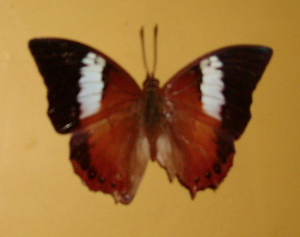
Charaxes bupalus

Charaxes bupalus

Jfi7811, CC BY 3.0, via Wikimedia Commons

Two-tailed Pasha

Two-tailed Pasha

Charaxes jasius

Hectonichus, CC BY-SA 3.0, via Wikimedia Commons

Side by side

Charaxes bupalusTwo-tailed Pasha
Scientific nameCharaxes bupalus Staudinger, 1889Charaxes jasius (Linnaeus, 1767)
English nameNot recordedTwo-tailed Pasha
GroupInsectsInsects
ClassInsecta InsectInsecta Insect
OrderLepidopteraLepidoptera
FamilyNymphalidae PurplesNymphalidae Purples
GenusCharaxes EmperorsCharaxes Emperors
Named in18891767
Countries on record1 country46 countries
GBIF occurrence records33 records30,259 records

Rows where the two agree are shown in grey.

Where each is found

Only Charaxes bupalus (1)

Only Two-tailed Pasha (46)

From Catalogue of Life checklists and GBIF occurrence records. A country missing from a list means no record is held, which is not proof of absence.

Checked facts

Charaxes bupalusTwo-tailed Pasha
Appearance
  • The butterfly has coppery rufous upper wing surfaces, broad brown marginal forewing bands edged with white, and coppery red hindwings. English Wikipedia
  • The hindwings have a submarginal row of brown spots and a small tail. English Wikipedia
  • Male forewings have a white upper band that is more regular and sharply defined than in C. borneensis. English Wikipedia
  • Male forewings lack marked postdiscal spots. English Wikipedia
  • Male hindwings have marked median bars between veins C and R2, while the following bar is vestigial. English Wikipedia
  • The male's underside is tawny russet, with more tawny coloration in the postdiscal interspaces. English Wikipedia
  • Male forewings have continuous median bars between veins R2 and SM2. English Wikipedia
  • Male hindwings have nearly continuous median bars between veins SC2 and M2. English Wikipedia
  • The male has heavy, linear white submarginal spots, except for the third spot. English Wikipedia
  • The female has a white discal band on the upper forewing that is broader than in C. borneensis, particularly toward the front. English Wikipedia
  • The female's upper forewing has white postdiscal interspaces between veins R1 and SM2, partly tinged with tawny. English Wikipedia
  • The female's hindwing median bars between veins C and M1 are almost continuous. English Wikipedia
  • The female's hindwing has a white discal band that is broader than in C. borneensis and becomes tawny olive toward the rear. English Wikipedia
  • The female's upper hindwing has white submarginal spots that are linear and heavy. English Wikipedia
  • The female's forewing median bars between veins R2 and M1 are continuous. English Wikipedia
  • The female's hindwing line of median bars between veins C and M2 is less irregular than in C. borneensis. English Wikipedia
  • Each hindwing has two characteristic tails. English Wikipedia
  • The upper surfaces of the wings are dark brownish-black with a variable purplish sheen. English Wikipedia
  • The forewings have orange postdiscal spots. English Wikipedia
  • The outer margins of both wing pairs have deep orange-ochreous coloration. English Wikipedia
  • The hindwings have small submarginal blue spots that are more developed in females. English Wikipedia
  • The underside of the wings has a mosaic pattern of brown, reddish, greyish and blackish patches edged with white. English Wikipedia
  • Females resemble males but have larger bodies and wings. English Wikipedia
  • The spring brood has smaller wings and tails that curve towards each other more noticeably than those of later broods. English Wikipedia
  • The caterpillar is green and cylindrical, with a maximum length of 50 mm. English Wikipedia
  • The caterpillar has yellow-white raised spots arranged in rings along its body. English Wikipedia
  • The caterpillar has yellow lateral lines along its sides and two yellow ocelli on its back. English Wikipedia
  • The caterpillar's head bears four backward-facing horns. English Wikipedia
  • The pupa changes from green to brown as the adult butterfly develops inside. English Wikipedia
Size
HabitatNo checked fact yet
  • Its typical Mediterranean habitat is maquis shrubland. English Wikipedia
  • It typically inhabits maquis shrubland at elevations up to 700–800 metres above sea level. English Wikipedia
  • Its habitat includes thick mixed scrub forests, often on hillsides in hot, dry regions. English Wikipedia
  • It occurs wherever its larval host plants are abundantly available. English Wikipedia
DietNo checked fact yet
  • The strawberry tree (Arbutus unedo) is its preferred larval food plant. English Wikipedia
  • Some Osyris species are also recorded as secondary or possibly accidental larval food plants. English Wikipedia
  • Adult males and females are attracted to fermenting fruits. English Wikipedia
  • Adults are attracted to ethanol in fermenting fruits. English Wikipedia
BehaviourNo checked fact yet
ReproductionNo checked fact yet
  • The species produces two or three generations annually, depending on latitude and altitude. English Wikipedia
  • The first batch of eggs is typically laid during May and June. English Wikipedia
  • The second batch of eggs is typically laid between mid-August and mid-October. English Wikipedia
  • Females lay eggs on the upper surfaces of host plant leaves, with no more than one egg per leaf. English Wikipedia
  • Caterpillars from the second egg batch overwinter in the larval stage and pupate the following spring. English Wikipedia
  • A fully grown caterpillar pupates while hanging from a twig. English Wikipedia
  • The pupal stage lasts between two weeks and one month. English Wikipedia
Distribution
  • The species occurs along the European Mediterranean coast from western Portugal to the coastal islands of Greece. English Wikipedia
  • Its European distribution includes the Balearic Islands, Corsica, Sardinia, Corfu and Crete. English Wikipedia
  • Its distribution includes Turkey, Lebanon and Israel. English Wikipedia
  • Its North African distribution extends along much of the coast to northwestern coastal Morocco near Tiznit. English Wikipedia
  • In a few Moroccan locations, it occurs inland at elevations reaching 2,400 metres above sea level. English Wikipedia
Similar species
  • Charaxes bupalus was formerly classified as a subspecies of Charaxes borneensis. English Wikipedia
  • Male Charaxes bupalus are similar in appearance to male Charaxes borneensis. English Wikipedia
No checked fact yet
OtherNo checked fact yet

In brief

Charaxes bupalus

Charaxes bupalus is endemic to Palawan in the Philippines. It has coppery rufous upper wing surfaces, broad brown marginal forewing bands edged with white, coppery red hindwings, and a submarginal row of brown spots with a small tail. Full profile

Two-tailed Pasha

The Two-tailed Pasha (Charaxes jasius) is an insect in the family Nymphalidae, order Lepidoptera and class Insecta. It inhabits Mediterranean maquis shrubland and thick mixed scrub forests, occurring along the European Mediterranean coast, in Turkey, Lebanon, Israel and North Africa. Each hindwing has two characteristic tails, and the upper wing surfaces are dark brownish-black with a variable purplish sheen. Full profile

Compare something else

Page built on 27 November 2026 from the data on the two species pages, where every source is listed.

Cite this page

ScientificNames.org. (2026). Charaxes bupalus vs Two-tailed Pasha. Retrieved November 27, 2026, from https://scientificnames.org/compare/charaxes-bupalus-vs-two-tailed-pasha