Comparison

Rubber Boa vs Arabian Sand Boa

Rubber Boa (Charina bottae) and Arabian Sand Boa (Eryx jayakari) both belong to the family Boidae (boas) and part ways below it.
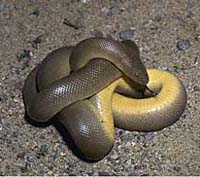
Rubber Boa

Rubber Boa

Charina bottae

Unknown author, Public domain, via Wikimedia Commons

Arabian Sand Boa

Arabian Sand Boa

Eryx jayakari

Omid Mozaffari, CC BY 2.0, via Wikimedia Commons

Side by side

Rubber BoaArabian Sand Boa
Scientific nameCharina bottae (Blainville, 1835)Eryx jayakari Boulenger, 1888
English nameRubber BoaArabian Sand Boa
GroupReptilesReptiles
ClassReptilia ReptileReptilia Reptile
OrderSquamata SnakesSquamata Snakes
FamilyBoidae BoasBoidae Boas
GenusCharina Rosy BoasEryx Old World Sand Boas
Named in18351888
Red List categoryLeast ConcernLeast Concern
Countries on record2 countries9 countries
GBIF occurrence records5,881 records272 records

Rows where the two agree are shown in grey.

Where each is found

Only Rubber Boa (2)

Only Arabian Sand Boa (9)

From Catalogue of Life checklists and GBIF occurrence records. A country missing from a list means no record is held, which is not proof of absence.

Checked facts

Rubber BoaArabian Sand Boa
Appearance
  • The species has loose, wrinkled skin covered with small, smooth, shiny scales that give it a rubber-like appearance and texture. English Wikipedia
  • Adults typically have tan to dark brown coloration with a lighter underside, although olive-green, yellow, and orange individuals also occur. English Wikipedia
  • Newborn individuals are often pink and slightly transparent before darkening as they age. English Wikipedia
  • The species has small eyes with vertically elliptical pupils and short, blunt heads that are no wider than its body. English Wikipedia
  • Its short, blunt tail closely resembles the shape of its head. English Wikipedia
  • Individuals typically have brown to olive-green upper coloration and yellow to cream undersides. animaldiversity.org
  • Dark spots or mottling can occur on the upper body, particularly in northern populations. animaldiversity.org
  • The tail contains a thick bulb of bone and resembles the head. animaldiversity.org
Size
  • Adults typically measure between 38 and 84 cm in length. English Wikipedia
  • Newborn individuals typically measure between 19 and 23 cm in length. English Wikipedia
  • Individuals commonly measure between 38 and 64 cm, although the documented overall range is 35 to 84 cm. animaldiversity.org
  • Adults can reach approximately 38 cm in total length, including the tail. English Wikipedia
  • Females have significantly greater total length, snout-to-vent length and body diameter than males. pmc.ncbi.nlm.nih.gov
  • Females have an average of 43 dorsal body scales, 169 ventral scales and 18 subcaudal scales. pmc.ncbi.nlm.nih.gov
  • Males have an average of 42 dorsal body scales, 168 ventral scales and 18 subcaudal scales. pmc.ncbi.nlm.nih.gov
Habitat
  • The species inhabits grasslands, meadows, chaparral, deciduous forests, coniferous forests, and high alpine environments. English Wikipedia
  • The species occurs at elevations ranging from sea level to over 3,000 metres. English Wikipedia
  • The species prefers moist coniferous forests, grassy meadows, and streamsides. animaldiversity.org
  • Individuals use rodent burrows, rock outcroppings, fallen logs, and dense leaf and pine-needle litter for shelter. animaldiversity.org
  • During summer, individuals are commonly found near streams, springs, and rivers. animaldiversity.org
  • The species inhabits deserts and lives semi-underground in sand or soft soil. English Wikipedia
  • The species lives mostly beneath desert sand. pmc.ncbi.nlm.nih.gov
  • The species was studied in sandy regions of Nafud Qunayfidhan, Nafud al Sirr, Nafud Dahna, Nafud Al Mazhur, Saad Park and Al-Thumamah in Riyadh, Saudi Arabia. pmc.ncbi.nlm.nih.gov
Diet
  • The species primarily feeds on young mammals, including shrews, voles, and mice. English Wikipedia
  • Its documented prey also includes salamanders, frogs, reptile eggs, lizards, young birds, bats, and other snakes. English Wikipedia
Behaviour
  • When threatened, individuals can release a strong-smelling musk from their vent. English Wikipedia
  • During winter, individuals brumate in underground dens. English Wikipedia
  • When threatened by predators, individuals curl around their heads and expose their tails as decoys. English Wikipedia
  • The species is solitary outside the breeding season, and individuals can have overlapping territories without being territorial. animaldiversity.org
  • The species has a prehensile tail that helps it climb vegetation and swim. animaldiversity.org
Reproduction
Distribution
  • The species occurs across western North America, from the Pacific Coast to western Utah and Montana, and from central California to southern British Columbia. English Wikipedia
  • Its documented range includes California, Oregon, Washington, Nevada, Utah, Wyoming, Montana, and Idaho, as well as British Columbia. English Wikipedia
  • The species also occurs in southern Canada and extends south to southern California. animaldiversity.org
  • The species is endemic to the Arabian Peninsula and Iran. English Wikipedia
  • Its recorded range includes Saudi Arabia, Oman, Yemen, Kuwait, the United Arab Emirates and southern Iran. English Wikipedia
  • Iranian specimens have been recorded from Khuzestan, Bushehr and Kerman provinces. English Wikipedia
  • The species has been recorded at several locations in the Riyadh region of Saudi Arabia. pmc.ncbi.nlm.nih.gov
ConservationNo checked fact yet
  • The species is classified as Least Concern by the IUCN. English Wikipedia
  • Its Least Concern classification is attributed to its extensive range, local abundance and absence of identified particular threats. English Wikipedia
Similar speciesNo checked fact yet

In brief

Rubber Boa

The Rubber Boa is viviparous and gives birth to live offspring. The species inhabits grasslands, meadows, chaparral, deciduous forests, coniferous forests, and high alpine environments. Full profile

Arabian Sand Boa

Eryx jayakari inhabits deserts in the Arabian Peninsula and Iran, living mostly beneath desert sand or in soft soil. It has very small eyes on top of its head, a wedge-shaped head and a blunt snout. Full profile

Compare something else

Page built on 27 November 2026 from the data on the two species pages, where every source is listed.

Cite this page

ScientificNames.org. (2026). Rubber Boa vs Arabian Sand Boa. Retrieved November 27, 2026, from https://scientificnames.org/compare/rubber-boa-vs-arabian-sand-boa