Comparison
Chestnut Teal vs Eurasian Teal
Chestnut Teal (Anas castanea) and Eurasian Teal (Anas crecca) both belong to the genus Anas (dabbling ducks) and part ways below it.
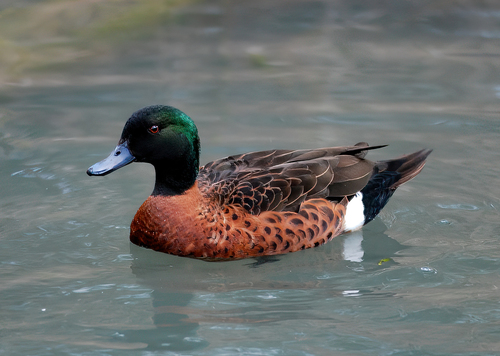
Chestnut Teal
Anas castanea
(c) Pål A. Olsvik, some rights reserved (CC BY), uploaded by Pål A. Olsvik, CC BY 4.0, via iNaturalist

Eurasian Teal
Anas crecca
Koshy Koshy from Faridabad, Haryana, India, CC BY 2.0, via Wikimedia Commons

Side by side
| Chestnut Teal | Eurasian Teal | |
|---|---|---|
| Scientific name | Anas castanea (Eyton, 1838) | Anas crecca Linnaeus, 1758 |
| English name | Chestnut Teal | Eurasian Teal |
| Group | Birds | Birds |
| Class | Aves Bird | Aves Bird |
| Order | Anseriformes Ducks | Anseriformes Ducks |
| Family | Anatidae Ducks | Anatidae Ducks |
| Genus | Anas Dabbling Ducks | Anas Dabbling Ducks |
| Named in | 1838 | 1758 |
| Red List category | Least Concern | Least Concern |
| Environment | freshwater, terrestrial | freshwater, marine, terrestrial |
| Countries on record | 2 countries | 156 countries |
| GBIF occurrence records | 496,991 records | 7,535,845 records |
Rows where the two agree are shown in grey.
Where each is found
Only Chestnut Teal (2)
Only Eurasian Teal (156)
- Afghanistan
- Aland Islands
- Albania
- Algeria
- Andorra
- Anguilla
- Antigua and Barbuda
- Armenia
- Aruba
- Austria
- Azerbaijan
- Bahamas
- Bahrain
- Bangladesh
- Barbados
- Belarus
- Belgium
- Belize
- Benin
- Bermuda
- Bhutan
- Bonaire, Saint Eustatius and Saba
- Bosnia and Herzegovina
- British Virgin Islands
- Brunei
- Bulgaria
- Cabo Verde
- Cambodia
- Cameroon
- Canada
- Cayman Islands
- Chad
- China
- Cocos Islands
- Costa Rica
- Croatia
- Cuba
- Curacao
- Cyprus
- Czechia
- Denmark
- Djibouti
- Egypt
- El Salvador
- Eritrea
- Estonia
- Ethiopia
- Faroe Islands
- Finland
- France
- Gambia
- Georgia
- Germany
- Ghana
- Greece
- Greenland
- Guadeloupe
- Guatemala
- Guernsey
- Haiti
- Honduras
- Hong Kong
- Hungary
- Iceland
- India
- Iran
- Iraq
- Ireland
- Isle of Man
- Israel
- Italy
- Jamaica
- Japan
- Jersey
- Jordan
- Kazakhstan
- Kenya
- Kosovo
- Kuwait
- Kyrgyzstan
- Laos
- Latvia
- Lebanon
- Libya
- Liechtenstein
- Lithuania
- Luxembourg
- Macao
- Malaysia
- Mali
- Malta
- Martinique
- Mauritania
- Mexico
- Moldova
- Mongolia
- Montenegro
- Morocco
- Myanmar
- Nepal
- Nicaragua
- Niger
- North Korea
- North Macedonia
- Norway
- Oman
- Pakistan
- Palestinian Territory
- Panama
- Philippines
- Poland
- Portugal
- Puerto Rico
- Qatar
- Romania
- Russia
- Saint Barthelemy
- Saint Kitts and Nevis
- Saint Lucia
- Saint Martin
- Saint Pierre and Miquelon
- Saint Vincent and the Grenadines
- Saudi Arabia
- Senegal
- Serbia
- Seychelles
- Slovakia
- Slovenia
- South Korea
- Spain
- Sri Lanka
- Sudan
- Svalbard and Jan Mayen
- Sweden
- Switzerland
- Syria
- Taiwan
- Tajikistan
- Tanzania
- Thailand
- The Netherlands
- Trinidad and Tobago
- Tunisia
- Turkey
- Turkmenistan
- Turks and Caicos Islands
- U.S. Virgin Islands
- Ukraine
- United Arab Emirates
- United Kingdom
- United States
- United States Minor Outlying Islands
- Uzbekistan
- Vietnam
- Western Sahara
- Yemen
From Catalogue of Life checklists and GBIF occurrence records. A country missing from a list means no record is held, which is not proof of absence.
Checked facts
| Chestnut Teal | Eurasian Teal | |
|---|---|---|
| Appearance |
|
|
| Size |
|
|
| Habitat | No checked fact yet |
|
| Diet |
|
|
| Behaviour |
|
|
| Reproduction |
|
|
| Conservation |
|
|
| Similar species |
| No checked fact yet |
| Other |
| No checked fact yet |
In brief
Chestnut Teal
The Chestnut Teal is a dabbling duck. The male has a green head and mottled brown body, while the female has a brown head and mottled brown body. Full profile
Eurasian Teal
During breeding, it inhabits freshwater wetlands, bogs, lakes and ponds, and during winter it uses brackish waters, coastal inlets and lagoons. Full profile
Compare something else
Page built on 27 November 2026 from the data on the two species pages, where every source is listed.
Cite this page
ScientificNames.org. (2026). Chestnut Teal vs Eurasian Teal. Retrieved November 27, 2026, from https://scientificnames.org/compare/chestnut-teal-vs-eurasian-teal
“Chestnut Teal vs Eurasian Teal.” ScientificNames.org, 2026, scientificnames.org/compare/chestnut-teal-vs-eurasian-teal. Accessed 27 Nov. 2026.
ScientificNames.org. “Chestnut Teal vs Eurasian Teal.” Accessed November 27, 2026. https://scientificnames.org/compare/chestnut-teal-vs-eurasian-teal.
@misc{scientificnames_chestnut_teal_vs_eurasian_teal,
  author = {{ScientificNames.org}},
  title = {Chestnut Teal vs Eurasian Teal},
  year = {2026},
  url = {https://scientificnames.org/compare/chestnut-teal-vs-eurasian-teal},
  note = {Accessed 2026-11-27}
}