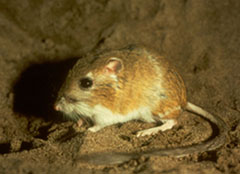
| Appearance | - The species has flat, broad incisors with anterior surfaces shaped like chisels. English Wikipedia
- Its back fur ranges from sandy brown and gray-brown to pale yellow, while its belly is white. English Wikipedia
- Its tail has brown fur, white side stripes, and a dark brown terminal tuft with scattered white hairs. English Wikipedia
- Its ears are large, rounded, and bicoloured. English Wikipedia
- The species has five toes on each foot. animaldiversity.org
| - The species has conspicuous white markings on its feet, upper lip, above its eyes, and across its hips. animaldiversity.org
- Its tail is dark above, has two white bands along each side, and ends in a grey tuft of longer hairs. animaldiversity.org
- Ord's kangaroo rat has small forelimbs and long, strong hindlegs adapted for jumping. animaldiversity.org
- The species has five toes on its hind feet, distinguishing it from Dipodomys elator. English Wikipedia
- Juveniles have duller and darker fur than adults. depts.ttu.edu
|
|---|
| Size | | |
|---|
| Habitat | - The species inhabits desert environments in mountainous areas at elevations between 1,000 and 3,500 m. animaldiversity.org
- Its abundance in desert valleys is primarily associated with Atriplex confertifolia. animaldiversity.org
- In desert uplands, its abundance is associated with deciduous blackbush (Coleogyne ramosissima). animaldiversity.org
- In San Bernardino County, California, the species occurs in the yucca plant belt. animaldiversity.org
- Where it occurs alongside D. merriami or D. ordii, it is associated more with gravel soils than with fine sand or clay. animaldiversity.org
- The species constructs underground burrows with multiple entrances, usually beneath shrubs. English Wikipedia
| - The species inhabits arid environments with sparse vegetation on sandy ground. animaldiversity.org
- Ord's kangaroo rats occur in shifting sand dunes and can establish populations in these habitats. animaldiversity.org
- The species occurs along riverbanks and in the Great Sand Hills of Saskatchewan. animaldiversity.org
- Ord's kangaroo rats inhabit semiarid grasslands, mixed-grass prairie, shrublands, scrublands, and pinyon-juniper woodlands on sandy soils. English Wikipedia
- In Utah, the species is associated with open shrublands and grasslands on sandy soils. English Wikipedia
- Ord's kangaroo rats rarely inhabit hard or gravelly soils. depts.ttu.edu
- Their burrows are commonly dug into loose sand along natural sand dunes, riverbanks, and road cuts. English Wikipedia
- Ord's kangaroo rats construct burrows with openings approximately 7.6 cm in diameter. English Wikipedia
|
|---|
| Diet | - Leaves of Atriplex confertifolia constitute approximately 60–80% of its diet. English Wikipedia
- The species primarily consumes leaves of Atriplex confertifolia and Coleogyne ramossisima, with seeds as a secondary food source. animaldiversity.org
- Seeds become a dominant dietary component when leaves are unavailable. animaldiversity.org
- The species consumes insects, although they make up only a small portion of its diet. English Wikipedia
- In spring, the species eats Atriplex leaves whole. animaldiversity.org
- During summer and autumn, it uses its incisors to remove the salty outer leaf tissues and consume the inner tissues. animaldiversity.org
- The species obtains water from the leaves it consumes. English Wikipedia
- It transports collected Atriplex leaves to its burrow in its cheek pouches. English Wikipedia
- Leaf caches can contain as much as 250 g of material. English Wikipedia
- Each cheek pouch has a capacity of approximately 4 cubic centimeters. animaldiversity.org
- The species assimilates approximately 91.3% of its diet. animaldiversity.org
| - The species primarily consumes seeds, green vegetation, and dry vegetation. English Wikipedia
- Ord's kangaroo rats occasionally consume animal material, particularly arthropods. English Wikipedia
- In summer, Ord's kangaroo rats also eat grasshoppers and moths. animaldiversity.org
- The species transports harvested seeds to its burrow in cheek pouches for consumption or storage. English Wikipedia
- Ord's kangaroo rats can obtain water physiologically from nearly dry seeds. depts.ttu.edu
|
|---|
| Behaviour | | - Ord's kangaroo rats are nocturnal and spend daylight hours in burrows. English Wikipedia
- The species is solitary outside breeding periods. animaldiversity.org
- Ord's kangaroo rats seal their burrow entrances with sand during the day. animaldiversity.org
- Individuals can make loud thumping noises with their hind legs when their burrow entrance is disturbed. animaldiversity.org
- Ord's kangaroo rats regularly bathe in sand to prevent their fur from becoming oily and matted. animaldiversity.org
- The species can evade predators with jumps reaching approximately 2 m. animaldiversity.org
|
|---|
| Reproduction | | No checked fact yet |
|---|
| Distribution | - Its distribution includes Nevada, Utah, California, Oregon, Arizona, and Idaho. English Wikipedia
| - Ord's kangaroo rat occurs across western North America, from southern Canada to central Mexico. English Wikipedia
- Its documented range extends from southern Alberta and Saskatchewan to southern Hidalgo, Mexico. English Wikipedia
|
|---|
| Conservation | No checked fact yet | - Ord's kangaroo rat is classified as a species of least concern by the IUCN. depts.ttu.edu
- The species is common throughout its range in Texas. depts.ttu.edu
- The Canadian population of Ord's kangaroo rat is considered endangered. English Wikipedia
|
|---|
| Uses | No checked fact yet | - In some sandy areas near San Antonio, Ord's kangaroo rats have been reported to consume seeds from watermelons and other cultivated row crops. depts.ttu.edu
|
|---|
| Other | - The species is described as the only folivore in the genus Dipodomys. English Wikipedia
| - Ord's kangaroo rats have an oil-secreting gland located between their shoulders. animaldiversity.org
- Secretions from the shoulder gland help individuals distinguish other individuals and their sexes. animaldiversity.org
|
|---|