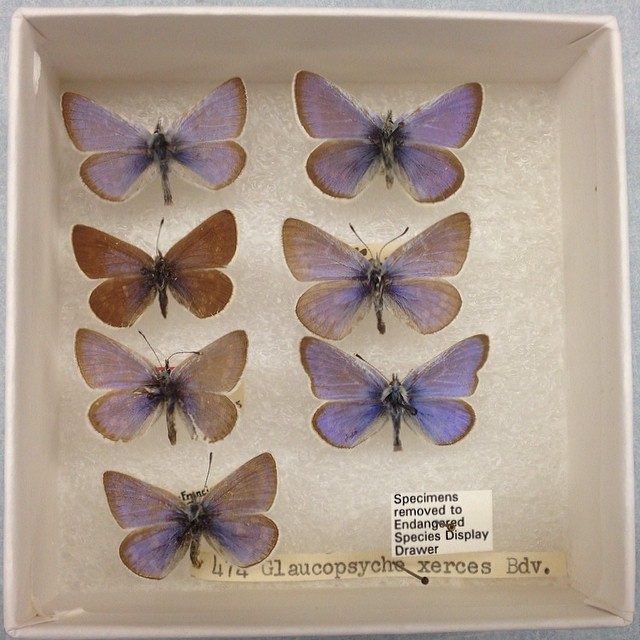
| Appearance | - Males have dark, iridescent purple upper wing surfaces. English Wikipedia
- Females have grayish-brown upper wing surfaces and may display iridescent purple near the wing bases. English Wikipedia
- Both sexes have bright lime-green undersides to their wings. English Wikipedia
- Both pairs of wings feature a bright silvery-white band behind the middle. English Wikipedia
- The hindwing's silver band projects toward the margin before turning inward to form a V shape. English Wikipedia
- A dark brownish-red patch with variable silvery-white frosting occurs beyond the hindwing's silver band. English Wikipedia
- Silvery-white frosting extends along the entire hindwing edge. English Wikipedia
- The hindwings have one pair of tails. English Wikipedia
- The eggs are shiny green. English Wikipedia
- Caterpillars range in colour from yellowish green to brownish. English Wikipedia
- Caterpillars have dark, wavy dorsal and subdorsal lines. English Wikipedia
- Caterpillars have a dark greenish middorsal stripe bordered on both sides by red ovals. English Wikipedia
- The chrysalis is tan to grayish brown and has a gray middorsal stripe. English Wikipedia
- The chrysalis is covered with black and brown spots. English Wikipedia
| - Males have iridescent blue coloration on the upper surfaces of their wings and pale spots on the undersides. floridamuseum.ufl.edu
- The species exhibited extensive variation in wing patterns, with several named forms. floridamuseum.ufl.edu
- The species was characterized by blue wings with white spots. English Wikipedia
|
|---|
| Size | | |
|---|
| Habitat | - The species inhabits subtropical woodlands, deserts, and hammock edges when its host plants are present nearby. English Wikipedia
| - The species inhabited coastal sand dunes on the San Francisco Peninsula in California. English Wikipedia
- The species preferred stabilized sandy sites where its low-growing larval host plant grew. floridamuseum.ufl.edu
- The species occupied coastal sand dunes in the upper San Francisco Peninsula, including areas now within the Golden Gate National Recreation Area. floridamuseum.ufl.edu
|
|---|
| Diet | - Caterpillars feed on unripe seeds while living inside their host plant's seed pods. English Wikipedia
- Balloon vine (Cardiospermum halicacabum) is a recorded host plant. English Wikipedia
- Cardiospermum corindum, also called faux persil, is a recorded host plant. English Wikipedia
- Florida Keys thoroughwort (Eupatorium villosum) is a recorded host plant. English Wikipedia
| - The caterpillars used Lotus scoparius (Deerweed) as their preferred larval host plant. pmc.ncbi.nlm.nih.gov
- The butterflies fed on plants belonging to the genera Lotus and Lupinus. English Wikipedia
- Lupinus was another recorded vegetative food source, but it was unsuitable for the larval stages. English Wikipedia
|
|---|
| Behaviour | - In southern Florida, adults are observed flying from May through December. English Wikipedia
- In southern Texas, adults are observed flying from June through December. English Wikipedia
- In southern Arizona, adults are observed from March through June and again from October to mid-November. English Wikipedia
- Caterpillars turn red shortly before pupation. English Wikipedia
| - The species had a major flight period documented in historical biological studies. pmc.ncbi.nlm.nih.gov
|
|---|
| Reproduction | | |
|---|
| Distribution | | - The species was endemic to the coastal sand dunes of the upper San Francisco Peninsula in California. floridamuseum.ufl.edu
|
|---|
| Conservation | No checked fact yet | - The Xerces blue is extinct, with its extinction associated with habitat loss caused by urban development. English Wikipedia
- The last known living individuals were observed in the early 1940s. pmc.ncbi.nlm.nih.gov
- Urban development and disturbance of sandy soils caused the local loss of important host plants, contributing to the species' extinction. pmc.ncbi.nlm.nih.gov
- The loss of Lotus plants used by the larvae is considered a contributing factor in the species' extinction. English Wikipedia
- The introduction of the Argentine ant coincided with the species' decline and has been proposed as a possible contributing factor. pmc.ncbi.nlm.nih.gov
- The invasive Argentine ant was proposed as a possible threat because it may have outcompeted native ants that tend and protect the caterpillars. pmc.ncbi.nlm.nih.gov
- The species' extinction inspired the establishment of the Xerces Society for Invertebrate Conservation in 1971. floridamuseum.ufl.edu
- The species is recognized as an important symbol of insect conservation in North America. pmc.ncbi.nlm.nih.gov
|
|---|
| Similar species | - The amethyst hairstreak (Chlorostrymon maesites) is identified as the only similar species within the silver-banded hairstreak's range. English Wikipedia
- The amethyst hairstreak is smaller than the silver-banded hairstreak. English Wikipedia
- The amethyst hairstreak's forewing underside lacks a silver band. English Wikipedia
- The amethyst hairstreak has two pairs of hindwing tails. English Wikipedia
- The xami hairstreak (Callophrys xami) is another related butterfly found in North America. English Wikipedia
- The silver-banded hairstreak has a broader silver-white postmedian line on the hindwing underside than the xami hairstreak. English Wikipedia
| - The closest relatives of the Xerces blue are Glaucopsyche australis and Glaucopsyche pseudoxerces. English Wikipedia
- The Xerces blue's closest relative group is most closely related to Glaucopsyche lygdamus, commonly called the silvery blue. English Wikipedia
- Historical researchers considered the Xerces blue and Glaucopsyche lygdamus closely related but separate species. pmc.ncbi.nlm.nih.gov
|
|---|
| Other | No checked fact yet | - Genetic analyses of museum specimens confirmed that the Xerces blue was a distinct species. pmc.ncbi.nlm.nih.gov
- DNA analysis was conducted using a museum specimen collected in 1928. pmc.ncbi.nlm.nih.gov
- The DNA analysis recovered 210,182,214 nucleotides from the museum specimen. pmc.ncbi.nlm.nih.gov
- Preserved specimens of the species are held by the California Academy of Sciences, Bohart Museum, and Harvard Museum of Natural History. English Wikipedia
- The Florida Museum of Natural History's McGuire Center holds specimens of the species. floridamuseum.ufl.edu
|
|---|