Comparison

Indian Awlking vs Silver-spotted Skipper

Indian Awlking (Choaspes benjaminii) and Silver-spotted Skipper (Epargyreus clarus) both belong to the family Hesperiidae (skipper) and part ways below it.

Indian Awlking

Indian Awlking

Choaspes benjaminii

Davidvraju, CC BY-SA 4.0, via Wikimedia Commons

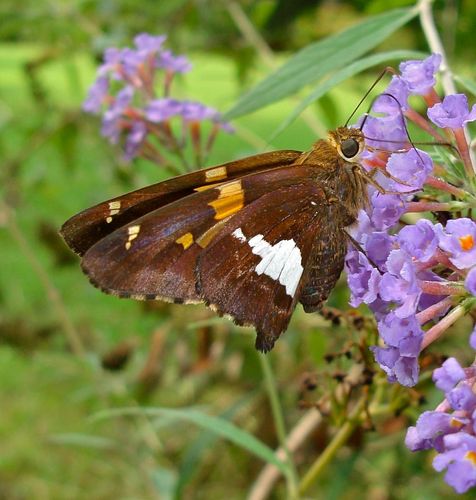
Silver-spotted Skipper

Silver-spotted Skipper

Epargyreus clarus

no rights reserved, uploaded by Elin Pierce, CC0, via iNaturalist

Side by side

Indian AwlkingSilver-spotted Skipper
Scientific nameChoaspes benjaminii (Guérin-Méneville, 1843)Epargyreus clarus (Cramer, 1775)
English nameIndian AwlkingSilver-spotted Skipper
GroupInsectsInsects
ClassInsecta InsectInsecta Insect
OrderLepidopteraLepidoptera
FamilyHesperiidae SkipperHesperiidae Skipper
GenusChoaspesEpargyreus Silverdrops
Named in18431775
Countries on record11 countries3 countries
GBIF occurrence records1,934 records100,908 records

Rows where the two agree are shown in grey.

Where each is found

Only Indian Awlking (11)

Only Silver-spotted Skipper (3)

From Catalogue of Life checklists and GBIF occurrence records. A country missing from a list means no record is held, which is not proof of absence.

Checked facts

Indian AwlkingSilver-spotted Skipper
Appearance
  • The hindwing has a shining green underside with black veins and an orange area bearing black spots near the tornus. English Wikipedia
  • Males have a shining indigo-blue upper surface. English Wikipedia
  • Males have purplish hairs at the base that become greenish as they age. English Wikipedia
  • The hindwing cilia and anal lobe of males are broadly ochreous red. English Wikipedia
  • Females have a dark, shining green appearance with bluish-grey hairs at the base. English Wikipedia
  • Females have a broad, pale cupreous-brown band along the posterior margin of the forewing. English Wikipedia
  • The female hindwing has a broad ochreous-red lobular patch with a black-spotted upper border and a broad central angular streak. English Wikipedia
  • The thorax is greyish olive above, the vertex is bluish olive, and the abdomen is brown. English Wikipedia
  • The palpi, front of the thorax, and underside of the abdomen are ochreous red. English Wikipedia
Size
Habitat
  • The species occurs in heavy jungles in hilly areas at elevations of 1,100–2,400 metres. English Wikipedia
  • The species inhabits fields, gardens, and forest edges. English Wikipedia
  • The species prefers open habitats containing nectar plants, including swamps, brushy areas, and riparian habitats at lower elevations. English Wikipedia
  • In the western part of its range, the species occurs primarily in mountainous locations. animaldiversity.org
Diet
  • Adult butterflies are attracted to flowers and animal and bird droppings. English Wikipedia
  • Larvae consume leaves of plants belonging to the pea family, Fabaceae. English Wikipedia
  • Recorded larval host plants include false indigobush, American hogpeanut, groundnut, and American wisteria. English Wikipedia
  • Larvae have also been recorded feeding on kudzu, black locust, and Chinese wisteria. animaldiversity.org
  • Adults feed on nectar from various flowers, as well as mud and animal feces. English Wikipedia
  • Adults favor blue, red, pink, and purple flowers and rarely visit yellow flowers. English Wikipedia
  • Recorded adult food plants include everlasting pea, common milkweed, red clover, buttonbush, blazing star, and thistles. English Wikipedia
Behaviour
  • During daylight, the butterfly frequents shaded areas. English Wikipedia
  • The butterfly flies in open areas during the early and late hours of the day. English Wikipedia
  • The caterpillar rolls itself onto the tip of the leaf on which it feeds and moves to another leaf after consuming it. English Wikipedia
  • Larvae construct leaf shelters using silk and may connect multiple leaves to form larger shelters. animaldiversity.org
  • Larvae generally leave their shelters only to feed or construct larger shelters. animaldiversity.org
  • Larvae can eject their waste as a defensive behaviour to reduce the attraction of parasitic wasps. animaldiversity.org
  • Threatened larvae regurgitate a greenish defensive chemical. English Wikipedia
Reproduction
  • The larva has broad transverse dorsal black and yellow bands and two rows of white spots along its back. English Wikipedia
  • The larval head, two anal segments, and lateral areas below the bands are red, while the face is black-spotted. English Wikipedia
  • The pupa is pinkish grey with black spots. English Wikipedia
  • Females generally deposit one egg on or occasionally near a host plant. English Wikipedia
  • Females have been recorded laying eggs on least snoutbean. English Wikipedia
  • Each copulation results in a female receiving a spermatophore from the male. English Wikipedia
  • After mating, females appear to reject additional males for at least some time. English Wikipedia
  • The species produces one generation annually in northern and western regions, two in eastern regions, and three to four in the Deep South. English Wikipedia
  • The last generation of the year overwinters in the pupal stage. animaldiversity.org
DistributionNo checked fact yet
  • The species ranges from southern Canada through most of the United States to northern Mexico, excluding the Great Basin and western Texas. English Wikipedia
  • The species occurs throughout the United States and in southern Canada. animaldiversity.org
UsesNo checked fact yet
Similar speciesNo checked fact yet

In brief

Indian Awlking

Choaspes benjaminii occurs in heavy jungles in hilly areas at elevations of 1,100–2,400 metres. It is distinguished by a shining green hindwing underside with black veins and an orange area bearing black spots near the tornus. Full profile

Silver-spotted Skipper

Epargyreus clarus inhabits fields, gardens, forest edges, swamps, brushy areas, and riparian habitats at lower elevations. Full profile

Compare something else

Page built on 27 November 2026 from the data on the two species pages, where every source is listed.

Cite this page

ScientificNames.org. (2026). Indian Awlking vs Silver-spotted Skipper. Retrieved November 27, 2026, from https://scientificnames.org/compare/indian-awlking-vs-silver-spotted-skipper