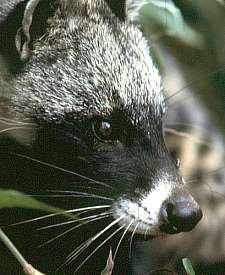
| Appearance | - The African civet has coarse, wiry fur ranging from white and creamy yellow to reddish on its back. English Wikipedia
- Its coat has deep brown to black stripes, spots, and blotches. English Wikipedia
- Its muzzle is pointed and its ears are small and rounded. English Wikipedia
- It has a black band across its eyes and two black bands around its short, broad neck. English Wikipedia
- Its dorsal crest extends from the neck to the base of the tail and can become erect. English Wikipedia
- Its paws have five digits and compact, black surfaces with hairless soles. English Wikipedia
- Its claws are long, curved, and semi-retractile. English Wikipedia
| - The common genet has a slender, cat-like body with a small head, pointed muzzle, large oval ears, and prominent eyes. English Wikipedia
- Its whiskers can reach 7 cm in length. English Wikipedia
- Its dense, soft coat is pale grey with numerous black markings. English Wikipedia
- Its back and flanks have approximately five rows of black spots. English Wikipedia
- A long black stripe runs along its back from the shoulders to the rump. English Wikipedia
- Its tail has between eight and thirteen dark rings. English Wikipedia
- It has a white tail tip and black hind feet. English Wikipedia
- It possesses an erectile hair crest extending from the shoulders to the base of the tail. English Wikipedia
|
|---|
| Size | | |
|---|
| Habitat | - It can occur along river systems extending into arid areas of Niger, Mali, and Chad. animaldiversity.org
- It has been recorded in gallery forest along the Mpassa River in Batéké Plateau National Park. English Wikipedia
- It has been recorded in the Western Congolian forest–savanna mosaic of Odzala-Kokoua National Park. English Wikipedia
| - The common genet occupies deciduous and evergreen habitats that provide abundant shelter. English Wikipedia
- Rocky terrain with caves and dense scrubland are among its habitats. English Wikipedia
- It can inhabit areas close to human settlements and agricultural land. English Wikipedia
- It prefers dense vegetation, including bushes, thickets, and evergreen oak forests. English Wikipedia
- It uses densely foliated trees and thick vegetation overgrown with climbing plants as resting sites. English Wikipedia
- In southwestern Europe, it inhabits oak and pine forests, olive groves, riparian zones, ash groves, rocky areas, and shrublands. English Wikipedia
- In central Spain's Manzanares Park, it mainly occupies rocky and shrubby areas at elevations of 1,000–1,200 m. English Wikipedia
- The common genet is absent from dense forests according to the habitat comparison in document 2. animaldiversity.org
|
|---|
| Diet | | - Its diet includes small mammals, lizards, birds, bird eggs, amphibians, centipedes, millipedes, scorpions, insects, and fruit. English Wikipedia
- Figs and olives are among the fruits consumed by common genets. English Wikipedia
- The wood mouse is a preferred prey species. English Wikipedia
- Common genets locate prey primarily through their sense of smell. English Wikipedia
- Common genets typically prey on small mammals, including rodents and insectivores. animaldiversity.org
- Insects from the orders Coleoptera and Orthoptera are commonly found in genet diets. animaldiversity.org
|
|---|
| Behaviour | - The African civet is primarily nocturnal and usually sleeps during the day. English Wikipedia
- Its peak activity generally begins one to two hours before sunset and continues until approximately midnight. animaldiversity.org
- It is generally solitary except during breeding. animaldiversity.org
- It communicates through visual, olfactory, and auditory signals. animaldiversity.org
- When threatened, it raises its dorsal crest to appear larger and more formidable. English Wikipedia
| - Common genets are solitary animals. English Wikipedia
- Adults are primarily nocturnal and crepuscular, with activity peaking after sunset and before sunrise. English Wikipedia
- Juveniles may be active during daylight hours. English Wikipedia
- During daylight hours, common genets rest in hollow trees or thickets and frequently reuse resting locations. English Wikipedia
- Males have larger home ranges than females in the studied Spanish populations. English Wikipedia
- Both sexes use scent marking to communicate territorial and reproductive information. English Wikipedia
- Common genets also deposit faeces at designated latrine sites, frequently near territorial boundaries. English Wikipedia
|
|---|
| Reproduction | - Females are polyestrous and can produce two or three litters annually. animaldiversity.org
- A typical litter contains one to four young. animaldiversity.org
- In southern Africa, breeding occurs during the warm, wet summer months from August to January. animaldiversity.org
- In southern Africa, females give birth between January and February during the rainy season. English Wikipedia
- Young begin leaving the nest at approximately 17 to 18 days old. animaldiversity.org
- Young are completely dependent on their mother's milk for approximately six weeks. animaldiversity.org
| |
|---|
| Distribution | | - The common genet is indigenous to Africa and was introduced to southwestern Europe. English Wikipedia
- Its African range includes areas north of the Sahara and savanna regions extending southward to southern Africa. English Wikipedia
- Its range extends along the Arabian coast through Saudi Arabia, Yemen, and Oman. English Wikipedia
- In North Africa, its distribution extends from Senegal and Mauritania to Somalia and Tanzania. English Wikipedia
- A discontinuous southern African population extends from southern Angola through Zambia and Zimbabwe to Mozambique. English Wikipedia
- Introduced populations occur in southern Europe, including the Iberian Peninsula, the Balearic Islands, and southern France. English Wikipedia
- The species was introduced into southern Europe and the Arabian Peninsula. animaldiversity.org
|
|---|
| Conservation | | - The common genet is classified as Least Concern on the IUCN Red List. English Wikipedia
- No major threats to common genets are currently known. English Wikipedia
- Common genets are hunted for their fur in parts of North Africa and southern Africa. English Wikipedia
- In Portugal, common genets are killed in predator traps. English Wikipedia
- Urbanization and infrastructure development contribute to habitat loss and fragmentation on Ibiza. English Wikipedia
|
|---|
| Uses | - Wild-caught African civets have been kept to produce civetone for the perfume industry. English Wikipedia
- Its perineal gland secretion has historically been used as an ingredient in perfumes. English Wikipedia
- African civets can cause agricultural losses by entering henhouses and killing lambs. animaldiversity.org
| No checked fact yet |
|---|
| Other | No checked fact yet | - The common genet is listed in Appendix III of the Bern Convention. English Wikipedia
- The common genet is included in Annex V of the European Union Habitats and Species Directive. English Wikipedia
|
|---|