Comparison
Swamp Sawgrass vs Hardstem Bulrush
Swamp Sawgrass (Cladium mariscus) and Hardstem Bulrush (Schoenoplectus acutus) both belong to the family Cyperaceae (sedge family) and part ways below it. Both are recorded in 4 countries.
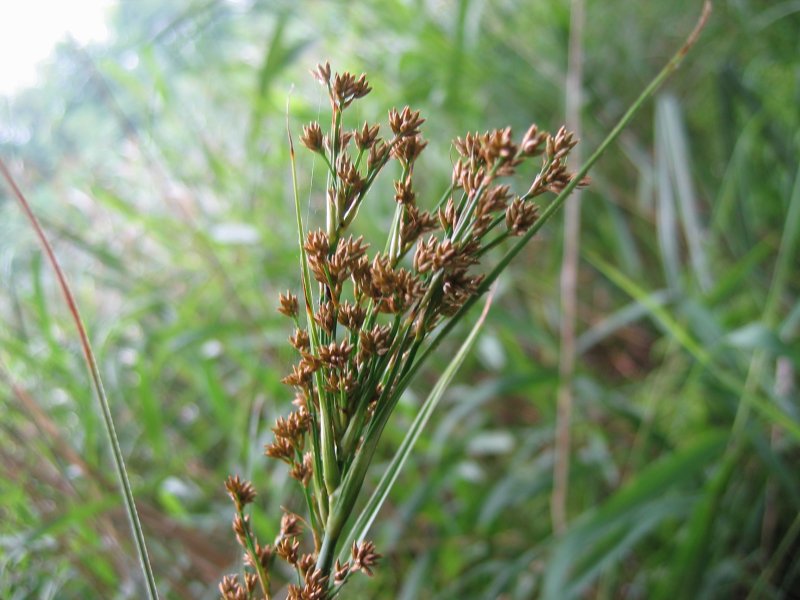
Swamp Sawgrass
Cladium mariscus
Kristian Peters -- Fabelfroh 15:47, 20 October 2006 (UTC), CC BY-SA 3.0, via Wikimedia Commons


Hardstem Bulrush
Schoenoplectus acutus
Britton, N.L., and A. Brown. 1913. An illustrated flora of the northern United States, Canada and the British Possessions. 3 vols. Charles Scribner's Sons, New York. Vol. 1: 332. Courtesy of Kentucky , Public domain, via Wikimedia Commons

Side by side
| Swamp Sawgrass | Hardstem Bulrush | |
|---|---|---|
| Scientific name | Cladium mariscus (L.) Pohl | Schoenoplectus acutus (Muhl. ex Bigelow) Á.Löve & D.Löve |
| English name | Swamp Sawgrass | Hardstem Bulrush |
| Group | Flowering plants | Flowering plants |
| Class | Liliopsida | Liliopsida |
| Order | Poales | Poales |
| Family | Cyperaceae Sedge Family | Cyperaceae Sedge Family |
| Genus | Cladium Sawgrass | Schoenoplectus Bulrush |
| Red List category | Least Concern | Least Concern |
| Countries on record | 130 countries | 6 countries |
| GBIF occurrence records | 63,387 records | 7,243 records |
Rows where the two agree are shown in grey.
Where each is found
Both recorded in 4 countries
Only Swamp Sawgrass (126)
- Aland Islands
- Albania
- Algeria
- Angola
- Antigua and Barbuda
- Argentina
- Australia
- Austria
- Azerbaijan
- Bahamas
- Belarus
- Belgium
- Belize
- Bermuda
- Bolivia
- Botswana
- Brazil
- Bulgaria
- Burundi
- Cabo Verde
- Cameroon
- Cayman Islands
- Chad
- China
- Colombia
- Cook Islands
- Costa Rica
- Croatia
- Cuba
- Cyprus
- Czechia
- Democratic Republic of the Congo
- Denmark
- Dominica
- Dominican Republic
- Egypt
- Estonia
- Ethiopia
- Finland
- French Polynesia
- Georgia
- Germany
- Greece
- Grenada
- Guadeloupe
- Guatemala
- Haiti
- Honduras
- Hong Kong
- Hungary
- India
- Indonesia
- Iran
- Iraq
- Ireland
- Israel
- Italy
- Jamaica
- Japan
- Jersey
- Jordan
- Kazakhstan
- Kenya
- Kyrgyzstan
- Latvia
- Libya
- Liechtenstein
- Lithuania
- Madagascar
- Malaysia
- Maldives
- Martinique
- Mauritius
- Montenegro
- Morocco
- Mozambique
- Myanmar
- Namibia
- Nepal
- New Caledonia
- Nicaragua
- Nigeria
- Norway
- Oman
- Pakistan
- Panama
- Papua New Guinea
- Paraguay
- Peru
- Poland
- Portugal
- Puerto Rico
- Romania
- Rwanda
- Saint Lucia
- Saudi Arabia
- Senegal
- Slovakia
- Slovenia
- Solomon Islands
- South Africa
- South Korea
- Spain
- Suriname
- Sweden
- Switzerland
- Taiwan
- Tanzania
- The Netherlands
- Timor Leste
- Tunisia
- Turkey
- Turkmenistan
- Turks and Caicos Islands
- Uganda
- Ukraine
- United Arab Emirates
- United Kingdom
- Uruguay
- Uzbekistan
- Vanuatu
- Venezuela
- Vietnam
- Yemen
- Zambia
- Zimbabwe
Only Hardstem Bulrush (2)
From Catalogue of Life checklists and GBIF occurrence records. A country missing from a list means no record is held, which is not proof of absence.
Checked facts
| Swamp Sawgrass | Hardstem Bulrush | |
|---|---|---|
| Appearance |
|
|
| Size |
|
|
| Habitat |
|
|
| Diet | No checked fact yet |
|
| Behaviour |
|
|
| Reproduction |
|
|
| Distribution |
|
|
| Uses |
|
|
| Similar species | No checked fact yet |
|
| Other |
| No checked fact yet |
In brief
Swamp Sawgrass
The species is native to temperate regions of Europe and Asia and grows in base-rich boggy areas and along lakesides. It has hard serrated leaf edges and can reach a height of 2.5 metres. Full profile
Hardstem Bulrush
Hardstem bulrush (Schoenoplectus acutus) is a perennial graminoid in the family Cyperaceae, order Poales, and class Liliopsida. It has thick, rounded green stems, long grasslike leaves, and compact, umbellate flowering structures. Full profile
Compare something else
Page built on 28 November 2026 from the data on the two species pages, where every source is listed.
Cite this page
ScientificNames.org. (2026). Swamp Sawgrass vs Hardstem Bulrush. Retrieved November 28, 2026, from https://scientificnames.org/compare/swamp-sawgrass-vs-hardstem-bulrush
“Swamp Sawgrass vs Hardstem Bulrush.” ScientificNames.org, 2026, scientificnames.org/compare/swamp-sawgrass-vs-hardstem-bulrush. Accessed 28 Nov. 2026.
ScientificNames.org. “Swamp Sawgrass vs Hardstem Bulrush.” Accessed November 28, 2026. https://scientificnames.org/compare/swamp-sawgrass-vs-hardstem-bulrush.
@misc{scientificnames_swamp_sawgrass_vs_hardstem_bulrush,
  author = {{ScientificNames.org}},
  title = {Swamp Sawgrass vs Hardstem Bulrush},
  year = {2026},
  url = {https://scientificnames.org/compare/swamp-sawgrass-vs-hardstem-bulrush},
  note = {Accessed 2026-11-28}
}