Comparison

Clay Phacelia vs Notch-leaved Phacelia

Clay Phacelia (Phacelia argillacea) and Notch-leaved Phacelia (Phacelia crenulata) both belong to the genus Phacelia (scorpionweed) and part ways below it. Both are recorded in 1 country.
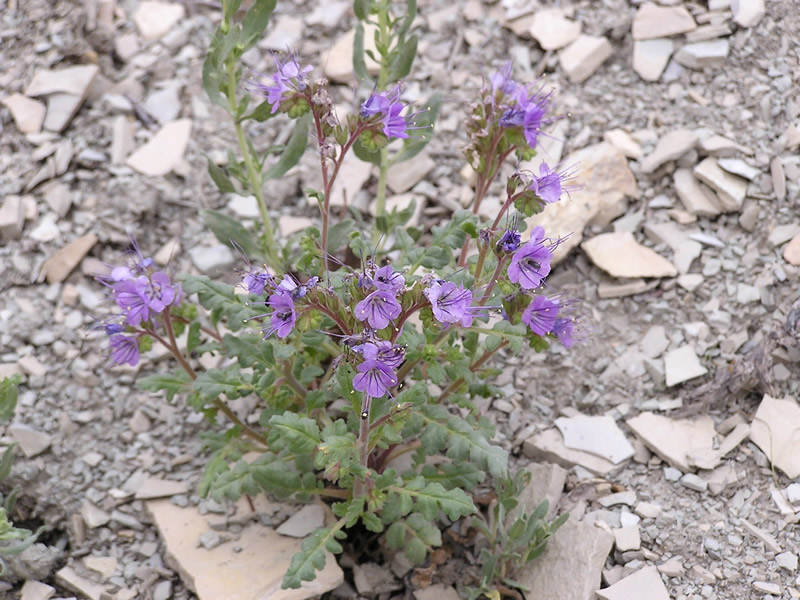
Clay Phacelia

Clay Phacelia

Phacelia argillacea

Denise Van Keuren, Forest Ecologist, Uinta National Forest, Public domain, via Wikimedia Commons

Notch-leaved Phacelia

Notch-leaved Phacelia

Phacelia crenulata

Stan Shebs, CC BY-SA 3.0, via Wikimedia Commons

Side by side

Clay PhaceliaNotch-leaved Phacelia
Scientific namePhacelia argillacea N.D.AtwoodPhacelia crenulata Torr. ex S.Watson
English nameClay PhaceliaNotch-leaved Phacelia
GroupFlowering plantsFlowering plants
ClassMagnoliopsidaMagnoliopsida
OrderBoraginalesBoraginales
FamilyHydrophyllaceae Waterleaf FamilyHydrophyllaceae Waterleaf Family
GenusPhacelia ScorpionweedPhacelia Scorpionweed
Countries on record1 country2 countries
GBIF occurrence records29 records12,976 records

Rows where the two agree are shown in grey.

Where each is found

Both recorded in 1 country

Only Notch-leaved Phacelia (1)

From Catalogue of Life checklists and GBIF occurrence records. A country missing from a list means no record is held, which is not proof of absence.

Checked facts

Clay PhaceliaNotch-leaved Phacelia
Appearance
  • The plant has a basal rosette of leaves with oblong blades bearing deep marginal lobes. English Wikipedia
  • Its inflorescence is a branched, curled cyme covered in hairs and glands. English Wikipedia
  • Its flowers have purple-blue, bell-shaped corollas approximately 0.5 centimeters long and wide. English Wikipedia
  • The flowers have stamens and a style that extend beyond the corolla opening. English Wikipedia
  • The plant produces capsules approximately 0.25 centimeters long. English Wikipedia
  • Phacelia crenulata is an aromatic annual flowering plant. English Wikipedia
  • The plant is covered with stiff glandular hairs. English Wikipedia
  • Its leaves are generally oblong with wavy or lobed margins. English Wikipedia
  • The plant produces a coiled cyme containing several flowers. English Wikipedia
  • Its flowers have bell-shaped purple or blue corollas. English Wikipedia
  • Its corolla has a white tube and may also have a white throat. English Wikipedia
  • The stamens and style extend well beyond the opening of the flower. English Wikipedia
  • Its fruit is a somewhat rounded capsule measuring a few millimeters across. English Wikipedia
  • The variety Phacelia crenulata var. ambigua has purple flowers measuring up to 10 millimeters long. English Wikipedia
  • The variety Phacelia crenulata var. crenulata has purple flowers measuring up to 7 millimeters long. English Wikipedia
  • The variety Phacelia crenulata var. minutiflora has white-throated lavender to blue flowers measuring up to 4 millimeters long. English Wikipedia
Size
Habitat
  • The species grows on steep slopes composed of clay and broken shale derived from the Green River Formation. English Wikipedia
  • Its habitat is pinyon-juniper woodland dominated by Colorado pinyon and Utah juniper. English Wikipedia
  • The species occupies sparsely vegetated slopes of the Green River shale formation at approximately 6,600 feet elevation. fs.usda.gov
  • The species grows on fragile, barren soils on steep hillsides. fs.usda.gov
No checked fact yet
BehaviourNo checked fact yet
Reproduction
  • The species generally flowers in July, although flowering can begin in May or June and continue into October. English Wikipedia
  • An individual plant can produce as many as 8,000 seeds. English Wikipedia
  • The species produced 11,000 seeds from 53 cultivated plants during an early propagation effort. fs.usda.gov
  • Initial germination procedures conducted in 2005 produced 53 potted plants. fs.usda.gov
No checked fact yet
Distribution
  • The species is endemic to Utah in the United States. English Wikipedia
  • The species is known only from Spanish Fork Canyon in central Utah. English Wikipedia
  • The species is currently known from two small populations on privately owned land. fs.usda.gov
  • Phacelia crenulata has an antitropical distribution, occurring at comparable latitudes in both hemispheres but not in the tropics. English Wikipedia
  • In North America, the species is native to the southwestern United States, extending eastward to Colorado and New Mexico. English Wikipedia
  • Its North American native range also includes Baja California and Sonora in Mexico. English Wikipedia
  • In South America, the species is native to southern Peru, western Bolivia, and northern Chile. English Wikipedia
  • Phacelia crenulata var. crenulata occurs from California to Utah. English Wikipedia
  • Phacelia crenulata var. minutiflora occurs in California, Arizona, and Baja California. English Wikipedia
Conservation
  • The species has been federally listed as endangered in the United States since 1978. English Wikipedia
  • Only nine individuals were known when the species was listed in 1978. English Wikipedia
  • The known population declined to four plants within two years of its endangered listing. English Wikipedia
  • Discovery of a second population in 1980 brought the estimated global population to approximately 200 plants. English Wikipedia
  • Sheep grazing at the main locality in 1987 left only one surviving plant. English Wikipedia
  • Twenty to thirty new plants germinated the year after the 1987 grazing incident. English Wikipedia
  • Drought, predation, and other natural and weather-related factors contributed to low plant numbers recorded in 2001. fs.usda.gov
  • The species faces extinction risk because of its small population size. English Wikipedia
  • Sheep, mule deer, and rock squirrels are identified as potential consumers of the plant. English Wikipedia
  • Railroad construction and maintenance have disturbed habitat at one occurrence. English Wikipedia
  • Highway 6 passes directly through another occurrence, where road maintenance can disturb the plants and pollinator-supporting habitat. English Wikipedia
  • Introduced horehound and houndstongue may compete with the species. English Wikipedia
  • Seed collection began in 2004 with funding from the U.S. Fish and Wildlife Service. fs.usda.gov
  • Collected seeds were intended for off-site testing, propagation, and seed banking. fs.usda.gov
  • The recovery program aims to establish up to thirteen new populations on federal land. fs.usda.gov
  • The planned federal-land populations are intended to receive greater legal protection and improve the species' chances of surviving in the wild. fs.usda.gov
No checked fact yet
Similar species
  • The species is closely related to Phacelia glandulosa and has sometimes been mistaken for it. English Wikipedia
No checked fact yet
Other
  • The U.S. Forest Service conducted surveys of suitable federal-land habitat adjacent to occupied sites but found no additional populations. fs.usda.gov
  • The species is classified in the waterleaf family, Hydrophyllaceae. English Wikipedia
  • The species has between two and five recognized varieties. English Wikipedia
  • The recognized varieties of Phacelia crenulata can intergrade in some areas. English Wikipedia

In brief

Clay Phacelia

Phacelia argillacea is endemic to Utah in the United States and is known only from Spanish Fork Canyon in central Utah. It has purple-blue, bell-shaped flowers and a basal rosette of deeply lobed leaves. Full profile

Notch-leaved Phacelia

Notch-leaved Phacelia is an aromatic annual flowering plant in the Hydrophyllaceae family. It occurs at comparable latitudes in both hemispheres, with native ranges in the southwestern United States, Mexico, southern Peru, western Bolivia, and northern Chile. It is covered with stiff glandular hairs and has generally oblong leaves with wavy or lobed margins and purple or blue bell-shaped flowers. Full profile

Compare something else

Page built on 29 November 2026 from the data on the two species pages, where every source is listed.

Cite this page

ScientificNames.org. (2026). Clay Phacelia vs Notch-leaved Phacelia. Retrieved November 29, 2026, from https://scientificnames.org/compare/clay-phacelia-vs-notch-leaved-phacelia