Comparison

Roughscale Sole vs Pacific Halibut

Roughscale Sole (Clidoderma asperrimum) and Pacific Halibut (Hippoglossus stenolepis) both belong to the subfamily Pleuronectinae and part ways below it. Both are recorded in 2 countries.

Roughscale Sole

Roughscale Sole

Clidoderma asperrimum

Jung-Goo MYOUNG, CC BY 3.0, via Wikimedia Commons

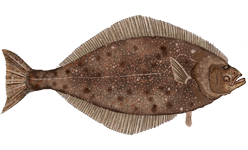
Pacific Halibut

Pacific Halibut

Hippoglossus stenolepis

Unknown authorUnknown author, Public domain, via Wikimedia Commons

Side by side

Roughscale SolePacific Halibut
Scientific nameClidoderma asperrimum (Temminck & Schlegel, 1846)Hippoglossus stenolepis Schmidt, 1904
English nameRoughscale SolePacific Halibut
GroupFishesFishes
ClassTeleostei TeleostTeleostei Teleost
OrderPleuronectiformesPleuronectiformes
FamilyPleuronectidae DabsPleuronectidae Dabs
GenusClidodermaHippoglossus Halibuts
Named in18461904
Red List categoryVulnerableLeast Concern
Environmentmarinemarine
Countries on record4 countries2 countries
GBIF occurrence records418 records37,193 records

Rows where the two agree are shown in grey.

Where each is found

Both recorded in 2 countries

Only Roughscale Sole (2)

From Catalogue of Life checklists and GBIF occurrence records. A country missing from a list means no record is held, which is not proof of absence.

Checked facts

Roughscale SolePacific Halibut
Appearance
  • Clidoderma asperrimum is a flatfish belonging to the family Pleuronectidae. English Wikipedia
  • The Pacific halibut has a diamond-shaped body that is more elongated than that of most flatfishes. English Wikipedia
  • Its body width is approximately one-third of its length. English Wikipedia
  • The lateral line arches prominently above the pectoral fin. English Wikipedia
  • Its tail is crescent-shaped. English Wikipedia
  • Its small scales are embedded in the skin. English Wikipedia
  • Both eyes are normally located on the dark upper side of its body. English Wikipedia
  • Its upper coloration tends to match the ocean bottom, while its underside is lighter. English Wikipedia
  • Its upper surface is generally gray to brown or nearly black, with mottling and numerous spots. adfg.alaska.gov
  • Its underside is typically white. adfg.alaska.gov
  • The dorsal fin extends continuously from near the eyes to the base of the tail. adfg.alaska.gov
  • Its mouth reaches the middle of the lower eye or farther and is nearly symmetrical. adfg.alaska.gov
  • Its tail is broad and symmetrical without a distinct fork. adfg.alaska.gov
Size
  • Females can exceed 2.4 metres in length and reach approximately 230 kilograms in weight. English Wikipedia
  • The maximum reported size exceeds 8 feet in length and 500 pounds in weight. adfg.alaska.gov
  • Male Pacific halibut rarely grow longer than three feet. adfg.alaska.gov
  • A 20-inch Pacific halibut is predicted to weigh approximately 3 pounds. English Wikipedia
  • A 58-inch Pacific halibut is predicted to weigh approximately 100 pounds. English Wikipedia
Habitat
  • The species inhabits the continental shelf of the North Pacific Ocean and the Bering Sea. English Wikipedia
  • Pacific halibut generally live on or near the seabed. English Wikipedia
  • The species prefers water temperatures between 3 and 8 degrees Celsius. English Wikipedia
  • Pacific halibut generally inhabit depths of 20 to 1,000 feet, although individuals have been recorded at 3,600 feet. adfg.alaska.gov
  • The species occurs over various seabed types. adfg.alaska.gov
  • Young halibut settle in shallow nearshore habitats at approximately six months of age. adfg.alaska.gov
Diet
  • The species feeds on zoobenthic organisms, including marine invertebrates and fish. English Wikipedia
  • Pacific halibut consume cod, turbot and pollock. English Wikipedia
  • Their diet includes octopus, crabs and shrimp. English Wikipedia
  • They sometimes leave the seabed to feed on pelagic fishes such as salmon, sand lance and herring. English Wikipedia
  • Pacific halibut have also been found with seal remains in their stomachs. English Wikipedia
  • During their first year, Pacific halibut larvae and juveniles feed on plankton. adfg.alaska.gov
  • Halibut aged one to three years consume euphausiids and small fishes. adfg.alaska.gov
  • Larger individuals consume herring, sand lance, capelin, smelt, pollock, sablefish, cod and rockfish. adfg.alaska.gov
  • Their diet also includes octopuses, crabs and clams. adfg.alaska.gov
BehaviourNo checked fact yet
  • Pacific halibut are strong swimmers capable of migrating long distances. English Wikipedia
  • Halibut of different ages and sizes generally migrate clockwise from northwest to southeast. English Wikipedia
  • Mature individuals migrate from shallow summer feeding grounds to deeper winter spawning grounds. English Wikipedia
  • Juvenile and some adult halibut generally migrate eastward and southward into the Gulf of Alaska coastal current. adfg.alaska.gov
ReproductionNo checked fact yet
  • Pacific halibut spawning generally occurs between November and March. adfg.alaska.gov
  • Spawning takes place at depths of approximately 300 to 1,500 feet. adfg.alaska.gov
  • Most male Pacific halibut reach sexual maturity at approximately eight years of age. adfg.alaska.gov
  • Approximately half of female Pacific halibut are sexually mature by twelve years of age. adfg.alaska.gov
  • Female Pacific halibut can release from a few thousand to several million eggs depending on their size. adfg.alaska.gov
  • Egg fertilization occurs externally. adfg.alaska.gov
  • Pacific halibut eggs hatch approximately fifteen days after fertilization. adfg.alaska.gov
  • Pacific halibut larvae initially have one eye on each side of the head. adfg.alaska.gov
  • The left eye migrates to the right side of the head when the larvae reach approximately one inch in length. adfg.alaska.gov
  • Pacific halibut larvae drift with ocean currents after hatching and eventually reach shallower coastal waters. adfg.alaska.gov
Distribution
  • The species is native to the northern Pacific Ocean. English Wikipedia
  • The species' native range extends from the coasts of China and Japan across the Bering Sea to Alaska, Canada and the Californian coast of America. English Wikipedia
No checked fact yet
Conservation
  • The species has a moderate to high vulnerability score of 50 out of 100 in FishBase. fishbase.se
  • The eastern Pacific population is managed as a single stock for assessment purposes because of extensive juvenile and adult movements. adfg.alaska.gov
  • The United States and Canadian commercial Pacific halibut fishery has received Marine Stewardship Council sustainability certification. adfg.alaska.gov
Uses
  • Pacific halibut are harvested by commercial, recreational and subsistence fisheries. English Wikipedia
  • Pacific halibut provide food for several Indigenous groups along the Pacific Coast. English Wikipedia
  • Some Pacific Coast Indigenous communities smoke and dry halibut for winter consumption. English Wikipedia
Similar speciesNo checked fact yet
  • Inexperienced anglers sometimes mistake Pacific halibut for arrowtooth flounder. adfg.alaska.gov

In brief

Roughscale Sole

Roughscale Sole (Clidoderma asperrimum) is a flatfish belonging to the family Pleuronectidae. It inhabits sandy and muddy seabed habitats at depths of 15 to 1,900 metres in the northern Pacific Ocean. It can reach 62 centimetres in length and weigh up to 4.4 kilograms. Full profile

Pacific Halibut

Hippoglossus stenolepis inhabits the continental shelf of the North Pacific Ocean and the Bering Sea. It has a diamond-shaped, elongated body, normally with both eyes on its dark upper side. Full profile

Compare something else

Page built on 27 November 2026 from the data on the two species pages, where every source is listed.

Cite this page

ScientificNames.org. (2026). Roughscale Sole vs Pacific Halibut. Retrieved November 27, 2026, from https://scientificnames.org/compare/roughscale-sole-vs-pacific-halibut