Comparison
Coast Black Gooseberry vs Blackcurrant
Coast Black Gooseberry (Ribes divaricatum) and Blackcurrant (Ribes nigrum) both belong to the genus Ribes (currant) and part ways below it. Both are recorded in 3 countries.

Coast Black Gooseberry
Ribes divaricatum
Walter Siegmund (talk), CC BY-SA 3.0, via Wikimedia Commons


Side by side
| Coast Black Gooseberry | Blackcurrant | |
|---|---|---|
| Scientific name | Ribes divaricatum Douglas | Ribes nigrum L. |
| English name | Coast Black Gooseberry | Blackcurrant |
| Group | Flowering plants | Flowering plants |
| Class | Magnoliopsida | Magnoliopsida |
| Order | Saxifragales | Saxifragales |
| Family | Grossulariaceae Currant Family | Grossulariaceae Currant Family |
| Genus | Ribes Currant | Ribes Currant |
| Countries on record | 3 countries | 55 countries |
| GBIF occurrence records | 3,218 records | 123,977 records |
Rows where the two agree are shown in grey.
Where each is found
Both recorded in 3 countries
Only Blackcurrant (52)
- Afghanistan
- Aland Islands
- Armenia
- Austria
- Belarus
- Belgium
- Bulgaria
- China
- Croatia
- Czechia
- Denmark
- Estonia
- Finland
- France
- Guernsey
- Hungary
- Iceland
- India
- Ireland
- Isle of Man
- Italy
- Japan
- Jersey
- Kazakhstan
- Kyrgyzstan
- Latvia
- Lithuania
- Luxembourg
- Moldova
- Mongolia
- New Zealand
- North Korea
- Norway
- Pakistan
- Poland
- Portugal
- Romania
- Russia
- Serbia
- Slovakia
- Slovenia
- South Korea
- Spain
- Sweden
- Switzerland
- Tajikistan
- The Netherlands
- Turkey
- Turkmenistan
- Ukraine
- United Kingdom
- Uzbekistan
From Catalogue of Life checklists and GBIF occurrence records. A country missing from a list means no record is held, which is not proof of absence.
Checked facts
| Coast Black Gooseberry | Blackcurrant | |
|---|---|---|
| Appearance |
|
|
| Size |
|
|
| Habitat |
|
|
| Diet |
|
|
| Behaviour | No checked fact yet |
|
| Reproduction | No checked fact yet |
|
| Distribution |
|
|
| Uses |
|
|
| Similar species |
| No checked fact yet |
| Other | No checked fact yet |
|
In brief
Coast Black Gooseberry
Ribes divaricatum occurs in forests, woodlands, and coastal scrub across western North America from British Columbia to California. It is a shrub with thick brown spines at the leaf nodes and sweet-tasting purplish-black berries. Full profile
Blackcurrant
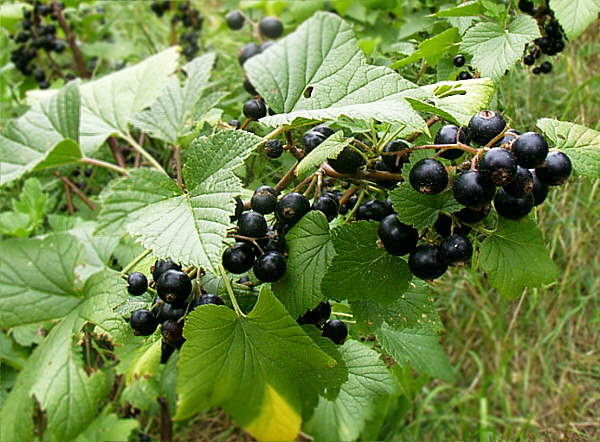
Ribes nigrum grows naturally in temperate regions of central and northern Europe and northern Asia. It produces very dark purple, nearly black berries that are edible and used in food and beverage production. Full profile
Compare something else
Page built on 27 November 2026 from the data on the two species pages, where every source is listed.
Cite this page
ScientificNames.org. (2026). Coast Black Gooseberry vs Blackcurrant. Retrieved November 27, 2026, from https://scientificnames.org/compare/coast-black-gooseberry-vs-blackcurrant
“Coast Black Gooseberry vs Blackcurrant.” ScientificNames.org, 2026, scientificnames.org/compare/coast-black-gooseberry-vs-blackcurrant. Accessed 27 Nov. 2026.
ScientificNames.org. “Coast Black Gooseberry vs Blackcurrant.” Accessed November 27, 2026. https://scientificnames.org/compare/coast-black-gooseberry-vs-blackcurrant.
@misc{scientificnames_coast_black_gooseberry_vs_blackcurrant,
  author = {{ScientificNames.org}},
  title = {Coast Black Gooseberry vs Blackcurrant},
  year = {2026},
  url = {https://scientificnames.org/compare/coast-black-gooseberry-vs-blackcurrant},
  note = {Accessed 2026-11-27}
}