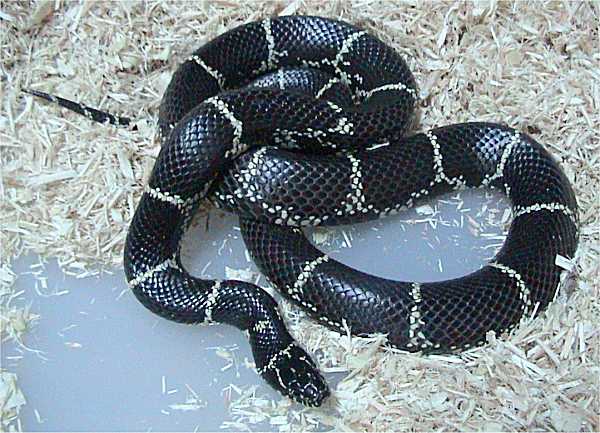
| Appearance | No checked fact yet | - The species has smooth, shiny scales and commonly displays alternating red, black, and yellow or white bands. English Wikipedia
- Individuals may have red blotches rather than colored bands. English Wikipedia
- The neck commonly has a light-colored V-shaped or Y-shaped marking. English Wikipedia
- The body may be gray or tan with dark-bordered brown or rust-colored blotches along its sides. animaldiversity.org
- The species has between 19 and 23 rows of smooth scales and one anal plate. animaldiversity.org
|
|---|
| Size | | - Recorded specimens range from 35 to 175 cm in length. animaldiversity.org
- Individuals in the United States most commonly measure between 60 and 130 cm long. animaldiversity.org
- Depending on the subspecies, individuals may measure between 36 and 180 cm long. English Wikipedia
- Wild adults in North America reportedly average between 38 and 225 g in weight. English Wikipedia
- Tropical populations generally attain greater adult sizes than temperate populations. English Wikipedia
|
|---|
| Habitat | - Eastern kingsnakes most frequently inhabit sandy uplands in Georgia and South Carolina. srelherp.uga.edu
- Eastern kingsnakes also occupy pine flatwoods, mixed hardwood forests, river floodplains, and wetland-adjacent habitats. srelherp.uga.edu
- Common kingsnakes occupy forests, grasslands, deserts, and urban areas. animaldiversity.org
- Eastern kingsnakes can use thick leaf litter and dense shrubbery as microhabitats. English Wikipedia
- Eastern kingsnakes frequently use logs, stumps, and other objects for cover. srelherp.uga.edu
- Eastern kingsnakes in southern Florida used rodent burrows on canal banks as nocturnal retreats. pubs.usgs.gov
| - The species commonly inhabits forest edges and open woodland. English Wikipedia
- The species also occurs in tropical hardwood forests, prairies, savannahs, rocky hillsides, streams, marshes, and agricultural or suburban areas. animaldiversity.org
- The species has been recorded from sea level to elevations of 8,000 feet. animaldiversity.org
- Individuals may use old barns and spaces beneath wood as daytime resting places. English Wikipedia
- Some populations move to higher and drier habitats for winter hibernation and to moister habitats during summer. English Wikipedia
|
|---|
| Diet | - Their diet includes amphibians, turtle eggs, and bird eggs, including those of northern bobwhites. English Wikipedia
- Eastern kingsnakes consume lizards, including five-lined skinks. English Wikipedia
- Eastern kingsnakes prey on small mammals such as white-footed mice. English Wikipedia
- At Rainey Slough, snakes were the only prey detected in the eastern kingsnake diet. pubs.usgs.gov
- Snakes, reptile eggs, and lizards account for 94.8% of the eastern kingsnake diet in Florida. pubs.usgs.gov
| - Adults primarily consume small mammals, including voles, mice, and rats. English Wikipedia
- Adult individuals also eat lizards, particularly skinks. English Wikipedia
- The species also consumes birds, bird eggs, frogs, fish, and other snakes. English Wikipedia
- Juveniles consume crickets, other insects, slugs, and earthworms. English Wikipedia
- Hatchlings primarily feed on other young snakes. animaldiversity.org
- The species captures prey by constriction and subsequently swallows it whole. animaldiversity.org
|
|---|
| Behaviour | - Eastern kingsnakes may vibrate their tails, release foul-smelling musk, or bite when cornered. srelherp.uga.edu
- When possible, eastern kingsnakes respond defensively by seeking refuge. srelherp.uga.edu
- Eastern kingsnakes use constriction as their primary feeding strategy. srelherp.uga.edu
- Eastern kingsnakes are resistant to the venom of venomous pit vipers. srelherp.uga.edu
- At the Rainey Slough study site, eastern kingsnakes were susceptible to capture mostly during winter and spring. pubs.usgs.gov
- Adult male eastern kingsnakes lost an average of 39.3% of their body mass during the spring reproductive season. pubs.usgs.gov
| |
|---|
| Reproduction | | |
|---|
| Distribution | - Eastern kingsnakes occur from southern New Jersey south through peninsular Florida and westward into Alabama. srelherp.uga.edu
| No checked fact yet |
|---|
| Conservation | - Some eastern kingsnake populations in the southeastern United States have declined substantially in recent decades. pubs.usgs.gov
- Eastern kingsnake populations at the protected Savannah River Site in South Carolina declined in abundance and body condition over three decades. srelherp.uga.edu
- Road mortality, human persecution, feral cats, and habitat degradation and fragmentation are major causes of declines at unprotected sites. srelherp.uga.edu
- Eastern kingsnakes are legally protected in Georgia and South Carolina. srelherp.uga.edu
- No eastern kingsnakes were detected at Rainey Slough during follow-up surveys conducted between 2006 and 2010. pubs.usgs.gov
- Road reconstruction, paving, and subsequent roadkill were identified as the likely primary cause of the Rainey Slough population's disappearance. pubs.usgs.gov
| - The species is classified as Least Concern by the IUCN. English Wikipedia
- Collection for the pet trade places pressure on some populations. English Wikipedia
- The species is considered common and is not listed as a conservation concern in Massachusetts. mass.gov
|
|---|
| Uses | No checked fact yet | - The species benefits agricultural and urban environments by consuming rodents concentrated around barns and trash. animaldiversity.org
|
|---|
| Similar species | No checked fact yet | - The species' coloration can resemble that of coral snakes through Batesian mimicry. English Wikipedia
- The species' color patterns may resemble those of copperheads or coral snakes. animaldiversity.org
|
|---|
| Other | | |
|---|