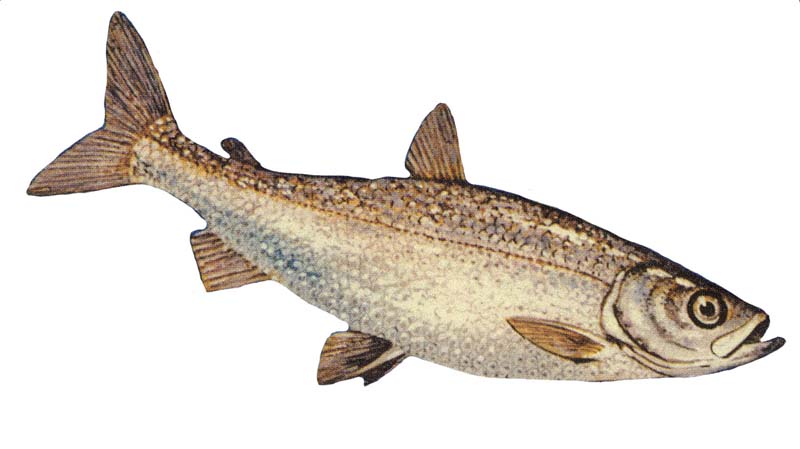
| Appearance | | - The lake whitefish has a snout that extends beyond its short lower jaw, positioning its mouth slightly underneath the head. English Wikipedia
- The lake whitefish has an adipose fin. English Wikipedia
- The lake whitefish has two small flaps in each nostril. English Wikipedia
- Its coloration ranges from silver to white, with olive, pale-green, or brown coloration on its back. English Wikipedia
- Its ventral fins are white and its tail has a dark posterior edge. English Wikipedia
|
|---|
| Habitat | - The bloater inhabits deep freshwater lakes in both pelagic and benthic regions. animaldiversity.org
- The bloater is most abundant at depths between 40 and 110 metres. animaldiversity.org
- The bloater has occasionally been recorded at depths of 10 metres and 180 metres. animaldiversity.org
- The bloater inhabits underwater slopes at depths between 30 and 198 metres. English Wikipedia
- The bloater tolerates water temperatures between 1.5 and 11.4 degrees Celsius. English Wikipedia
- Bloater larvae are frequently found near the bottom at depths of 90 to 110 metres in water no warmer than 4.7 degrees Celsius. animaldiversity.org
| |
|---|
| Diet | - The bloater primarily feeds on animals living on the lake bottom. English Wikipedia
- The bloater also consumes small drifting animals and zooplankton. English Wikipedia
- Recorded food items of the bloater include Mysis diluviana and Diporeia hoyi. English Wikipedia
- Stomach analyses have identified Mysis relicta and Pontoporeia affinis as important food items. animaldiversity.org
- Copepods, fish eggs, and fingernail clams have also been recorded in bloater stomachs. animaldiversity.org
- The bloater is classified as a carnivore that consumes eggs and non-insect arthropods. animaldiversity.org
| - Larval and postlarval lake whitefish feed on plankton. English Wikipedia
- After reaching approximately 76–102 mm in length, young lake whitefish switch to eating bottom-dwelling animals. English Wikipedia
- Lake whitefish consume snails, insect larvae, zebra mussels, and fingernail clams during the remainder of their lives. English Wikipedia
- Some inland lake populations of lake whitefish feed on emerging mayflies and midges in late June and July. English Wikipedia
|
|---|
| Behaviour | - The bloater generally stays on or near the lake bottom during daylight. animaldiversity.org
- The bloater moves upward into the water column at night to feed. animaldiversity.org
- Nighttime densities of bloaters in the water column have reached 6.61 fish per cubic metre. animaldiversity.org
- The bloater's nocturnal migration patterns vary with water temperature, light levels, and individual size. animaldiversity.org
| - Lake whitefish can feed on lake-bottom organisms and food particles suspended in or floating on the water. English Wikipedia
- Lake whitefish undertake spawning migrations into the Athabasca Delta in northwestern Canada during late summer. English Wikipedia
- Migrating lake whitefish move upstream in the Athabasca River. English Wikipedia
- A tagged lake whitefish recorded a maximum single movement of 388 km between Fort McMurray and the north shore of Lake Athabasca in Alberta. English Wikipedia
|
|---|
| Reproduction | - Bloater spawning generally occurs in February and March, although reproduction can occur throughout the year. animaldiversity.org
- Bloater spawning occurs over various bottom types at depths between 36 and 90 metres. animaldiversity.org
- Female bloaters produce approximately 3,000 to 12,000 eggs, with larger females producing more eggs. animaldiversity.org
- Bloater eggs have an average diameter of 1.95 millimetres. animaldiversity.org
- The bloater provides no parental care. animaldiversity.org
- Bloater larvae remain in the larval state for approximately 24 days. animaldiversity.org
| - Lake whitefish spawn between September and January. English Wikipedia
- Lake whitefish spawn at depths of approximately two to four metres during nighttime. English Wikipedia
- Mature lake whitefish move into shallow water during autumn to lay their eggs on rubble and gravel shoals. English Wikipedia
- Lake whitefish do not provide parental care to their young. English Wikipedia
- Young lake whitefish hatch in the spring following spawning. English Wikipedia
|
|---|
| Distribution | - The bloater is native to the Great Lakes except Lake Erie and to Lake Nipigon. English Wikipedia
| - Lake whitefish occur throughout much of Canada and parts of the northern United States, including all five Great Lakes. English Wikipedia
|
|---|
| Conservation | - The bloater is classified as Vulnerable to global extinction by the IUCN. English Wikipedia
- Bloater populations have declined in Lakes Superior and Huron. English Wikipedia
- Predation by alewives is identified as the principal cause of bloater population declines, with sea lamprey predation and pollution also contributing. English Wikipedia
- The Lake Ontario bloater reintroduction program involves multiple North American fishery agencies. English Wikipedia
- The Lake Ontario restoration program aims to provide an alternative food source for top predators and improve ecological function. pubs.usgs.gov
| - The invasive sea lamprey is identified as a major threat to lake whitefish. English Wikipedia
- In Lakes Michigan and Huron, invasive quagga mussels threaten lake whitefish by filtering out zooplankton that juvenile fish depend on as food. English Wikipedia
|
|---|
| Uses | - Bloater catches are commercially processed primarily by smoking for human consumption. animaldiversity.org
- The bloater is an important food source for larger salmonid fishes. animaldiversity.org
- The bloater was historically considered a suitable panfish but too small for commercial marketing. English Wikipedia
| - Lake whitefish are commercially valuable fish and are also occasionally caught by sport fishermen. English Wikipedia
- Lake whitefish fillets are sold smoked, refrigerated, or vacuum-packed in North American grocery stores. English Wikipedia
- Lake whitefish are an important species for commercial inland fisheries in North America. English Wikipedia
- The Great Lakes fishery harvested an average of 11 million pounds of lake whitefish annually between 1981 and 1999. English Wikipedia
|
|---|
| Similar species | - The bloater closely resembles the kiyi but can be distinguished by its lighter upper lip and smaller eye. English Wikipedia
- The bloater is closely related to the cisco or lake herring and the shortjaw cisco. English Wikipedia
| - The lake whitefish resembles other whitefish species in the Coregoninae subfamily of Salmonidae, including the northern cisco. English Wikipedia
- Lake whitefish and cisco cannot be reliably distinguished by morphology alone during early life stages. English Wikipedia
|
|---|
| Name origin | - The common name bloater refers to the swollen appearance caused by expansion of the gas bladder after the fish is brought up from deep water. English Wikipedia
| No checked fact yet |
|---|