Comparison
Corvina Drum vs Meagre
Corvina Drum (Cilus gilberti) and Meagre (Argyrosomus regius) both belong to the family Sciaenidae (drums) and part ways below it.


Meagre
Argyrosomus regius
Buffon, Georges Louis Leclerc; Cuvier, Georges; Valenciennes, Public domain, via Wikimedia Commons

Side by side
| Corvina Drum | Meagre | |
|---|---|---|
| Scientific name | Cilus gilberti (Abbott, 1899) | Argyrosomus regius (Asso, 1801) |
| English name | Corvina Drum | Meagre |
| Group | Fishes | Fishes |
| Class | Teleostei Teleost | Teleostei Teleost |
| Order | Perciformes | Perciformes |
| Family | Sciaenidae Drums | Sciaenidae Drums |
| Genus | Cilus | Argyrosomus Meagres |
| Named in | 1899 | 1801 |
| Red List category | Data Deficient | Least Concern |
| Environment | marine | brackish, marine |
| Countries on record | 2 countries | 16 countries |
| GBIF occurrence records | 5,214 records | 2,274 records |
Rows where the two agree are shown in grey.
Where each is found
Only Corvina Drum (2)
Only Meagre (16)
- Algeria
- Angola
- Democratic Republic of the Congo
- Egypt
- France
- Gabon
- Italy
- Mauritania
- Morocco
- Portugal
- Senegal
- South Africa
- Spain
- The Netherlands
- United Kingdom
- Western Sahara
From Catalogue of Life checklists and GBIF occurrence records. A country missing from a list means no record is held, which is not proof of absence.
Checked facts
| Corvina Drum | Meagre | |
|---|---|---|
| Appearance |
|
|
| Size |
| No checked fact yet |
| Habitat |
|
|
| Diet | No checked fact yet |
|
| Behaviour | No checked fact yet |
|
| Reproduction | No checked fact yet |
|
| Distribution |
| No checked fact yet |
| Uses |
|
|
| Other |
| No checked fact yet |
In brief
Corvina Drum
Corvina Drum is a fish in the family Sciaenidae and the monospecific genus Cilus. It inhabits soft-bottom marine environments along the Pacific coast of South America from Chile to Panama and around the Galapagos Islands, at depths of 5 to 50 metres. It has an elongated, somewhat compressed body, a blue-grey upper body, silvery coloration, and a large mouth. Full profile
Meagre
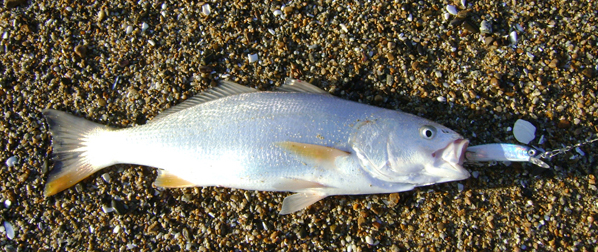
Argyrosomus regius inhabits inshore waters, continental shelf environments, estuaries and coastal lagoons. It has a pearly-silver body, a large terminal mouth and a conspicuous lateral line extending to the caudal fin. Full profile
Compare something else
Page built on 27 November 2026 from the data on the two species pages, where every source is listed.
Cite this page
ScientificNames.org. (2026). Corvina Drum vs Meagre. Retrieved November 27, 2026, from https://scientificnames.org/compare/corvina-drum-vs-meagre
“Corvina Drum vs Meagre.” ScientificNames.org, 2026, scientificnames.org/compare/corvina-drum-vs-meagre. Accessed 27 Nov. 2026.
ScientificNames.org. “Corvina Drum vs Meagre.” Accessed November 27, 2026. https://scientificnames.org/compare/corvina-drum-vs-meagre.
@misc{scientificnames_corvina_drum_vs_meagre,
  author = {{ScientificNames.org}},
  title = {Corvina Drum vs Meagre},
  year = {2026},
  url = {https://scientificnames.org/compare/corvina-drum-vs-meagre},
  note = {Accessed 2026-11-27}
}