Comparison
Cabbage White Parasitoid Wasp vs Tomato Hornworm Parasitoid Wasp
Cabbage White Parasitoid Wasp (Cotesia glomerata) and Tomato Hornworm Parasitoid Wasp (Cotesia congregata) both belong to the genus Cotesia and part ways below it. Both are recorded in 2 countries.
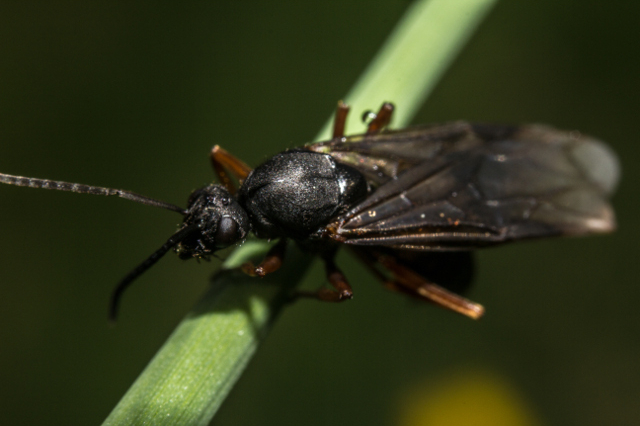
Cabbage White Parasitoid Wasp
Cotesia glomerata
Lennart Tange on Flickr, CC BY 3.0, via Wikimedia Commons


Tomato Hornworm Parasitoid Wasp
Cotesia congregata
Beatriz Moisset, CC BY-SA 3.0, via Wikimedia Commons

Side by side
| Cabbage White Parasitoid Wasp | Tomato Hornworm Parasitoid Wasp | |
|---|---|---|
| Scientific name | Cotesia glomerata (Linnaeus, 1758) | Cotesia congregata (Say, 1836) |
| English name | Cabbage White Parasitoid Wasp | Tomato Hornworm Parasitoid Wasp |
| Group | Insects | Insects |
| Class | Insecta Insect | Insecta Insect |
| Order | Hymenoptera Ants | Hymenoptera Ants |
| Family | Braconidae Braconids | Braconidae Braconids |
| Genus | Cotesia | Cotesia |
| Named in | 1758 | 1836 |
| Countries on record | 25 countries | 2 countries |
| GBIF occurrence records | 1,516 records | 2,451 records |
Rows where the two agree are shown in grey.
Where each is found
Both recorded in 2 countries
Only Cabbage White Parasitoid Wasp (23)
- Australia
- Austria
- Belgium
- Czechia
- Denmark
- Finland
- France
- Germany
- Hungary
- India
- Israel
- Italy
- Nepal
- New Zealand
- Pakistan
- Portugal
- Russia
- South Korea
- Spain
- Sweden
- The Netherlands
- Turkey
- United Kingdom
From Catalogue of Life checklists and GBIF occurrence records. A country missing from a list means no record is held, which is not proof of absence.
Checked facts
| Cabbage White Parasitoid Wasp | Tomato Hornworm Parasitoid Wasp | |
|---|---|---|
| Appearance | No checked fact yet |
|
| Size |
|
|
| Habitat |
|
|
| Diet |
|
|
| Behaviour |
|
|
| Reproduction |
|
|
| Lifespan | No checked fact yet |
|
| Distribution |
|
|
| Conservation |
|
|
| Similar species | No checked fact yet |
|
| Other |
| No checked fact yet |
In brief
Cabbage White Parasitoid Wasp
The Cabbage White Parasitoid Wasp is an insect in the family Braconidae, order Hymenoptera and class Insecta. The species occurs throughout most of Europe and is recorded from the Afrotropical, Australasian, Nearctic and Neotropical realms. It is an endoparasitic wasp that develops inside caterpillar hosts and parasitizes several Pieris butterfly species. Full profile
Tomato Hornworm Parasitoid Wasp
Adult wasps can be found on flowers where they drink nectar. The species produces conspicuous snow-white cocoons that adhere to the skin of host caterpillars. Full profile
Compare something else
Page built on 26 November 2026 from the data on the two species pages, where every source is listed.
Cite this page
ScientificNames.org. (2026). Cabbage White Parasitoid Wasp vs Tomato Hornworm Parasitoid Wasp. Retrieved November 26, 2026, from https://scientificnames.org/compare/cabbage-white-parasitoid-wasp-vs-tomato-hornworm-parasitoid-wasp
“Cabbage White Parasitoid Wasp vs Tomato Hornworm Parasitoid Wasp.” ScientificNames.org, 2026, scientificnames.org/compare/cabbage-white-parasitoid-wasp-vs-tomato-hornworm-parasitoid-wasp. Accessed 26 Nov. 2026.
ScientificNames.org. “Cabbage White Parasitoid Wasp vs Tomato Hornworm Parasitoid Wasp.” Accessed November 26, 2026. https://scientificnames.org/compare/cabbage-white-parasitoid-wasp-vs-tomato-hornworm-parasitoid-wasp.
@misc{scientificnames_cabbage_white_parasitoid_wasp_vs_tomato_hornworm_parasitoid_wasp,
  author = {{ScientificNames.org}},
  title = {Cabbage White Parasitoid Wasp vs Tomato Hornworm Parasitoid Wasp},
  year = {2026},
  url = {https://scientificnames.org/compare/cabbage-white-parasitoid-wasp-vs-tomato-hornworm-parasitoid-wasp},
  note = {Accessed 2026-11-26}
}