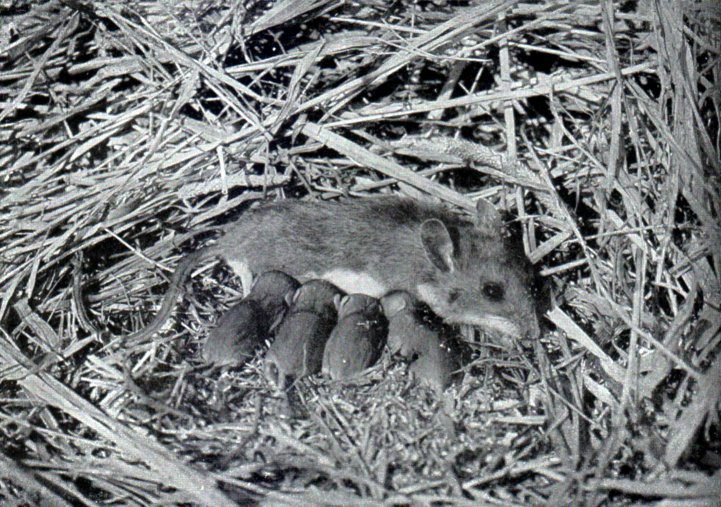
| Appearance | - The cotton mouse has a dark brown body with white feet and a creamy white underside. English Wikipedia
- The dorsal coat consists of short dark brown hairs and longer, darker hairs along the middle of the back. animaldiversity.org
- The cotton mouse has sparsely haired tail and a relatively short tail compared with other rodents. animaldiversity.org
- The skull has a flattened upper surface and little or no postorbital process. animaldiversity.org
- The ears measure 16–18 mm from the notch. depts.ttu.edu
- The upperparts are mummy brown, with black suffusion along the middle of the back, russet sides, and creamy white underparts. depts.ttu.edu
- The feet are white, although the heel's tarsal joint is dark like the leg. depts.ttu.edu
| - The upperparts of this species range from pale to rich reddish brown, while its underside and feet are white. animaldiversity.org
- Its tail is darker on the upper surface and lighter underneath. biokids.umich.edu
|
|---|
| Size | | |
|---|
| Habitat | - The species inhabits hardwood forests, swamps, field margins, salt savanna edges, dunes, scrub, and rocky bluffs and ledges. English Wikipedia
- Cotton mice commonly occupy forest floors and use hollow logs, vines, and brush as shelter. animaldiversity.org
- Underground tortoise burrows have been identified as a primary habitat for cotton mice in one study. animaldiversity.org
- The species occurs in wooded areas along stream edges and in areas subject to potential flooding. animaldiversity.org
- Cotton mice use underground refuges including stump holes, tree cavities, root boles, and burrows. English Wikipedia
- In eastern Texas, the species has been trapped in canebrakes, beneath logs, and in and around old buildings in wooded areas. depts.ttu.edu
| - This species is most frequently encountered in warm, dry forests and brushlands at low and intermediate elevations. animaldiversity.org
- It can inhabit environments ranging from high-elevation forests to semi-desert landscapes. animaldiversity.org
- It also occupies suburban and agricultural environments. biokids.umich.edu
- In the southern and western portions of its range, this species mainly inhabits wooded areas and semi-desert scrub near waterways. animaldiversity.org
- In southern Mexico, this species is primarily associated with agricultural environments. biokids.umich.edu
- It constructs nests in warm, dry locations such as hollow trees and abandoned bird nests. animaldiversity.org
|
|---|
| Diet | - Cotton mice are omnivorous and consume seeds and insects. English Wikipedia
- Animal matter may account for more than half of the cotton mouse's diet. depts.ttu.edu
- Captive cotton mice readily ate rolled oats, wheat, corn, and bread. depts.ttu.edu
- Cotton mice consume green foods sparingly. depts.ttu.edu
| - This species is omnivorous and consumes seeds, berries, nuts, insects, grains, fruits, and fungi. biokids.umich.edu
- Its diet includes seeds, nuts, fruits, berries, and insects. tn.gov
- It consumes the pupal stage of invasive gypsy moths. English Wikipedia
- It gathers and stores seeds and nuts during autumn for consumption during winter. biokids.umich.edu
|
|---|
| Behaviour | - Cotton mice use underground refuges to avoid predators and wildfires. English Wikipedia
- The use of underground refuges allows cotton mice to survive fires without significant population losses. English Wikipedia
- Cotton mice can climb and may occupy hollows in trees above ground. depts.ttu.edu
- Male cotton mice have larger home ranges than females, and male ranges overlap extensively with those of other males and females. animaldiversity.org
- Female cotton mice have restricted home ranges that may overlap male ranges but not those of other females. animaldiversity.org
| - This species is primarily active during nighttime. animaldiversity.org
- Individuals are generally solitary and territorial, although neighboring home ranges can overlap. animaldiversity.org
- Its home ranges generally cover between 0.5 and 1.5 acres. biokids.umich.edu
- Its population density can range from 4 to 12 individuals per acre. animaldiversity.org
- Individuals are capable of climbing and swimming effectively. animaldiversity.org
- Captured individuals have demonstrated the ability to return to their original capture location after being released two miles away. animaldiversity.org
- Individuals produce a prolonged buzzing sound by striking hollow reeds or dry leaves with their forepaws. biokids.umich.edu
- Females transport threatened offspring individually by holding them around the neck with their teeth. biokids.umich.edu
|
|---|
| Reproduction | - Cotton mice can breed throughout the year, although reproductive activity may decline during summer. depts.ttu.edu
- In Texas, breeding generally begins in late August, peaks between November and January, and declines by early May. depts.ttu.edu
- The gestation period is approximately 23 days in nonnursing females and 30 days in females nursing a previous litter. depts.ttu.edu
- Adult females can produce four or more litters annually. depts.ttu.edu
- Litter sizes range from one to seven offspring, averaging three or four. depts.ttu.edu
- Newborn cotton mice are naked and blind. depts.ttu.edu
- Young cotton mice are completely weaned between 20 and 25 days of age. depts.ttu.edu
- Cotton mice generally reach sexual maturity between 60 and 70 days of age. depts.ttu.edu
- In Florida, cotton mice breed throughout the year, with peak activity in late autumn and early winter. animaldiversity.org
- Female cotton mice construct nests primarily from cotton for giving birth. animaldiversity.org
- The eyes of young cotton mice generally open between 12 and 14 days after birth. animaldiversity.org
- Female cotton mice in captivity reach reproductive maturity between 43 and 73 days of age. animaldiversity.org
| |
|---|
| Distribution | No checked fact yet | - This species occurs across much of eastern North America, extending from Nova Scotia westward to Saskatchewan and Montana. animaldiversity.org
- Its geographical range extends southward into eastern and southern Mexico and the Yucatan Peninsula. biokids.umich.edu
|
|---|
| Conservation | - The cotton deermouse is classified as a species of least concern by the IUCN. depts.ttu.edu
- Potential future threats include excessive logging, conversion to pine plantations, drainage of bottomland wetlands, and habitat fragmentation. depts.ttu.edu
| |
|---|
| Uses | | - This species contributes to controlling populations of insect pests such as gypsy moths. animaldiversity.org
- It serves as an important prey species for numerous small predators. maine.gov
- It is commonly used as a laboratory animal, ranking among the most frequently used mouse species after the house mouse. English Wikipedia
- Domesticated individuals are also maintained as pets and have been selectively bred for different coat colors. English Wikipedia
|
|---|
| Similar species | - The cotton mouse resembles the white-footed mouse but is larger and has a longer skull and hind feet. English Wikipedia
- The cotton mouse can be distinguished from the white-footed deermouse by its greater adult weight, longer skull, and larger hind foot. depts.ttu.edu
- The golden mouse shares habitat and geographical regions with the cotton mouse. English Wikipedia
| - The eastern deer mouse (Peromyscus maniculatus) is a similar species. English Wikipedia
- Other closely related species that can be difficult to distinguish from it include Peromyscus maniculatus, P. eremicus, P. polionotus, and P. gossypinus. animaldiversity.org
|
|---|