| Appearance | | - The zebrafish has five uniform, pigmented, horizontal blue stripes along each side of its body that extend to the end of the caudal fin. English Wikipedia
- The zebrafish has a fusiform, laterally compressed body and an upward-directed mouth. English Wikipedia
- Male zebrafish have gold stripes between their blue stripes, whereas females have silver stripes and a larger whitish belly. English Wikipedia
- Adult female zebrafish have a small genital papilla located in front of the anal fin origin. English Wikipedia
- Zebrafish have centrally located eyes, thin elongated mandibles, and a protrusive lower jaw. animaldiversity.org
- Zebrafish have an incomplete lateral line, two pairs of barbels, and usually five to seven longitudinal body stripes. animaldiversity.org
- Male zebrafish generally have more yellow coloration and larger anal fins than females. animaldiversity.org
|
|---|
| Size | | No checked fact yet |
|---|
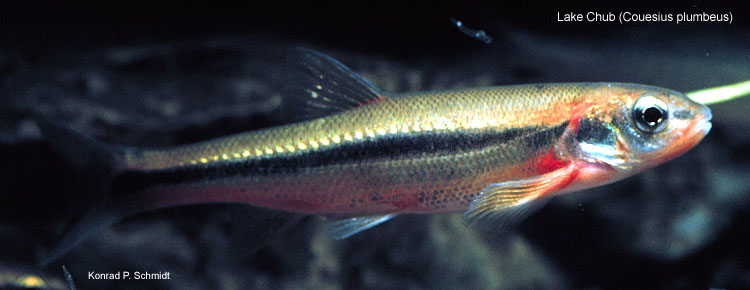
| Habitat | - Lake chubs inhabit cool, shallow waters in both lakes and streams. biokids.umich.edu
- In lakes, lake chubs are commonly found near shorelines with sandy bottoms and large boulders. animaldiversity.org
- In streams, lake chubs commonly inhabit river-mouth areas at depths of approximately one metre or less. animaldiversity.org
- Lake chubs more commonly inhabit lakes in the southern part of their range and rivers in the northern part. biokids.umich.edu
- Lake chubs can occupy river shallows, rocky shores, lake shoals, and substrates consisting of silt, leaves, gravel, or rocks during spawning. animaldiversity.org
| - Zebrafish inhabit moderately flowing to stagnant, clear, shallow freshwater environments. English Wikipedia
- Zebrafish occur in streams, canals, ditches, oxbow lakes, ponds, and rice paddies. English Wikipedia
- Zebrafish habitats commonly contain submerged or overhanging vegetation and sandy, muddy, or silty bottoms. English Wikipedia
- Zebrafish are commonly found in shallow, slow-moving water near stream edges and in ditches. animaldiversity.org
|
|---|
| Diet | | - Zebrafish are omnivores that feed opportunistically on zooplankton, insects, and phytoplankton. pmc.ncbi.nlm.nih.gov
- Zebrafish obtain most of their food from the water column, particularly zooplankton and aquatic insects. animaldiversity.org
- Zebrafish also feed at the water surface on terrestrial insects and arachnids. animaldiversity.org
- Mosquito larvae are a commonly consumed food item of zebrafish. animaldiversity.org
- Zebrafish are stomachless and toothless and use gill rakers to break up food. animaldiversity.org
- Zebrafish are obligate suction feeders. animaldiversity.org
|
|---|
| Behaviour | | - Zebrafish are active, social, and diurnal fish. animaldiversity.org
- Zebrafish naturally form shoals and establish social hierarchies involving both sexes. animaldiversity.org
- Dominance among zebrafish is established through aggressive behaviours such as biting and chasing. animaldiversity.org
- Dominant zebrafish establish mating territories near spawning sites and monopolize food resources. animaldiversity.org
|
|---|
| Reproduction | - Lake chubs generally reach sexual maturity at approximately three years of age. animaldiversity.org
- Lake chubs spawn in spring at lower latitudes and later in summer at higher latitudes. biokids.umich.edu
- Spawning migrations can cover distances ranging from less than 0.8 km to approximately 1.6 km. animaldiversity.org
- Lake chubs commonly enter creeks and streams or travel along lake shores to spawn. biokids.umich.edu
- Lake chub eggs are demersal and non-adhesive. animaldiversity.org
- Lake chubs do not provide parental care to their eggs or juveniles. animaldiversity.org
- Lake chubs have not been documented constructing nests. biokids.umich.edu
| - Zebrafish generally reproduce seasonally during the monsoon period from April to August. animaldiversity.org
- Zebrafish spawning typically begins at first light during the breeding season and continues for approximately one hour. animaldiversity.org
- During courtship, approximately three to seven male zebrafish pursue females and guide them toward spawning sites. animaldiversity.org
- Wild zebrafish generally spawn in well-vegetated pools with silty bottoms. animaldiversity.org
- Female zebrafish release approximately five to twenty eggs at a time during spawning. animaldiversity.org
- Zebrafish lay non-adhesive eggs without constructing nests and are group spawners that scatter their eggs. animaldiversity.org
- Most zebrafish eggs hatch within 48 to 72 hours after fertilization. animaldiversity.org
- Newly hatched zebrafish are approximately 3 mm long and immediately independent. animaldiversity.org
- Female zebrafish can spawn at intervals of two to three days and produce hundreds of eggs per clutch under favourable conditions. English Wikipedia
- Zebrafish embryos develop precursors to all major organs within 36 hours of fertilization. English Wikipedia
- Adult zebrafish provide no parental care to their offspring. animaldiversity.org
|
|---|
| Conservation | | - The introduced zebrafish population in New Mexico had disappeared by 2003. English Wikipedia
|
|---|
| Uses | - Lake chubs can be used as bait for fishing because they are preyed upon by large predatory fishes. English Wikipedia
| - Zebrafish are extensively used as vertebrate model organisms in scientific research, particularly developmental biology. English Wikipedia
- Zebrafish are used in research on gene function, oncology, teratology, and drug development. English Wikipedia
- Zebrafish are used as research models for pancreatic development, beta-cell regeneration, and diabetes. English Wikipedia
- Zebrafish are popular aquarium fish that are considered suitable for beginner aquarists. English Wikipedia
- Zebrafish have been used to produce genetically modified fluorescent aquarium fish marketed as GloFish. English Wikipedia
|
|---|
| Similar species | No checked fact yet | |
|---|