Comparison

Yellow-legged Rain Frog vs Robber Frog

Yellow-legged Rain Frog (Craugastor andi) and Robber Frog (Craugastor raniformis) both belong to the genus Craugastor (northern rainfrogs) and part ways below it. Both are recorded in 1 country.

Yellow-legged Rain Frog

Craugastor andi
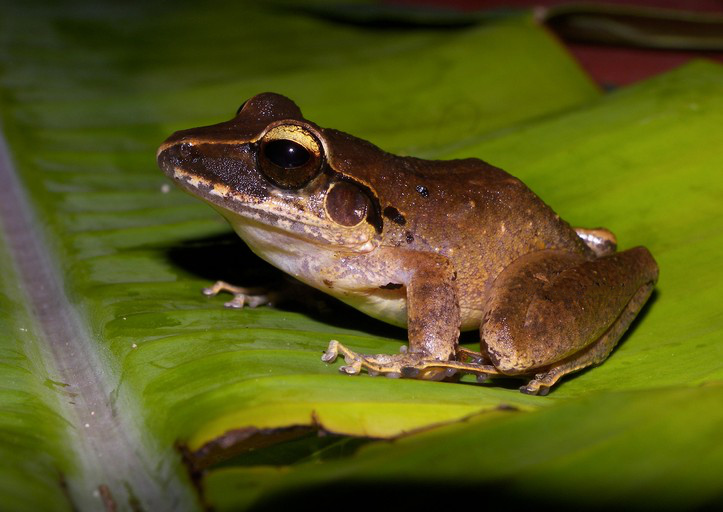
Robber Frog

Robber Frog

Craugastor raniformis

Esteban Alzate, CC BY-SA 2.5, via Wikimedia Commons

Side by side

Yellow-legged Rain FrogRobber Frog
Scientific nameCraugastor andi (Savage, 1974)Craugastor raniformis (Boulenger, 1896)
English nameYellow-legged Rain FrogRobber Frog
GroupAmphibiansAmphibians
ClassAmphibia AmphibiansAmphibia Amphibians
OrderAnura FrogsAnura Frogs
FamilyCraugastoridae Robber FrogsCraugastoridae Robber Frogs
GenusCraugastor Northern RainfrogsCraugastor Northern Rainfrogs
Named in19741896
Red List categoryCritically EndangeredLeast Concern
Countries on record2 countries2 countries
GBIF occurrence records69 records3,616 records

Rows where the two agree are shown in grey.

Where each is found

Both recorded in 1 country

Only Yellow-legged Rain Frog (1)

Only Robber Frog (1)

From Catalogue of Life checklists and GBIF occurrence records. A country missing from a list means no record is held, which is not proof of absence.

Checked facts

Yellow-legged Rain FrogRobber Frog
Appearance
  • The species has a relatively narrow head and a long, pointed snout. English Wikipedia
  • Its back is dark brown and may have a thin, light stripe running down the middle. English Wikipedia
  • Its underside has a white background with dark spots and may have yellow or reddish coloration. English Wikipedia
  • The groin and backs of the thighs are chocolate brown with bright yellow spots or broad stripes in living specimens. English Wikipedia
  • Its throat is dark brown or black, with a lighter stripe running along it. English Wikipedia
  • Its iris is coppery gold with a horizontal dark brown line through the middle. English Wikipedia
  • The skin of its back may be smooth or have some warts, but is not tuberculate. English Wikipedia
  • Its third and fourth fingers have enlarged ball-shaped or disc-like pads. English Wikipedia
  • Its feet have thin webbing between all five digits. English Wikipedia
  • Adult males possess nuptial pads and vocal slits. English Wikipedia
  • Craugastor raniformis has a relatively large body and a rather pointed snout. English Wikipedia
Size
  • Adult female Craugastor raniformis measure 52–74 mm in snout–vent length. English Wikipedia
  • Adult male Craugastor raniformis measure 27–43 mm in snout–vent length. English Wikipedia
Habitat
  • Its native habitat is tropical wet premontane rainforest containing bromeliads, generally near streams. English Wikipedia
  • It occurs at elevations between 560 and 1,500 metres above sea level. English Wikipedia
  • Most recorded collections have been made at elevations of 1,000–1,200 metres. English Wikipedia
  • In Panama, specimens have been collected at 910 metres elevation. English Wikipedia
  • Craugastor raniformis inhabits humid lowland and montane forests at elevations up to 1,500 metres above sea level. English Wikipedia
  • Craugastor raniformis also occurs in wet pastureland. English Wikipedia
  • Craugastor raniformis is a dominant frog in abandoned mixed farming areas of Colombia's coastal Pacific rainforests. English Wikipedia
  • Craugastor raniformis has been observed at elevations between sea level and 1,500 metres. English Wikipedia
  • Craugastor raniformis is not frequently observed in primary forest. English Wikipedia
  • The species' range includes the Ranita Dorada Amphibian Reserve, Parque Nacional Darién, and Area de Manejo Especial Nusagandi. English Wikipedia
  • Craugastor raniformis is a terrestrial frog inhabiting tropical dry forest in Colombia. academia.edu
DietNo checked fact yet
  • Craugastor raniformis primarily eats crickets, millipedes, spiders, and ants. English Wikipedia
Behaviour
  • The species is nocturnal and is considered probably arboreal. English Wikipedia
  • Individuals are usually found near streams and have also been observed up to five metres high in water-filled bromeliad centres. English Wikipedia
  • Males call from locations along streams. English Wikipedia
  • The male call is described as a deep sound repeated several times. English Wikipedia
  • During daytime, Craugastor raniformis individuals conceal themselves in leaf litter on the forest floor. English Wikipedia
  • At night, Craugastor raniformis may climb vegetation to heights of at least 2.5 metres above the ground. English Wikipedia
  • Male and juvenile Craugastor raniformis climb more frequently than adult females. English Wikipedia
  • Male Craugastor raniformis produce a call described as a repeated sequence of four 'ha' sounds. English Wikipedia
Reproduction
  • Female Craugastor raniformis have been observed guarding their eggs. English Wikipedia
  • Craugastor raniformis lays terrestrial eggs that hatch directly into small froglets. English Wikipedia
Distribution
  • The species occurs in the Caribbean drainage of Costa Rica and extreme northwestern Panama. English Wikipedia
  • Its recorded Costa Rican mountain ranges include the Guanacaste, Tilarán, Volcánica Central and northern Talamanca cordilleras. English Wikipedia
  • The species was recorded along the Río Claro in Bocas del Toro Province, Panama, before 2010. English Wikipedia
  • Recorded Costa Rican protected areas include Monteverde Cloud Forest Reserve, Alberto Manuel Brenes Biological Reserve and Maquenque National Wildlife Refuge. English Wikipedia
Conservation
  • The species was last recorded in 1990 and has not been observed since. English Wikipedia
  • It was assessed as critically endangered by the IUCN in 2004 and retained that status in 2008. English Wikipedia
  • Its critically endangered assessment was attributed to a drastic population decline. English Wikipedia
  • The species is protected in Costa Rica under wildlife conservation law No. 7317, environmental law No. 7554 and decree No. 26435-MINAE. English Wikipedia
  • Infection by the introduced chytrid fungus has been suggested as a possible cause of its decline. English Wikipedia
  • Climate change has also been mentioned as a possible source of impact on the species. English Wikipedia
  • The species has no ex situ conservation population. English Wikipedia
  • The species is suspected to be susceptible to the chytrid fungus Batrachochytrium dendrobatidis. English Wikipedia

In brief

Yellow-legged Rain Frog

Craugastor andi occurs in the Caribbean drainage of Costa Rica and extreme northwestern Panama, in tropical wet premontane rainforest generally near streams. It has a white underside with dark spots and yellow or reddish coloration, while its groin and the backs of its thighs have bright yellow markings. Full profile

Robber Frog

Craugastor raniformis occurs in Colombia and Panama, inhabiting humid lowland and montane forests and wet pastureland at elevations up to 1,500 metres above sea level. It has a relatively large body, a rather pointed snout, and terrestrial eggs that hatch directly into small froglets. Full profile

Compare something else

Page built on 28 November 2026 from the data on the two species pages, where every source is listed.

Cite this page

ScientificNames.org. (2026). Yellow-legged Rain Frog vs Robber Frog. Retrieved November 28, 2026, from https://scientificnames.org/compare/yellow-legged-rain-frog-vs-robber-frog