Comparison
Cream-coloured Courser vs Jerdon's Courser
Cream-coloured Courser (Cursorius cursor) and Jerdon's Courser (Rhinoptilus bitorquatus) both belong to the family Glareolidae (coursers) and part ways below it. Both are recorded in 1 country.

Cream-coloured Courser
Cursorius cursor
Mohamed Sabry Photographer, CC BY-SA 4.0, via Wikimedia Commons


Side by side
| Cream-coloured Courser | Jerdon's Courser | |
|---|---|---|
| Scientific name | Cursorius cursor (Latham, 1787) | Rhinoptilus bitorquatus (Blyth, 1848) |
| English name | Cream-coloured Courser | Jerdon's Courser |
| Group | Birds | Birds |
| Class | Aves Bird | Aves Bird |
| Order | Charadriiformes Auks | Charadriiformes Auks |
| Family | Glareolidae Coursers | Glareolidae Coursers |
| Genus | Cursorius Coursers | Rhinoptilus Short-billed Coursers |
| Named in | 1787 | 1848 |
| Red List category | Least Concern | Critically Endangered |
| Environment | marine, terrestrial | Not recorded |
| Countries on record | 49 countries | 1 country |
| GBIF occurrence records | 19,338 records | 31 records |
Rows where the two agree are shown in grey.
Where each is found
Both recorded in 1 country
Only Cream-coloured Courser (48)
- Afghanistan
- Algeria
- Bahrain
- Belgium
- Cabo Verde
- Chad
- Cyprus
- Czechia
- Denmark
- Egypt
- Ethiopia
- Finland
- France
- Greece
- Iran
- Iraq
- Israel
- Italy
- Jordan
- Kenya
- Kuwait
- Lebanon
- Libya
- Mali
- Mauritania
- Morocco
- Namibia
- Niger
- Norway
- Oman
- Pakistan
- Palestinian Territory
- Portugal
- Qatar
- Saudi Arabia
- Senegal
- Somalia
- Spain
- Sudan
- Sweden
- Syria
- The Netherlands
- Tunisia
- Turkey
- United Arab Emirates
- United Kingdom
- Western Sahara
- Yemen
From Catalogue of Life checklists and GBIF occurrence records. A country missing from a list means no record is held, which is not proof of absence.
Checked facts
| Cream-coloured Courser | Jerdon's Courser | |
|---|---|---|
| Appearance |
|
|
| Size | No checked fact yet |
|
| Habitat |
|
|
| Diet |
|
|
| Behaviour |
|
|
| Reproduction |
|
|
| Distribution |
|
|
| Conservation | No checked fact yet |
|
| Other |
| No checked fact yet |
In brief
Cream-coloured Courser
The Cream-coloured Courser is a bird in the wader family Glareolidae. It occurs in the Canary Islands, Cape Verde, North Africa and Southwest Asia. It has sandy-coloured plumage, black wing feathers, a grey crown, a blue-grey nape and a conspicuous white supercilium. Full profile
Jerdon's Courser
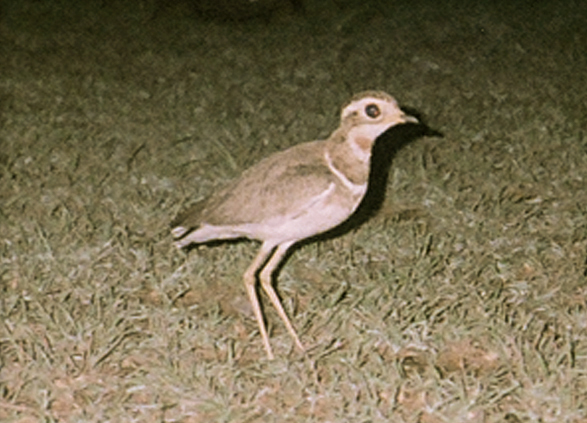
Jerdon's Courser (Rhinoptilus bitorquatus) is a bird in the family Glareolidae, order Charadriiformes and class Aves. The species is principally known from southern Andhra Pradesh and currently occurs in Sri Lankamalleswara Wildlife Sanctuary and Sri Penusila Narasimha Wildlife Sanctuary. It has two brown breast-bands, a broad buff supercilium and an orange-chestnut throat patch. Full profile
Compare something else
Page built on 28 November 2026 from the data on the two species pages, where every source is listed.
Cite this page
ScientificNames.org. (2026). Cream-coloured Courser vs Jerdon's Courser. Retrieved November 28, 2026, from https://scientificnames.org/compare/cream-coloured-courser-vs-jerdons-courser
“Cream-coloured Courser vs Jerdon's Courser.” ScientificNames.org, 2026, scientificnames.org/compare/cream-coloured-courser-vs-jerdons-courser. Accessed 28 Nov. 2026.
ScientificNames.org. “Cream-coloured Courser vs Jerdon's Courser.” Accessed November 28, 2026. https://scientificnames.org/compare/cream-coloured-courser-vs-jerdons-courser.
@misc{scientificnames_cream_coloured_courser_vs_jerdons_courser,
  author = {{ScientificNames.org}},
  title = {Cream-coloured Courser vs Jerdon's Courser},
  year = {2026},
  url = {https://scientificnames.org/compare/cream-coloured-courser-vs-jerdons-courser},
  note = {Accessed 2026-11-28}
}