Comparison

Rusty Tinamou vs Undulated Tinamou

Rusty Tinamou (Crypturellus brevirostris) and Undulated Tinamou (Crypturellus undulatus) both belong to the genus Crypturellus (crypturellus tinamous) and part ways below it. Both are recorded in 4 countries.

Rusty Tinamou

Crypturellus brevirostris
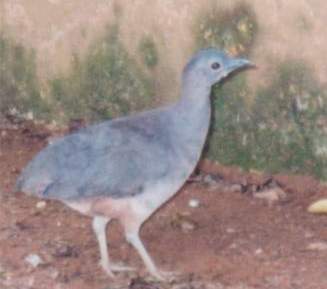
Undulated Tinamou

Undulated Tinamou

Crypturellus undulatus

Unknown author, CC BY-SA 3.0, via Wikimedia Commons

Side by side

Rusty TinamouUndulated Tinamou
Scientific nameCrypturellus brevirostris (Pelzeln, 1863)Crypturellus undulatus (Temminck, 1815)
English nameRusty TinamouUndulated Tinamou
GroupBirdsBirds
ClassAves BirdAves Bird
OrderTinamiformes TinamouTinamiformes Tinamou
FamilyTinamidae TinamouTinamidae Tinamou
GenusCrypturellus Crypturellus TinamousCrypturellus Crypturellus Tinamous
Named in18631815
Red List categoryLeast ConcernLeast Concern
EnvironmentNot recordedterrestrial
Countries on record5 countries10 countries
GBIF occurrence records190 records60,105 records

Rows where the two agree are shown in grey.

Where each is found

Both recorded in 4 countries

Only Rusty Tinamou (1)

Only Undulated Tinamou (6)

From Catalogue of Life checklists and GBIF occurrence records. A country missing from a list means no record is held, which is not proof of absence.

Checked facts

Rusty TinamouUndulated Tinamou
Appearance
  • The species has rufous upperparts marked with bold black bars, a white throat, a bright rufous breast, a white belly, and black-barred flanks. English Wikipedia
  • The species has a chestnut-colored crown and yellowish-grey legs. English Wikipedia
  • The species has barred cinnamon and black upperparts, rusty underparts, and a pale belly. ebird.org
  • The species has brownish-grey plumage with varying degrees of dark barring or vermiculated markings on its back and neck. English Wikipedia
  • Its throat is whitish. English Wikipedia
  • Its lower underparts range from olive-grey to buff, with dark vermiculations on the lower flanks and vent. English Wikipedia
  • Its bill is black on the upper portion and grey on the lower portion. English Wikipedia
  • Its legs and feet are grey, dull yellow, or greenish. English Wikipedia
  • The species has a dark grey body and a white throat, with variable barring above and below. ebird.org
Size
Habitat
  • The species primarily inhabits terra firme and seasonally flooded forests. English Wikipedia
  • The species has also been recorded in forests growing on saprolite soils. English Wikipedia
  • The species has also been recorded in white-sand forests and forests around inselbergs. English Wikipedia
  • The species is found mostly in seasonally flooded forests, with additional records from upland forests. ebird.org
  • The species has not been observed above 500 m elevation. English Wikipedia
  • The species inhabits wooded environments ranging from dense, humid Amazonian forests to dry, relatively open savanna-woodland. English Wikipedia
  • The species occurs at elevations up to 1,400 m. English Wikipedia
  • A significant portion of the species' range occurs in the Cerrado. English Wikipedia
DietNo checked fact yet
Behaviour
  • The species is diurnal. English Wikipedia
  • The species is elusive throughout its geographical range. English Wikipedia
  • The species is primarily distinguished by its vocalizations rather than its appearance. English Wikipedia
  • Its primary song begins with a whistled note followed by faster whistles that increase in pitch. English Wikipedia
  • The primary song can reach approximately 2.5 notes per second. English Wikipedia
  • Its secondary song consists of short, irregular whistles. English Wikipedia
  • The species has been observed responding to calls of the variegated tinamou with its primary song. English Wikipedia
  • The species is secretive and is heard more frequently than it is seen. English Wikipedia
  • Its song is a deep whistle consisting of three or four notes and is commonly given throughout the day. English Wikipedia
  • The species is generally resident, although local seasonal movements between habitats occur. English Wikipedia
Reproduction
  • The average breeding age of the species is approximately two years. English Wikipedia
  • Male tinamous in the Crypturellus genus construct ground nests by scraping small depressions into the soil. English Wikipedia
  • Males attract females to their nests through calling. English Wikipedia
  • Eggs laid in a nest may originate from multiple females. English Wikipedia
  • The male incubates and protects the eggs until the young hatch and become independent, usually within two to three weeks. English Wikipedia
Distribution
  • The species occurs discontinuously in northwestern and northeastern Brazil, far eastern Colombia, Guyana, Suriname, French Guiana, and eastern Peru. English Wikipedia
  • The populations across its documented range are resident populations. English Wikipedia
  • The species occurs in eastern and northern South America. English Wikipedia
  • The subspecies Crypturellus undulatus manapiare is known with certainty from the vicinity of the Ventuari River in northern Amazonas State, Venezuela. English Wikipedia
  • The subspecies Crypturellus undulatus simplex occurs in southern Guyana, French Guiana, and northeastern Brazil. English Wikipedia
  • The subspecies Crypturellus undulatus adspersus occurs in Brazil south of the Amazon, between the Tapajós and Madeira rivers. English Wikipedia
  • The subspecies Crypturellus undulatus yapura occurs in southeastern Colombia, eastern Ecuador, northeastern and east-central Peru, and western Brazil. English Wikipedia
  • The subspecies Crypturellus undulatus vermiculatus occurs in eastern Brazil, including Maranhão, Tocantins, and Mato Grosso. English Wikipedia
  • The subspecies Crypturellus undulatus undulatus occurs in southeastern Peru, eastern and northern Bolivia, the Brazilian Pantanal, Paraguay, and northern Argentina. English Wikipedia
Conservation
  • The species is currently considered to have a decreasing population trend. English Wikipedia
  • The species' population is estimated to have declined by 7% over a ten-year period. English Wikipedia
  • The species has lost an estimated 5.4–6.1% of its suitable habitat over three generations. English Wikipedia
  • The number of mature individuals in the species' population is unknown. datazone.birdlife.org
  • The population trend is classified as decreasing. datazone.birdlife.org
  • The species remains common across most of its range despite heavy hunting in some regions. English Wikipedia
  • The IUCN classifies the species as Least Concern. English Wikipedia
  • The species has an estimated range of occurrence of 10,600,000 km². English Wikipedia
Uses
  • The species has not been recorded in large-scale bird trade. English Wikipedia
  • The species has become more susceptible to hunting and trapping as deforestation disrupts its camouflage. English Wikipedia
OtherNo checked fact yet

In brief

Rusty Tinamou

The Rusty Tinamou (Crypturellus brevirostris) is a monotypic bird in the family Tinamidae, order Tinamiformes, and class Aves. It occurs discontinuously in northwestern and northeastern Brazil, far eastern Colombia, Guyana, Suriname, French Guiana, and eastern Peru. It is primarily distinguished by its vocalizations, including a primary song of whistles that increase in pitch. Full profile

Undulated Tinamou

Crypturellus undulatus inhabits wooded environments ranging from dense, humid Amazonian forests to dry, relatively open savanna-woodland in eastern and northern South America. It has brownish-grey plumage with variable dark barring or vermiculated markings and a whitish throat. Full profile

Compare something else

Page built on 27 November 2026 from the data on the two species pages, where every source is listed.

Cite this page

ScientificNames.org. (2026). Rusty Tinamou vs Undulated Tinamou. Retrieved November 27, 2026, from https://scientificnames.org/compare/rusty-tinamou-vs-undulated-tinamou