Comparison
Crystal Goby vs Blueband Goby
Crystal Goby (Crystallogobius linearis) and Blueband Goby (Valenciennea strigata) both belong to the subfamily Gobiinae and part ways below it.
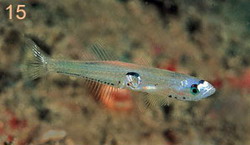


Side by side
| Crystal Goby | Blueband Goby | |
|---|---|---|
| Scientific name | Crystallogobius linearis (Düben, 1845) | Valenciennea strigata (Broussonet, 1782) |
| English name | Crystal Goby | Blueband Goby |
| Group | Fishes | Fishes |
| Class | Teleostei Teleost | Teleostei Teleost |
| Order | Gobiiformes | Gobiiformes |
| Family | Gobiidae True Gobies | Gobiidae True Gobies |
| Genus | Crystallogobius Crystal Gobies | Valenciennea Sleeper Gobies |
| Named in | 1845 | 1782 |
| Red List category | Least Concern | Least Concern |
| Environment | marine | marine |
| Countries on record | 12 countries | 33 countries |
| GBIF occurrence records | 4,291 records | 3,217 records |
Rows where the two agree are shown in grey.
Where each is found
Only Crystal Goby (12)
Only Blueband Goby (33)
- American Samoa
- Australia
- China
- Christmas Island
- Cocos Islands
- Cook Islands
- Fiji
- French Polynesia
- Guam
- India
- Indonesia
- Iran
- Japan
- Kiribati
- Malaysia
- Marshall Islands
- Micronesia
- New Caledonia
- Norfolk Island
- Northern Mariana Islands
- Palau
- Papua New Guinea
- Philippines
- Solomon Islands
- Sri Lanka
- Taiwan
- Thailand
- Timor Leste
- Tonga
- United States Minor Outlying Islands
- Vanuatu
- Vietnam
- Wallis and Futuna
From Catalogue of Life checklists and GBIF occurrence records. A country missing from a list means no record is held, which is not proof of absence.
Checked facts
| Crystal Goby | Blueband Goby | |
|---|---|---|
| Appearance |
|
|
| Size |
|
|
| Habitat |
|
|
| Behaviour | No checked fact yet |
|
| Reproduction |
|
|
| Lifespan |
| No checked fact yet |
| Conservation |
| No checked fact yet |
| Uses |
|
|
| Similar species |
| No checked fact yet |
| Name origin |
| No checked fact yet |
| Other | No checked fact yet |
|
In brief
Crystal Goby
Crystal Goby (Crystallogobius linearis) is the only known member of its genus. Crystal Gobies inhabit Atlantic European coastal waters and the Mediterranean Sea. The Crystal Goby has a transparent, glass-like body and lacks scales. Full profile
Blueband Goby
The blueband goby is a fish in the family Gobiidae and the type species of the genus Valenciennea. It inhabits outer lagoons and the seaward sides of reefs, occurring over sand, rubble and hard substrates at depths of 1–25 metres, usually shallower than 6 metres. It primarily occupies burrows beneath rubble, which it uses for nesting and protection from predators. Full profile
Compare something else
Page built on 27 November 2026 from the data on the two species pages, where every source is listed.
Cite this page
ScientificNames.org. (2026). Crystal Goby vs Blueband Goby. Retrieved November 27, 2026, from https://scientificnames.org/compare/crystal-goby-vs-blueband-goby
“Crystal Goby vs Blueband Goby.” ScientificNames.org, 2026, scientificnames.org/compare/crystal-goby-vs-blueband-goby. Accessed 27 Nov. 2026.
ScientificNames.org. “Crystal Goby vs Blueband Goby.” Accessed November 27, 2026. https://scientificnames.org/compare/crystal-goby-vs-blueband-goby.
@misc{scientificnames_crystal_goby_vs_blueband_goby,
  author = {{ScientificNames.org}},
  title = {Crystal Goby vs Blueband Goby},
  year = {2026},
  url = {https://scientificnames.org/compare/crystal-goby-vs-blueband-goby},
  note = {Accessed 2026-11-27}
}