Comparison

Indian Courser vs Jerdon's Courser

Indian Courser (Cursorius coromandelicus) and Jerdon's Courser (Rhinoptilus bitorquatus) both belong to the family Glareolidae (coursers) and part ways below it. Both are recorded in 1 country.

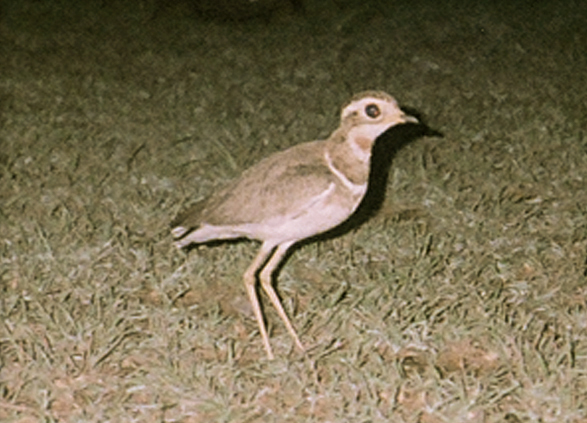
Indian Courser

Indian Courser

Cursorius coromandelicus

Tisha Mukherjee, CC BY-SA 4.0, via Wikimedia Commons

Jerdon's Courser

Jerdon's Courser

Rhinoptilus bitorquatus

PJeganathan, CC BY-SA 3.0, via Wikimedia Commons

Side by side

Indian CourserJerdon's Courser
Scientific nameCursorius coromandelicus (J. F. Gmelin, 1789)Rhinoptilus bitorquatus (Blyth, 1848)
English nameIndian CourserJerdon's Courser
GroupBirdsBirds
ClassAves BirdAves Bird
OrderCharadriiformes AuksCharadriiformes Auks
FamilyGlareolidae CoursersGlareolidae Coursers
GenusCursorius CoursersRhinoptilus Short-billed Coursers
Named in17891848
Red List categoryNear ThreatenedCritically Endangered
Countries on record4 countries1 country
GBIF occurrence records8,258 records31 records

Rows where the two agree are shown in grey.

Where each is found

Both recorded in 1 country

Only Indian Courser (3)

From Catalogue of Life checklists and GBIF occurrence records. A country missing from a list means no record is held, which is not proof of absence.

Checked facts

Indian CourserJerdon's Courser
Appearance
Size
  • The Indian Courser is described as a large plover-like bird. ebird.org
Habitat
  • The species inhabits dry, stony, scrub-covered or rocky terrain and rarely occurs on sandy ground. English Wikipedia
  • The Indian Courser avoids wet forest habitats. English Wikipedia
  • The species commonly occupies open and fallow land covered with short grass in parts of Gujarat. English Wikipedia
  • Indian Coursers generally occur where grass does not exceed their own height. English Wikipedia
  • The species inhabits sparse scrub forest containing patches of bare ground. English Wikipedia
  • The species is associated with scrubland in which tall bushes occur at densities of 300 to 700 per hectare. English Wikipedia
  • The species is known to inhabit open, dry thorny scrubland. ebird.org
Diet
Behaviour
Reproduction
  • The Indian Courser breeds mainly between March and August. English Wikipedia
  • Indian Coursers nest in shallow scrapes on bare, stony ground. English Wikipedia
  • A typical clutch contains two or three speckled eggs. English Wikipedia
  • The eggs are very spherical and well camouflaged. English Wikipedia
  • Newly hatched chicks can move independently but initially receive food from their parents. English Wikipedia
  • Young Indian Coursers begin foraging independently approximately one week after hatching. English Wikipedia
  • When alarmed, Indian Courser chicks crouch and remain motionless, making them difficult to detect. English Wikipedia
  • Adult Indian Coursers do not call or display when people approach their nests or chicks. English Wikipedia
  • The only known egg of the species is preserved at the Zoology Museum of the University of Aberdeen. English Wikipedia
  • The known egg was collected in 1917 by Ernest Gilbert Meaton, a veterinarian working at Kolar Gold Fields. English Wikipedia
Distribution
  • The Indian Courser occurs in mainland South Asia, particularly in the plains between the Ganges and Indus river systems. English Wikipedia
  • The species is principally known from southern Andhra Pradesh. English Wikipedia
  • The species is currently known from Sri Lankamalleswara Wildlife Sanctuary and Sri Penusila Narasimha Wildlife Sanctuary. English Wikipedia
Conservation
  • Construction and agricultural activities threaten the dry, open habitats occupied by the Indian Courser. English Wikipedia
  • The Indian Courser has disappeared from many areas of Gujarat where it was formerly common. English Wikipedia
  • Vehicular activity and industrialization have destroyed some habitats previously occupied by the species. English Wikipedia
  • The species is classified as Critically Endangered. birdlife.org
  • The species remains critically endangered because of habitat loss. English Wikipedia
  • Estimates of the species' population range from 50 to 249 individuals. English Wikipedia
  • The species has an extremely restricted known geographical range. English Wikipedia
  • Agricultural expansion has contributed to the decline of the species' preferred scrub habitat. English Wikipedia
  • Extensive quarrying threatens the species' habitat. English Wikipedia
  • Livestock pressure and firewood extraction increased following human population growth in the region. English Wikipedia
  • The Telugu Ganga water-supply project threatened the species' only known location in December 2005. English Wikipedia
  • The species' habitat has been surveyed using camera traps and fine-sand strips to estimate population density from footprints. English Wikipedia
Similar species
  • The Indian Courser resembles the cream-coloured courser but has brighter coloration and a broader black eye-stripe. English Wikipedia
  • The Indian Courser is closely related to Cursorius cursor, Cursorius rufus and Cursorius temminckii. English Wikipedia
No checked fact yet
Other
  • The Indian Courser is classified as a monotypic species with no recognized subspecies. English Wikipedia
  • Johann Friedrich Gmelin formally described the Indian Courser in 1789. English Wikipedia
  • The species is currently classified in the genus Cursorius. English Wikipedia
No checked fact yet

In brief

Indian Courser

The Indian Courser (Cursorius coromandelicus) is a bird in the family Glareolidae, order Charadriiformes and class Aves. It inhabits dry, stony, scrub-covered or rocky terrain across mainland South Asia, particularly in the plains between the Ganges and Indus river systems. It is distinguished by a chestnut crown, rufous breast and broad black eye-stripe extending from the base of its beak. Full profile

Jerdon's Courser

Jerdon's Courser (Rhinoptilus bitorquatus) is a bird in the family Glareolidae, order Charadriiformes and class Aves. The species is principally known from southern Andhra Pradesh and currently occurs in Sri Lankamalleswara Wildlife Sanctuary and Sri Penusila Narasimha Wildlife Sanctuary. It has two brown breast-bands, a broad buff supercilium and an orange-chestnut throat patch. Full profile

Compare something else

Page built on 26 November 2026 from the data on the two species pages, where every source is listed.

Cite this page

ScientificNames.org. (2026). Indian Courser vs Jerdon's Courser. Retrieved November 26, 2026, from https://scientificnames.org/compare/indian-courser-vs-jerdons-courser