Comparison

Celestial Pearl Danio vs Glowlight Danio

Celestial Pearl Danio (Danio margaritatus) and Glowlight Danio (Danio choprae) both belong to the genus Danio (danios) and part ways below it. Both are recorded in 2 countries.
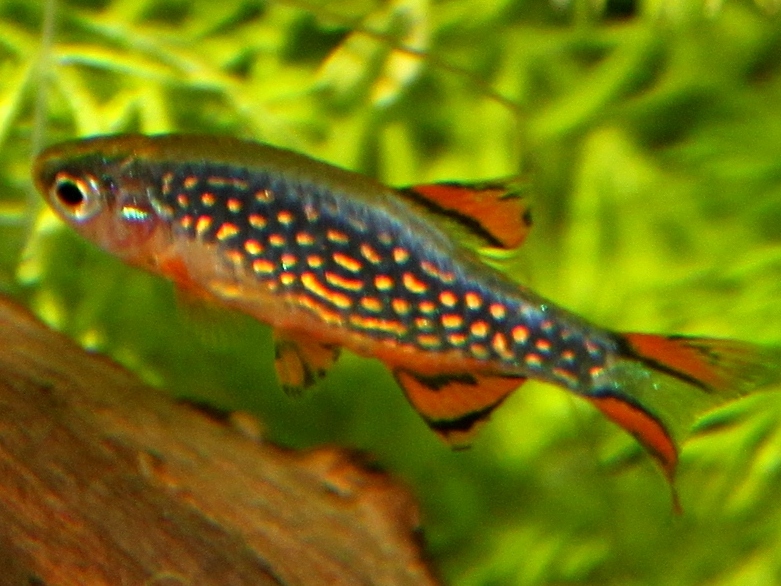
Celestial Pearl Danio

Celestial Pearl Danio

Danio margaritatus

Cisamarc, CC BY-SA 3.0, via Wikimedia Commons

Glowlight Danio

Glowlight Danio

Danio choprae

Lerdsuwa, CC BY-SA 3.0, via Wikimedia Commons

Side by side

Celestial Pearl DanioGlowlight Danio
Scientific nameDanio margaritatus (Roberts, 2007)Danio choprae Hora, 1928
English nameCelestial Pearl DanioGlowlight Danio
GroupFishesFishes
ClassTeleostei TeleostTeleostei Teleost
OrderCypriniformesCypriniformes
FamilyCyprinidae CarpsCyprinidae Carps
GenusDanio DaniosDanio Danios
Named in20071928
Red List categoryData DeficientLeast Concern
Environmentfreshwaterfreshwater
Countries on record2 countries2 countries
GBIF occurrence records32 records21 records

Rows where the two agree are shown in grey.

Where each is found

Both recorded in 2 countries

From Catalogue of Life checklists and GBIF occurrence records. A country missing from a list means no record is held, which is not proof of absence.

Checked facts

Celestial Pearl DanioGlowlight Danio
Appearance
  • The species has a plump body and a distinctly blunt snout. English Wikipedia
  • Its body is covered with small pearly spots. English Wikipedia
  • Males have a bright-blue background coloration, whereas females have a dull blue-green background. English Wikipedia
  • The back is bronzy green, and females have a yellowish-white belly. English Wikipedia
  • The species has transparent gill covers through which its blood-red gills are visible. English Wikipedia
  • Males have more brightly colored fins than females. English Wikipedia
  • Males have a higher caudal peduncle than females. English Wikipedia
  • Most fins have two parallel black lines separated by a bright-red area. English Wikipedia
  • Courting males develop red bellies and more strongly contrasting pearly spots on their flanks. English Wikipedia
  • Reproductive-age females can be identified by a black anal spot. English Wikipedia
  • Males possess a small black pad along the edges of the lower jaw that is absent or reduced in females. English Wikipedia
  • Immature individuals initially show a striped pattern that eventually develops into pearly spots. English Wikipedia
  • The species has a streamlined body with an orange longitudinal band, vertical blue-black flank bars, and yellow-edged fins. English Wikipedia
Size
Habitat
  • The species inhabits small ponds formed by groundwater seepage or overflow from small brooks and springs. English Wikipedia
  • Its natural habitat is heavily vegetated with Hydrocharitaceae plants resembling Elodea. English Wikipedia
  • Water temperatures in its habitat are approximately 22–24 °C during January. English Wikipedia
  • The species' natural habitat has slightly alkaline water. English Wikipedia
  • The species inhabits shallow ponds that heat up rapidly during hot periods. English Wikipedia
  • The species is considered probably tolerant of water temperatures exceeding 26 °C. English Wikipedia
Diet
  • Newly free-swimming larvae begin feeding independently after becoming lighter in color. English Wikipedia
  • Protists provide an initial food source for the fry in densely planted spawning environments. English Wikipedia
  • The species eats insects that fall into the water, aquatic insect larvae, and other small animals. English Wikipedia
  • In aquariums, the species accepts most foods offered, including most dry foods. English Wikipedia
Behaviour
  • Males prominently display their unpaired fins to other members of the species. English Wikipedia
  • The species is relatively stationary and often hovers in preferred locations. English Wikipedia
  • Males and females tend to remain separated while resting. English Wikipedia
  • The species is not a true shoaling fish. English Wikipedia
  • The species is generally peaceful, although individuals sometimes nip other fish's fins. English Wikipedia
  • Courting males seek out and attempt to defend patches of dense vegetation. English Wikipedia
  • The species generally gets along with other Danio species except the giant danio. English Wikipedia
Reproduction
  • The species does not have a dedicated spawning season. English Wikipedia
  • Females produce batches of approximately 30 eggs per spawning episode. English Wikipedia
  • Eggs are apparently deposited as loose batches hidden within vegetation. English Wikipedia
  • At water temperatures of 24–25 °C, the larvae hatch approximately 3–4 days after the eggs are laid. English Wikipedia
  • Newly hatched larvae remain hidden between substrate and detritus for approximately three days. English Wikipedia
  • Individuals undergo metamorphosis into adult form approximately 8–10 weeks after hatching. English Wikipedia
  • The adult color pattern begins appearing from approximately the twelfth week after hatching. English Wikipedia
  • The species has a moderate to hard breeding difficulty in captivity. English Wikipedia
Distribution
  • The species is reported from Myanmar and northern Thailand in the Salween basin. English Wikipedia
  • Its documented distribution includes a small area near Hopong, east of Inle Lake, at elevations exceeding 1,000 m. English Wikipedia
  • The species occurs in the Nam Lang and Nam Pawn Rivers within the Salween basin. English Wikipedia
  • Myanmar officials documented populations at no fewer than five locations around Hopong. English Wikipedia
  • A geographical variant of the species is reported from the Putao area of northern Myanmar. English Wikipedia
Conservation
  • Myanmar prohibited exports of the species in February 2007. English Wikipedia
  • The species is commercially captive-bred worldwide and also bred by aquarium hobbyists. English Wikipedia
Uses
  • The species is locally harvested and dried for use as a food protein source. English Wikipedia
  • The species is traded as an aquarium fish but has no other commercial importance. English Wikipedia
Similar species
  • Danio erythromicron is identified as one of the species' closest relatives. English Wikipedia
  • Danio choprae is identified as one of the species' closest relatives. English Wikipedia
No checked fact yet

In brief

Celestial Pearl Danio

Danio margaritatus inhabits small ponds in Myanmar and northern Thailand within the Salween basin. It has a plump body covered with small pearly spots, with distinct coloration differences between males and females. Full profile

Glowlight Danio

The species spends most of its time in mid-water levels. It has an orange longitudinal band, vertical blue-black flank bars, and yellow-edged fins. Full profile

Compare something else

Page built on 28 November 2026 from the data on the two species pages, where every source is listed.

Cite this page

ScientificNames.org. (2026). Celestial Pearl Danio vs Glowlight Danio. Retrieved November 28, 2026, from https://scientificnames.org/compare/celestial-pearl-danio-vs-glowlight-danio