| Appearance | - The zebrafish has five uniform, pigmented, horizontal blue stripes along each side of its body that extend to the end of the caudal fin. English Wikipedia
- The zebrafish has a fusiform, laterally compressed body and an upward-directed mouth. English Wikipedia
- Male zebrafish have gold stripes between their blue stripes, whereas females have silver stripes and a larger whitish belly. English Wikipedia
- Adult female zebrafish have a small genital papilla located in front of the anal fin origin. English Wikipedia
- Zebrafish have centrally located eyes, thin elongated mandibles, and a protrusive lower jaw. animaldiversity.org
- Zebrafish have an incomplete lateral line, two pairs of barbels, and usually five to seven longitudinal body stripes. animaldiversity.org
- Male zebrafish generally have more yellow coloration and larger anal fins than females. animaldiversity.org
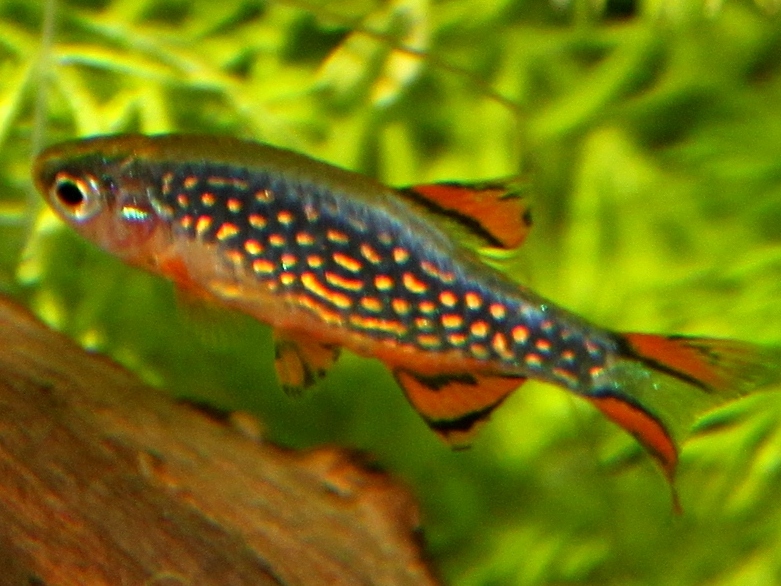
| - The species has a plump body and a distinctly blunt snout. English Wikipedia
- Its body is covered with small pearly spots. English Wikipedia
- Males have a bright-blue background coloration, whereas females have a dull blue-green background. English Wikipedia
- The back is bronzy green, and females have a yellowish-white belly. English Wikipedia
- The species has transparent gill covers through which its blood-red gills are visible. English Wikipedia
- Males have more brightly colored fins than females. English Wikipedia
- Males have a higher caudal peduncle than females. English Wikipedia
- Most fins have two parallel black lines separated by a bright-red area. English Wikipedia
- Courting males develop red bellies and more strongly contrasting pearly spots on their flanks. English Wikipedia
- Reproductive-age females can be identified by a black anal spot. English Wikipedia
- Males possess a small black pad along the edges of the lower jaw that is absent or reduced in females. English Wikipedia
- Immature individuals initially show a striped pattern that eventually develops into pearly spots. English Wikipedia
|
|---|
| Size | No checked fact yet | |
|---|
| Habitat | - Zebrafish inhabit moderately flowing to stagnant, clear, shallow freshwater environments. English Wikipedia
- Zebrafish occur in streams, canals, ditches, oxbow lakes, ponds, and rice paddies. English Wikipedia
- Zebrafish habitats commonly contain submerged or overhanging vegetation and sandy, muddy, or silty bottoms. English Wikipedia
- Zebrafish are commonly found in shallow, slow-moving water near stream edges and in ditches. animaldiversity.org
| - The species inhabits small ponds formed by groundwater seepage or overflow from small brooks and springs. English Wikipedia
- Its natural habitat is heavily vegetated with Hydrocharitaceae plants resembling Elodea. English Wikipedia
- Water temperatures in its habitat are approximately 22–24 °C during January. English Wikipedia
- The species' natural habitat has slightly alkaline water. English Wikipedia
- The species inhabits shallow ponds that heat up rapidly during hot periods. English Wikipedia
- The species is considered probably tolerant of water temperatures exceeding 26 °C. English Wikipedia
|
|---|
| Diet | - Zebrafish are omnivores that feed opportunistically on zooplankton, insects, and phytoplankton. pmc.ncbi.nlm.nih.gov
- Zebrafish obtain most of their food from the water column, particularly zooplankton and aquatic insects. animaldiversity.org
- Zebrafish also feed at the water surface on terrestrial insects and arachnids. animaldiversity.org
- Mosquito larvae are a commonly consumed food item of zebrafish. animaldiversity.org
- Zebrafish are stomachless and toothless and use gill rakers to break up food. animaldiversity.org
- Zebrafish are obligate suction feeders. animaldiversity.org
| - Newly free-swimming larvae begin feeding independently after becoming lighter in color. English Wikipedia
- Protists provide an initial food source for the fry in densely planted spawning environments. English Wikipedia
|
|---|
| Behaviour | - Zebrafish are active, social, and diurnal fish. animaldiversity.org
- Zebrafish naturally form shoals and establish social hierarchies involving both sexes. animaldiversity.org
- Dominance among zebrafish is established through aggressive behaviours such as biting and chasing. animaldiversity.org
- Dominant zebrafish establish mating territories near spawning sites and monopolize food resources. animaldiversity.org
| - Males prominently display their unpaired fins to other members of the species. English Wikipedia
- The species is relatively stationary and often hovers in preferred locations. English Wikipedia
- Males and females tend to remain separated while resting. English Wikipedia
- The species is not a true shoaling fish. English Wikipedia
- The species is generally peaceful, although individuals sometimes nip other fish's fins. English Wikipedia
- Courting males seek out and attempt to defend patches of dense vegetation. English Wikipedia
|
|---|
| Reproduction | - Zebrafish generally reproduce seasonally during the monsoon period from April to August. animaldiversity.org
- Zebrafish spawning typically begins at first light during the breeding season and continues for approximately one hour. animaldiversity.org
- During courtship, approximately three to seven male zebrafish pursue females and guide them toward spawning sites. animaldiversity.org
- Wild zebrafish generally spawn in well-vegetated pools with silty bottoms. animaldiversity.org
- Female zebrafish release approximately five to twenty eggs at a time during spawning. animaldiversity.org
- Zebrafish lay non-adhesive eggs without constructing nests and are group spawners that scatter their eggs. animaldiversity.org
- Most zebrafish eggs hatch within 48 to 72 hours after fertilization. animaldiversity.org
- Newly hatched zebrafish are approximately 3 mm long and immediately independent. animaldiversity.org
- Female zebrafish can spawn at intervals of two to three days and produce hundreds of eggs per clutch under favourable conditions. English Wikipedia
- Zebrafish embryos develop precursors to all major organs within 36 hours of fertilization. English Wikipedia
- Adult zebrafish provide no parental care to their offspring. animaldiversity.org
| - The species does not have a dedicated spawning season. English Wikipedia
- Females produce batches of approximately 30 eggs per spawning episode. English Wikipedia
- Eggs are apparently deposited as loose batches hidden within vegetation. English Wikipedia
- At water temperatures of 24–25 °C, the larvae hatch approximately 3–4 days after the eggs are laid. English Wikipedia
- Newly hatched larvae remain hidden between substrate and detritus for approximately three days. English Wikipedia
- Individuals undergo metamorphosis into adult form approximately 8–10 weeks after hatching. English Wikipedia
- The adult color pattern begins appearing from approximately the twelfth week after hatching. English Wikipedia
|
|---|
| Distribution | No checked fact yet | - The species is reported from Myanmar and northern Thailand in the Salween basin. English Wikipedia
- Its documented distribution includes a small area near Hopong, east of Inle Lake, at elevations exceeding 1,000 m. English Wikipedia
- The species occurs in the Nam Lang and Nam Pawn Rivers within the Salween basin. English Wikipedia
- Myanmar officials documented populations at no fewer than five locations around Hopong. English Wikipedia
|
|---|
| Conservation | - The introduced zebrafish population in New Mexico had disappeared by 2003. English Wikipedia
| - Myanmar prohibited exports of the species in February 2007. English Wikipedia
- The species is commercially captive-bred worldwide and also bred by aquarium hobbyists. English Wikipedia
|
|---|
| Uses | - Zebrafish are extensively used as vertebrate model organisms in scientific research, particularly developmental biology. English Wikipedia
- Zebrafish are used in research on gene function, oncology, teratology, and drug development. English Wikipedia
- Zebrafish are used as research models for pancreatic development, beta-cell regeneration, and diabetes. English Wikipedia
- Zebrafish are popular aquarium fish that are considered suitable for beginner aquarists. English Wikipedia
- Zebrafish have been used to produce genetically modified fluorescent aquarium fish marketed as GloFish. English Wikipedia
| - The species is locally harvested and dried for use as a food protein source. English Wikipedia
|
|---|
| Similar species | | - Danio erythromicron is identified as one of the species' closest relatives. English Wikipedia
- Danio choprae is identified as one of the species' closest relatives. English Wikipedia
|
|---|