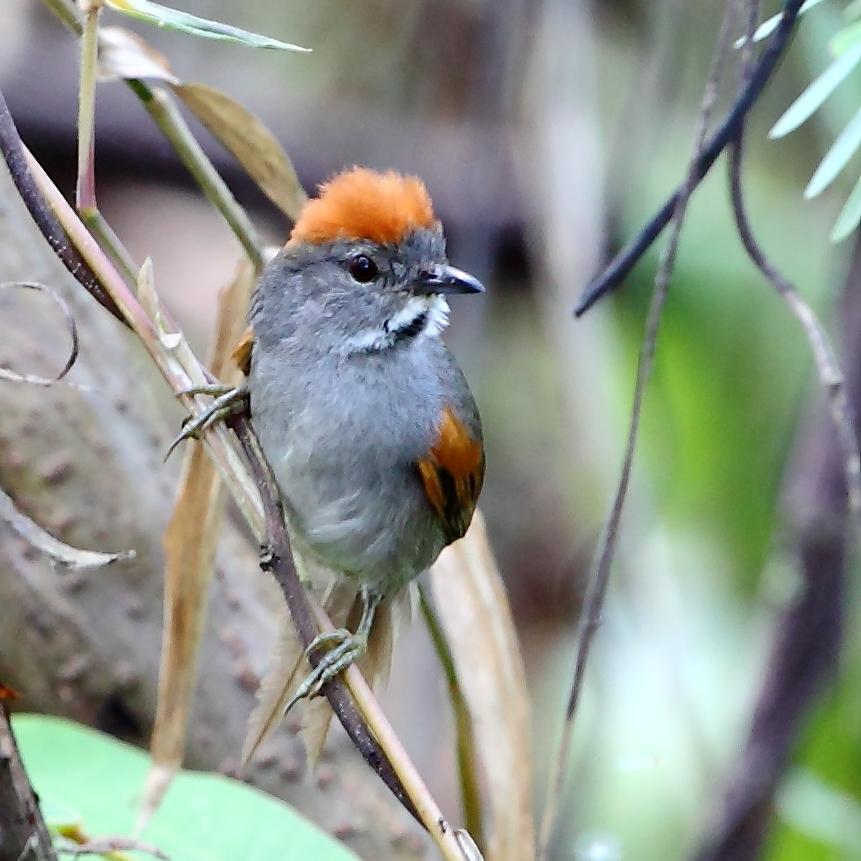
| Appearance | - Males and females have identical plumage. English Wikipedia
- Adults of the nominate subspecies have a brownish-gray face and forecrown. English Wikipedia
- Adults of the nominate subspecies have a dark-rufous hindcrown and nape. English Wikipedia
- The back, rump, and uppertail coverts of the nominate subspecies are olive-brown. English Wikipedia
- The wing coverts are dark rufous with paler edges. English Wikipedia
- The flight feathers are dark brownish. English Wikipedia
- The tail is dull brown, graduated, and composed of feathers with pointed tips. English Wikipedia
- The throat is grayish white with sooty flecks. English Wikipedia
- The lower throat feathers are blackish with pale-gray edges. English Wikipedia
- The breast and sides are brownish gray. English Wikipedia
- The belly is paler gray to nearly white in its center. English Wikipedia
- The flanks and undertail coverts are browner than the belly. English Wikipedia
- The iris ranges from reddish brown to brown or pale brown. English Wikipedia
- The maxilla is black to dark gray. English Wikipedia
- The mandible is grayish to blue-gray. English Wikipedia
- The legs and feet range from greenish gray to greenish yellow. English Wikipedia
- Juveniles have a brownish-gray crown and mostly dark-ochraceous underparts. English Wikipedia
- Juveniles have a throat patch that is paler and less distinct than that of adults. English Wikipedia
- The S. a. rodolphei subspecies has a slightly darker back and substantially darker underparts than the nominate subspecies. English Wikipedia
- The S. a. rodolphei subspecies has a strongly contrasting whitish center of the belly. English Wikipedia
- The northern Peruvian population of the nominate subspecies is darker than most other populations of that subspecies. English Wikipedia
- The species has a gray overall coloration with a chestnut crown and shoulders. ebird.org
- The species has a black throat spot bordered by a white V-shaped marking. ebird.org
| - Males and females have the same plumage coloration. English Wikipedia
- Adults have a brownish-gray face with a narrow brownish line extending through the eye. English Wikipedia
- The adult forecrown is dark gray-brown, while the hindcrown and nape are dark rufous. English Wikipedia
- The adult back, rump, and uppertail coverts are brown with a reddish tinge. English Wikipedia
- The wing coverts are dark rufous, and the flight feathers are tawny-rufous with dusky tips. English Wikipedia
- The tail is dark rufous and graduated, with slightly pointed feather tips. English Wikipedia
- The adult chin is whitish and the throat is grayer, with a blackish crescent and pale speckles on the lower throat feathers. English Wikipedia
- The breast is grayish brown, while the belly is paler than the breast. English Wikipedia
- The flanks and undertail coverts are browner than the breast and belly. English Wikipedia
- The iris coloration varies considerably among individuals. English Wikipedia
- The maxilla ranges from blackish to dark gray. English Wikipedia
- The mandible ranges from gray to pale gray and sometimes has a blackish tip. English Wikipedia
- The legs and feet range from olive-gray to greenish gray. English Wikipedia
- Juveniles have a brownish-gray crown and an ochraceous wash on their underparts. English Wikipedia
- Adult plumage becomes duller toward the southwest of the species' range. English Wikipedia
- The species has a black throat. ebird.org
- The species has a rufous crown, wings, and tail. ebird.org
|
|---|
| Size | | |
|---|
| Habitat | - The species inhabits tall grass, scrub, and Gynerium cane stands on river islands. English Wikipedia
- The species also occupies mainland scrub, shrubby grassy clearings, pastures, and plantations. English Wikipedia
- The species occurs mainly between sea level and 1,500 m elevation. English Wikipedia
- The species has been recorded locally at elevations up to 2,100 m. English Wikipedia
- The species inhabits grassy areas in lowlands and foothills. ebird.org
| - The species inhabits semi-open landscapes, including gallery forests. English Wikipedia
- The species occurs along the edges of scrubby or deciduous forests. English Wikipedia
- The species inhabits woodlands and bushy savannas. English Wikipedia
- Its natural habitats include subtropical or tropical dry environments. inaturalist.org
- The species occurs in open woodlands, forest edges, and savannas. ebird.org
|
|---|
| Diet | | |
|---|
| Behaviour | - The species remains resident throughout its range year-round. English Wikipedia
- The species usually forages in pairs. English Wikipedia
- While foraging, the species gleans prey from foliage and small branches. English Wikipedia
- The species typically forages approximately 1–2 m above the ground but also feeds on the ground. English Wikipedia
- The species' song consists of hurried repeated phrases described as 'chéép, du-du-du' or 'whít, di-di-di'. English Wikipedia
- The species also produces a short chatter and an accelerating whinny. English Wikipedia
| - The species remains in most of its range throughout the year. English Wikipedia
- The southernmost subpopulation may move northward after the breeding season. English Wikipedia
- The species usually forages in pairs. English Wikipedia
- The species apparently collects prey from foliage, small branches, and occasionally the ground. English Wikipedia
- The species generally forages below approximately 2 m above the ground. English Wikipedia
|
|---|
| Reproduction | | - The species breeds during the austral spring and summer. English Wikipedia
- The species is thought to have a monogamous mating system. English Wikipedia
- Its nest consists of a globe of thorny twigs with a lateral entrance tube and an inner chamber lined with soft materials. English Wikipedia
- The nest is generally placed in a thorny bush no more than approximately 2.5 m above the ground. English Wikipedia
- Some nests are positioned as high as approximately 4 m above the ground. English Wikipedia
- The clutch contains three to four eggs. English Wikipedia
- Incubation lasts between 15 and 16 days. English Wikipedia
|
|---|
| Distribution | - The species occurs in Bolivia, Brazil, Colombia, Ecuador, and Peru. English Wikipedia
- The S. a. rodolphei subspecies occurs from Meta Department in south-central Colombia south to Napo Province in northeastern Ecuador. English Wikipedia
- The nominate subspecies occurs from Napo in Ecuador and extreme southern Amazonas Department in southeastern Colombia south through eastern Ecuador and Peru into western Bolivia. English Wikipedia
- The nominate subspecies extends eastward in Brazil along the Amazon River to the Rio Negro. English Wikipedia
| - The species occurs in Argentina, Bolivia, Brazil, Paraguay, and Uruguay. English Wikipedia
|
|---|
| Conservation | | |
|---|
| Similar species | - The species was formerly classified as conspecific with the pale-breasted spinetail (Synallaxis albescens). English Wikipedia
- Some authors consider the dark-breasted and pale-breasted spinetails to be sister species. English Wikipedia
| No checked fact yet |
|---|
| Other | - The species has two recognized subspecies, S. a. albigularis and S. a. rodolphei. English Wikipedia
- A population within the nominate subspecies may represent a third subspecies. English Wikipedia
- The species was most recently assessed for the IUCN Red List in 2024. iucnredlist.org
| No checked fact yet |
|---|