Comparison

Dark-breasted Spinetail vs Spix's Spinetail

Dark-breasted Spinetail (Synallaxis albigularis) and Spix's Spinetail (Synallaxis spixi) both belong to the genus Synallaxis (spinetails) and part ways below it. Both are recorded in 2 countries.
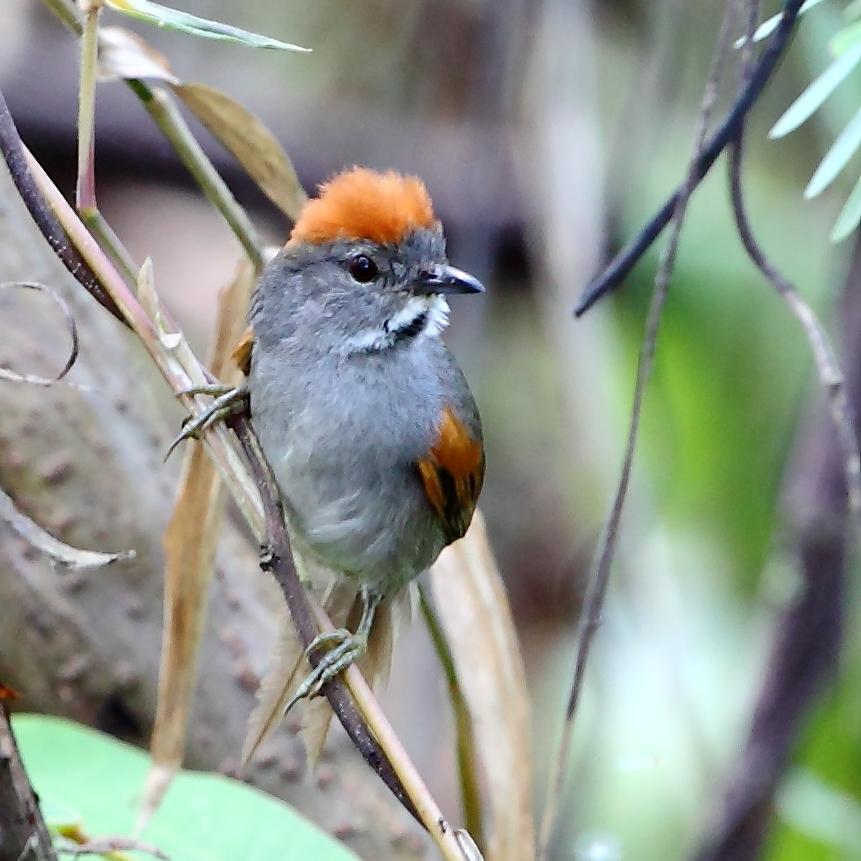
Dark-breasted Spinetail

Dark-breasted Spinetail

Synallaxis albigularis

Hector Bottai, CC BY-SA 4.0, via Wikimedia Commons

Spix's Spinetail

Spix's Spinetail

Synallaxis spixi

Hector Bottai, CC BY-SA 4.0, via Wikimedia Commons

Side by side

Dark-breasted SpinetailSpix's Spinetail
Scientific nameSynallaxis albigularis P. L. Sclater, 1858Synallaxis spixi P. L. Sclater, 1856
English nameDark-breasted SpinetailSpix's Spinetail
GroupBirdsBirds
ClassAves BirdAves Bird
OrderPasseriformes PasserinePasseriformes Passerine
FamilyFurnariidae OvenbirdFurnariidae Ovenbird
GenusSynallaxis SpinetailsSynallaxis Spinetails
Named in18581856
Red List categoryLeast ConcernLeast Concern
Countries on record5 countries5 countries
GBIF occurrence records9,933 records67,981 records

Rows where the two agree are shown in grey.

Where each is found

Both recorded in 2 countries

Only Dark-breasted Spinetail (3)

Only Spix's Spinetail (3)

From Catalogue of Life checklists and GBIF occurrence records. A country missing from a list means no record is held, which is not proof of absence.

Checked facts

Dark-breasted SpinetailSpix's Spinetail
Appearance
  • Males and females have identical plumage. English Wikipedia
  • Adults of the nominate subspecies have a brownish-gray face and forecrown. English Wikipedia
  • Adults of the nominate subspecies have a dark-rufous hindcrown and nape. English Wikipedia
  • The back, rump, and uppertail coverts of the nominate subspecies are olive-brown. English Wikipedia
  • The wing coverts are dark rufous with paler edges. English Wikipedia
  • The flight feathers are dark brownish. English Wikipedia
  • The tail is dull brown, graduated, and composed of feathers with pointed tips. English Wikipedia
  • The throat is grayish white with sooty flecks. English Wikipedia
  • The lower throat feathers are blackish with pale-gray edges. English Wikipedia
  • The breast and sides are brownish gray. English Wikipedia
  • The belly is paler gray to nearly white in its center. English Wikipedia
  • The flanks and undertail coverts are browner than the belly. English Wikipedia
  • The iris ranges from reddish brown to brown or pale brown. English Wikipedia
  • The maxilla is black to dark gray. English Wikipedia
  • The mandible is grayish to blue-gray. English Wikipedia
  • The legs and feet range from greenish gray to greenish yellow. English Wikipedia
  • Juveniles have a brownish-gray crown and mostly dark-ochraceous underparts. English Wikipedia
  • Juveniles have a throat patch that is paler and less distinct than that of adults. English Wikipedia
  • The S. a. rodolphei subspecies has a slightly darker back and substantially darker underparts than the nominate subspecies. English Wikipedia
  • The S. a. rodolphei subspecies has a strongly contrasting whitish center of the belly. English Wikipedia
  • The northern Peruvian population of the nominate subspecies is darker than most other populations of that subspecies. English Wikipedia
  • The species has a gray overall coloration with a chestnut crown and shoulders. ebird.org
  • The species has a black throat spot bordered by a white V-shaped marking. ebird.org
Size
Habitat
  • The species inhabits tall grass, scrub, and Gynerium cane stands on river islands. English Wikipedia
  • The species also occupies mainland scrub, shrubby grassy clearings, pastures, and plantations. English Wikipedia
  • The species occurs mainly between sea level and 1,500 m elevation. English Wikipedia
  • The species has been recorded locally at elevations up to 2,100 m. English Wikipedia
  • The species inhabits grassy areas in lowlands and foothills. ebird.org
Diet
Behaviour
  • The species remains resident throughout its range year-round. English Wikipedia
  • The species usually forages in pairs. English Wikipedia
  • While foraging, the species gleans prey from foliage and small branches. English Wikipedia
  • The species typically forages approximately 1–2 m above the ground but also feeds on the ground. English Wikipedia
  • The species' song consists of hurried repeated phrases described as 'chéép, du-du-du' or 'whít, di-di-di'. English Wikipedia
  • The species also produces a short chatter and an accelerating whinny. English Wikipedia
Reproduction
Distribution
  • The species occurs in Bolivia, Brazil, Colombia, Ecuador, and Peru. English Wikipedia
  • The S. a. rodolphei subspecies occurs from Meta Department in south-central Colombia south to Napo Province in northeastern Ecuador. English Wikipedia
  • The nominate subspecies occurs from Napo in Ecuador and extreme southern Amazonas Department in southeastern Colombia south through eastern Ecuador and Peru into western Bolivia. English Wikipedia
  • The nominate subspecies extends eastward in Brazil along the Amazon River to the Rio Negro. English Wikipedia
  • Spix's Spinetail occurs in Argentina, Brazil, Paraguay, and Uruguay. English Wikipedia
Conservation
Similar species
  • The species was formerly classified as conspecific with the pale-breasted spinetail (Synallaxis albescens). English Wikipedia
  • Some authors consider the dark-breasted and pale-breasted spinetails to be sister species. English Wikipedia
  • The cinereous-breasted spinetail was formerly classified as a subspecies of Spix's Spinetail. English Wikipedia
  • Spix's Spinetail and the cinereous-breasted spinetail are considered sister species. English Wikipedia
Other
  • The species has two recognized subspecies, S. a. albigularis and S. a. rodolphei. English Wikipedia
  • A population within the nominate subspecies may represent a third subspecies. English Wikipedia
  • The species was most recently assessed for the IUCN Red List in 2024. iucnredlist.org
No checked fact yet

In brief

Dark-breasted Spinetail

Synallaxis albigularis occurs in Bolivia, Brazil, Colombia, Ecuador, and Peru. It has gray overall coloration, a chestnut crown and shoulders, and a black throat spot bordered by a white V-shaped marking. Full profile

Spix's Spinetail

Spix's Spinetail is a medium-sized spinetail. It occurs in Argentina, Brazil, Paraguay, and Uruguay. Adults have a rufous crown, dark brown back, and graduated dark brown tail with pointed central feathers. Full profile

Compare something else

Page built on 27 November 2026 from the data on the two species pages, where every source is listed.

Cite this page

ScientificNames.org. (2026). Dark-breasted Spinetail vs Spix's Spinetail. Retrieved November 27, 2026, from https://scientificnames.org/compare/dark-breasted-spinetail-vs-spixs-spinetail