Comparison
Little 17-year Cicada vs 17-year Decim Cicada
Little 17-year Cicada (Magicicada septendecula) and 17-year Decim Cicada (Magicicada septendecim) both belong to the genus Magicicada (periodical cicadas) and part ways below it. Both are recorded in 2 countries.

Little 17-year Cicada
Magicicada septendecula
Fontaine K, Cooley J, Simon C (2007), CC BY 2.5, via Wikimedia Commons
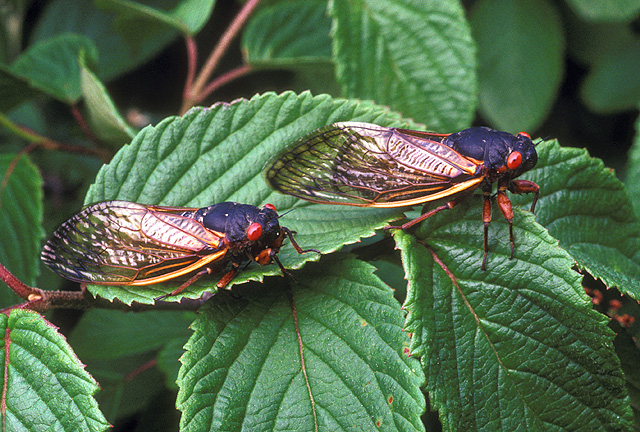


Side by side
| Little 17-year Cicada | 17-year Decim Cicada | |
|---|---|---|
| Scientific name | Magicicada septendecula Alexander & Moore, 1962 | Magicicada septendecim (Linnaeus, 1758) |
| English name | Little 17-year Cicada | 17-year Decim Cicada |
| Group | Insects | Insects |
| Class | Insecta Insect | Insecta Insect |
| Order | Hemiptera | Hemiptera |
| Family | Cicadidae Cicada | Cicadidae Cicada |
| Genus | Magicicada Periodical Cicadas | Magicicada Periodical Cicadas |
| Named in | 1962 | 1758 |
| Red List category | Near Threatened | Near Threatened |
| Countries on record | 2 countries | 3 countries |
| GBIF occurrence records | 928 records | 14,019 records |
Rows where the two agree are shown in grey.
Where each is found
Both recorded in 2 countries
Only 17-year Decim Cicada (1)
From Catalogue of Life checklists and GBIF occurrence records. A country missing from a list means no record is held, which is not proof of absence.
Checked facts
| Little 17-year Cicada | 17-year Decim Cicada | |
|---|---|---|
| Appearance |
|
|
| Habitat |
|
|
| Diet |
|
|
| Behaviour |
|
|
| Reproduction |
|
|
| Lifespan |
|
|
| Distribution |
|
|
| Uses | No checked fact yet |
|
| Other | No checked fact yet |
|
In brief
Little 17-year Cicada
Magicicada septendecula is endemic to the United States. It is smaller than Magicicada septendecim and has narrow orange bands on its abdomen, without an orange spot on the side of its pronotum. Full profile
17-year Decim Cicada
Magicicada septendecim is native to Canada and the United States and occurs primarily in the northern Midwestern and eastern United States. Its nymphs remain underground for seventeen years, and adults emerge in coordinated groups called broods. Full profile
Compare something else
Page built on 27 November 2026 from the data on the two species pages, where every source is listed.
Cite this page
ScientificNames.org. (2026). Little 17-year Cicada vs 17-year Decim Cicada. Retrieved November 27, 2026, from https://scientificnames.org/compare/little-17-year-cicada-vs-17-year-decim-cicada
“Little 17-year Cicada vs 17-year Decim Cicada.” ScientificNames.org, 2026, scientificnames.org/compare/little-17-year-cicada-vs-17-year-decim-cicada. Accessed 27 Nov. 2026.
ScientificNames.org. “Little 17-year Cicada vs 17-year Decim Cicada.” Accessed November 27, 2026. https://scientificnames.org/compare/little-17-year-cicada-vs-17-year-decim-cicada.
@misc{scientificnames_little_17_year_cicada_vs_17_year_decim_cicada,
  author = {{ScientificNames.org}},
  title = {Little 17-year Cicada vs 17-year Decim Cicada},
  year = {2026},
  url = {https://scientificnames.org/compare/little-17-year-cicada-vs-17-year-decim-cicada},
  note = {Accessed 2026-11-27}
}