Comparison
Definitive Leaf-eared Mouse vs Yellow-rumped Leaf-eared Mouse
Definitive Leaf-eared Mouse (Phyllotis definitus) and Yellow-rumped Leaf-eared Mouse (Phyllotis xanthopygus) both belong to the genus Phyllotis (leaf-eared mice) and part ways below it. Both are recorded in 1 country.
Definitive Leaf-eared Mouse
Phyllotis definitus
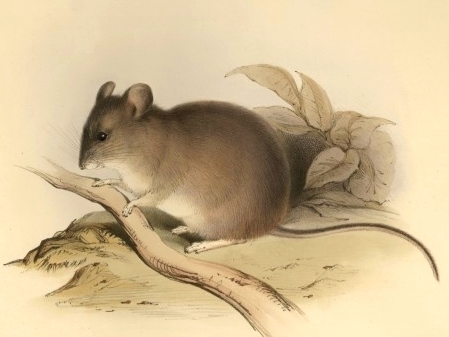
Yellow-rumped Leaf-eared Mouse
Phyllotis xanthopygus
Bell, Thomas; Darwin, Charles; Gould, Elizabeth; Gould, John; Owen, Richard; Waterhouse, G. R., Public domain, via Wikimedia Commons

Side by side
| Definitive Leaf-eared Mouse | Yellow-rumped Leaf-eared Mouse | |
|---|---|---|
| Scientific name | Phyllotis definitus Osgood, 1915 | Phyllotis xanthopygus (Waterhouse, 1837) |
| English name | Definitive Leaf-eared Mouse | Yellow-rumped Leaf-eared Mouse |
| Group | Mammals | Mammals |
| Class | Mammalia Mammal | Mammalia Mammal |
| Order | Rodentia Rodent | Rodentia Rodent |
| Family | Cricetidae New World Mice and Rats | Cricetidae New World Mice and Rats |
| Genus | Phyllotis Leaf-eared Mice | Phyllotis Leaf-eared Mice |
| Named in | 1915 | 1837 |
| Red List category | Endangered | Least Concern |
| Countries on record | 1 country | 5 countries |
| GBIF occurrence records | 27 records | 4,058 records |
Rows where the two agree are shown in grey.
Where each is found
Both recorded in 1 country
Only Yellow-rumped Leaf-eared Mouse (4)
From Catalogue of Life checklists and GBIF occurrence records. A country missing from a list means no record is held, which is not proof of absence.
Checked facts
| Definitive Leaf-eared Mouse | Yellow-rumped Leaf-eared Mouse | |
|---|---|---|
| Appearance | No checked fact yet |
|
| Size | No checked fact yet |
|
| Habitat |
|
|
| Diet | No checked fact yet |
|
| Behaviour | No checked fact yet |
|
| Reproduction | No checked fact yet |
|
| Distribution |
|
|
| Conservation | No checked fact yet |
|
| Other | No checked fact yet |
|
In brief
Definitive Leaf-eared Mouse
Phyllotis definitus occurs exclusively in west-central Peru. It inhabits rocky and shrub-covered areas at elevations between 2,600 and 3,000 metres. Full profile
Yellow-rumped Leaf-eared Mouse
The Yellow-rumped Leaf-eared Mouse is the most widespread member of the genus Phyllotis. It inhabits rocky environments in the Andes of Peru, Argentina, Chile, and Bolivia, across elevations from sea level to 5,000 meters. It has predominantly greyish-brown or sand-colored fur, broad triangular ears, and seasonal variation in coat coloration. Full profile
Compare something else
Page built on 27 November 2026 from the data on the two species pages, where every source is listed.
Cite this page
ScientificNames.org. (2026). Definitive Leaf-eared Mouse vs Yellow-rumped Leaf-eared Mouse. Retrieved November 27, 2026, from https://scientificnames.org/compare/definitive-leaf-eared-mouse-vs-yellow-rumped-leaf-eared-mouse
“Definitive Leaf-eared Mouse vs Yellow-rumped Leaf-eared Mouse.” ScientificNames.org, 2026, scientificnames.org/compare/definitive-leaf-eared-mouse-vs-yellow-rumped-leaf-eared-mouse. Accessed 27 Nov. 2026.
ScientificNames.org. “Definitive Leaf-eared Mouse vs Yellow-rumped Leaf-eared Mouse.” Accessed November 27, 2026. https://scientificnames.org/compare/definitive-leaf-eared-mouse-vs-yellow-rumped-leaf-eared-mouse.
@misc{scientificnames_definitive_leaf_eared_mouse_vs_yellow_rumped_leaf_eared_mouse,
  author = {{ScientificNames.org}},
  title = {Definitive Leaf-eared Mouse vs Yellow-rumped Leaf-eared Mouse},
  year = {2026},
  url = {https://scientificnames.org/compare/definitive-leaf-eared-mouse-vs-yellow-rumped-leaf-eared-mouse},
  note = {Accessed 2026-11-27}
}