Comparison

Cinnamon-throated Woodcreeper vs Thorn-tailed Rayadito

Cinnamon-throated Woodcreeper (Dendrexetastes rufigula) and Thorn-tailed Rayadito (Aphrastura spinicauda) both belong to the family Furnariidae (ovenbird) and part ways below it.
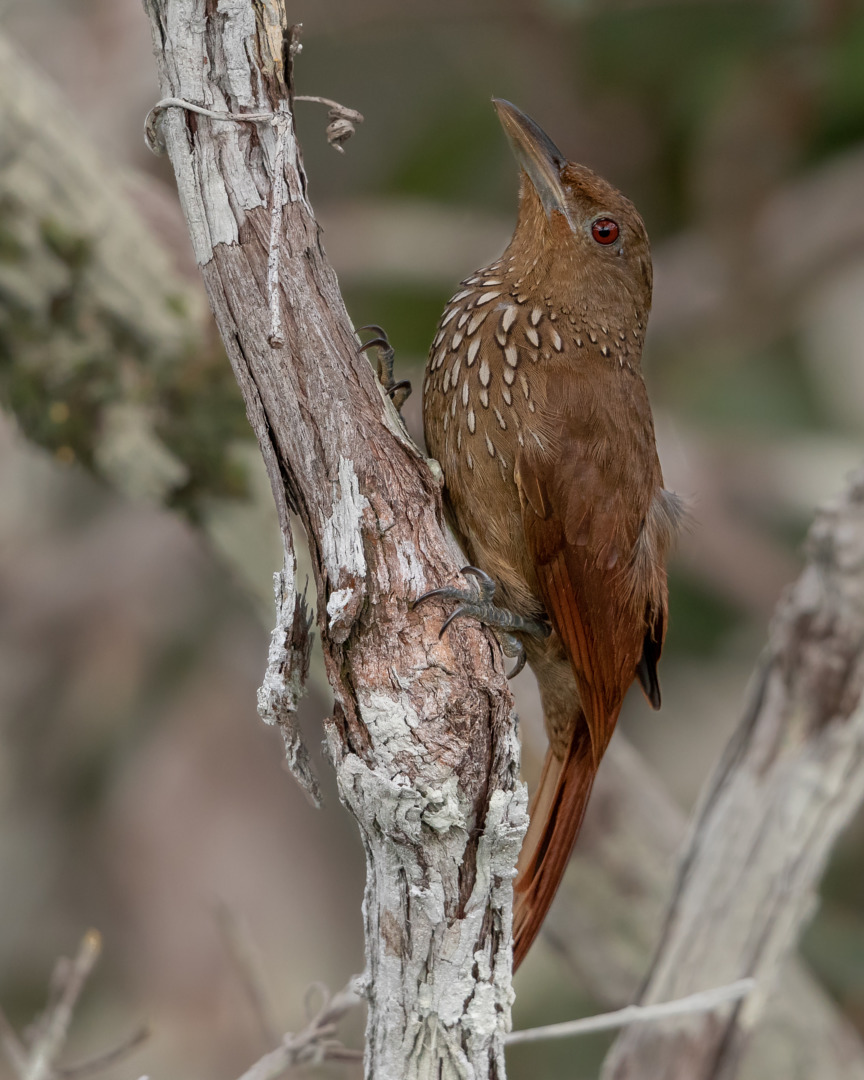
Cinnamon-throated Woodcreeper

Cinnamon-throated Woodcreeper

Dendrexetastes rufigula

Hector Bottai, CC BY-SA 4.0, via Wikimedia Commons

Thorn-tailed Rayadito

Thorn-tailed Rayadito

Aphrastura spinicauda

Arthur Chapman, CC BY 2.0, via Wikimedia Commons

Side by side

Cinnamon-throated WoodcreeperThorn-tailed Rayadito
Scientific nameDendrexetastes rufigula (R. P. Lesson, 1844)Aphrastura spinicauda (J. F. Gmelin, 1789)
English nameCinnamon-throated WoodcreeperThorn-tailed Rayadito
GroupBirdsBirds
ClassAves BirdAves Bird
OrderPasseriformes PasserinePasseriformes Passerine
FamilyFurnariidae OvenbirdFurnariidae Ovenbird
GenusDendrexetastesAphrastura Rayaditos
Named in18441789
Red List categoryLeast ConcernLeast Concern
Countries on record9 countries2 countries
GBIF occurrence records13,167 records68,197 records

Rows where the two agree are shown in grey.

Where each is found

Only Cinnamon-throated Woodcreeper (9)

Only Thorn-tailed Rayadito (2)

From Catalogue of Life checklists and GBIF occurrence records. A country missing from a list means no record is held, which is not proof of absence.

Checked facts

Cinnamon-throated WoodcreeperThorn-tailed Rayadito
Appearance
  • The species has a heavy body, short wings, and a short, stout bill with a slightly hooked tip. English Wikipedia
  • The nominate subspecies has predominantly medium-brown upperparts, a paler crown, and rufous-chestnut wings, rump, and tail. English Wikipedia
  • The nominate subspecies has a bright rusty-buff throat. English Wikipedia
  • The nominate subspecies has broad whitish breast streaks edged in black. English Wikipedia
  • The nominate subspecies has a red to light-brown iris. English Wikipedia
  • The species is reddish brown overall, with olive-brown underparts and fine white breast streaking. ebird.org
  • The nominate subspecies has brown plumage with several black lines on its upperparts and generally white underparts. English Wikipedia
  • The species has a distinctive elongated tail containing twelve spiny rectrices. English Wikipedia
  • Juveniles gradually develop their characteristic spiny tail as they mature. English Wikipedia
  • The Chiloé subspecies has a cinnamon-colored throat rather than a white one. English Wikipedia
  • The Mocha Island subspecies has entirely brown upperparts without black lines and a white throat. English Wikipedia
Size
  • The thorn-tailed rayadito measures approximately 14 centimetres in length, including its tail. English Wikipedia
  • Adult thorn-tailed rayaditos weigh approximately 11 grams on average. English Wikipedia
  • Males weigh approximately 10 percent more than females. English Wikipedia
Habitat
  • The species primarily inhabits humid terra firme and várzea forests. English Wikipedia
  • In the Guianas, the species typically occupies forests on sand ridges and savannas. English Wikipedia
  • The species favors palm forests, evergreen forest edges, and mid- to late-age secondary forests over primary forest interiors. English Wikipedia
  • The species frequently occurs on river islands. English Wikipedia
  • The species generally occurs below 500 m elevation but has occasionally been recorded at 950 m. English Wikipedia
  • The species is associated with the lowlands of the Amazon region. ebird.org
  • The species inhabits temperate forests and subtropical dry shrubland south of 30°S. English Wikipedia
  • Its habitats include tall Nothofagus and Araucaria forests in northern parts of its range. English Wikipedia
  • Its southern habitats include low subantarctic forests. English Wikipedia
  • The species also inhabits relatively dry Austrocedrus forests in the eastern part of its range. English Wikipedia
Diet
  • The species' diet appears to consist mainly of arthropods, with some fruit. English Wikipedia
Behaviour
  • The species remains in its range throughout the year. English Wikipedia
  • The species forages alone or in mixed-species feeding flocks with approximately equal frequency. English Wikipedia
  • The species forages less frequently in pairs than alone or in mixed-species flocks. English Wikipedia
  • While foraging, the species moves along tree trunks and branches between the forest mid-level and canopy. English Wikipedia
  • The species searches living and dead leaf clusters and epiphytes by creeping and probing. English Wikipedia
  • The species sings primarily at dawn and dusk. English Wikipedia
  • The species forms large mixed-species flocks during the non-breeding season from March to September. English Wikipedia
  • Non-breeding individuals typically gather in flocks of four to seven birds. English Wikipedia
  • During the breeding season from October to February, individuals strongly defend territories as pairs. English Wikipedia
  • The species is highly curious and shows little fear of humans in its forest habitat. English Wikipedia
  • Its characteristic thorn-like tail is believed to serve as a courtship attraction rather than an aid to climbing trees. English Wikipedia
  • Thorn-tailed rayaditos are core members of mixed-species winter feeding flocks. ebird.org
Reproduction
LifespanNo checked fact yet
  • The oldest recorded thorn-tailed rayadito was six years and four months old. English Wikipedia
Distribution
  • The species occurs in Bolivia, Brazil, Colombia, Ecuador, French Guiana, Guyana, Peru, Suriname, and Venezuela. English Wikipedia
  • The devillei subspecies occurs in western Amazonia, extending from central Colombia, eastern Ecuador, and eastern Peru into Brazil and northern Bolivia. English Wikipedia
  • The rufigula subspecies occurs in northeastern Amazonia, from eastern Venezuela through the Guianas into northern Brazil. English Wikipedia
  • The moniliger subspecies inhabits Amazonian Brazil south of the Amazon River, between the Madeira and Tocantins rivers, extending south to Mato Grosso. English Wikipedia
  • The paraensis subspecies occurs in Amazonian Brazil south of the Amazon River and east of the Tocantins River. English Wikipedia
  • The species occurs in central Chile and adjacent Argentina, extending south to Tierra del Fuego. English Wikipedia
  • The subspecies Aphrastura spinicauda bullocki occurs on Mocha Island off Chile. English Wikipedia
  • The subspecies Aphrastura spinicauda fulva occurs on Chiloé Island off Chile. English Wikipedia
  • The species remains one of the most common native birds in the temperate forests of southern and southern-central Chile. English Wikipedia
Conservation
  • The IUCN classifies the species as Least Concern. English Wikipedia
  • The species has a very large geographic range. English Wikipedia
  • The species' population is believed to be stable, although its size is unknown. English Wikipedia
  • No immediate threats to the species have been identified. English Wikipedia
  • The species is considered uncommon to common, although its occurrence is often localized. English Wikipedia
  • The species is considered highly sensitive to habitat modification. English Wikipedia
  • The species has disappeared from selectively logged forest at one documented site. English Wikipedia
  • The IUCN Red List classifies Aphrastura spinicauda as Least Concern. iucnredlist.org
Similar species
  • The species is genetically most closely related to the long-billed woodcreeper. English Wikipedia
No checked fact yet
Other
  • The species is the sole recognized member of the genus Dendrexetastes. English Wikipedia
  • Four subspecies of the thorn-tailed rayadito are recognized in the document. English Wikipedia

In brief

Cinnamon-throated Woodcreeper

The Cinnamon-throated Woodcreeper is the sole recognized member of the genus Dendrexetastes. It occurs in Bolivia, Brazil, Colombia, Ecuador, French Guiana, Guyana, Peru, Suriname, and Venezuela. It has a reddish-brown overall appearance, olive-brown underparts, and fine white breast streaking. Full profile

Thorn-tailed Rayadito

Aphrastura spinicauda occurs in central Chile and adjacent Argentina, extending south to Tierra del Fuego. It is distinguished by an elongated tail containing twelve spiny rectrices. Full profile

Compare something else

Page built on 28 November 2026 from the data on the two species pages, where every source is listed.

Cite this page

ScientificNames.org. (2026). Cinnamon-throated Woodcreeper vs Thorn-tailed Rayadito. Retrieved November 28, 2026, from https://scientificnames.org/compare/cinnamon-throated-woodcreeper-vs-thorn-tailed-rayadito