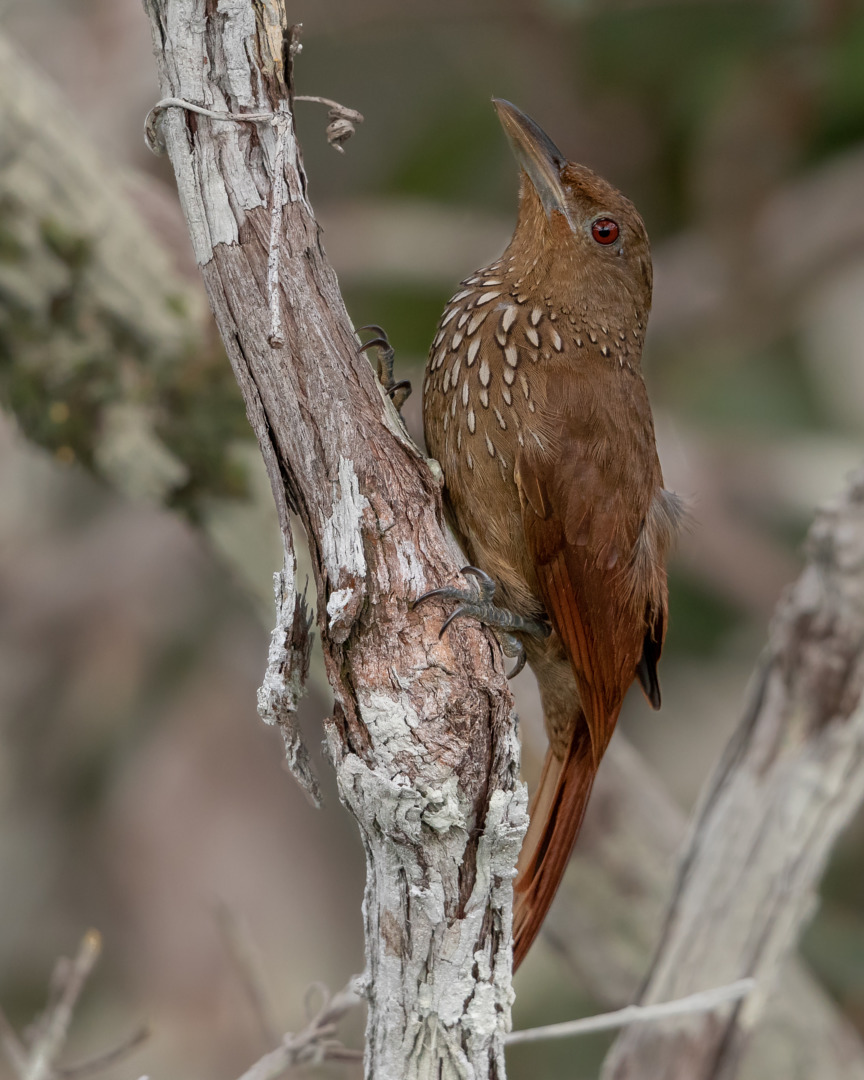
| Appearance | - The species has a heavy body, short wings, and a short, stout bill with a slightly hooked tip. English Wikipedia
- The nominate subspecies has predominantly medium-brown upperparts, a paler crown, and rufous-chestnut wings, rump, and tail. English Wikipedia
- The nominate subspecies has a bright rusty-buff throat. English Wikipedia
- The nominate subspecies has broad whitish breast streaks edged in black. English Wikipedia
- The nominate subspecies has a red to light-brown iris. English Wikipedia
- The species is reddish brown overall, with olive-brown underparts and fine white breast streaking. ebird.org
| - The Greater Thornbird is the heaviest and reddest species of thornbird. English Wikipedia
- Male and female Greater Thornbirds have identical plumage. English Wikipedia
- Adult Greater Thornbirds have a predominantly rufescent brown to grayish brown face, with a paler supercilium and ear coverts and a whitish malar area. English Wikipedia
- The adult Greater Thornbird has a reddish chestnut crown marked with pale streaks. English Wikipedia
- The adult Greater Thornbird's back is rich reddish brown to olive-brown and sometimes becomes chestnut on the lower back. English Wikipedia
- The Greater Thornbird has a lighter rufescent brown rump and chestnut uppertail coverts. English Wikipedia
- The Greater Thornbird's wings are nearly uniformly rufous-chestnut, and its tail is reddish chestnut. English Wikipedia
- The Greater Thornbird has a whitish throat, a pale breast with a light brownish tinge, a whitish belly, and light rufescent brown undertail coverts. English Wikipedia
- The Greater Thornbird's iris ranges from light yellow to orange. English Wikipedia
- The Greater Thornbird has a blackish to dark grayish horn-colored maxilla and a pale gray to grayish green mandible. English Wikipedia
- The Greater Thornbird's legs and feet are gray to olive in color. English Wikipedia
- Juvenile Greater Thornbirds have a less distinct crown patch and brownish mottling on the breast compared with adults. English Wikipedia
|
|---|
| Size | | |
|---|
| Habitat | - The species primarily inhabits humid terra firme and várzea forests. English Wikipedia
- In the Guianas, the species typically occupies forests on sand ridges and savannas. English Wikipedia
- The species favors palm forests, evergreen forest edges, and mid- to late-age secondary forests over primary forest interiors. English Wikipedia
- The species frequently occurs on river islands. English Wikipedia
- The species generally occurs below 500 m elevation but has occasionally been recorded at 950 m. English Wikipedia
- The species is associated with the lowlands of the Amazon region. ebird.org
| - The Greater Thornbird inhabits landscapes that are almost always close to water. English Wikipedia
- The Greater Thornbird occupies thickets along watercourses. English Wikipedia
- The Greater Thornbird inhabits the borders of marshes. English Wikipedia
- The Greater Thornbird generally occurs at elevations between 300 and 1,100 m. English Wikipedia
- In Bolivia, the Greater Thornbird locally reaches elevations of 1,400 m. English Wikipedia
|
|---|
| Diet | - The species' diet appears to consist mainly of arthropods, with some fruit. English Wikipedia
| |
|---|
| Behaviour | - The species remains in its range throughout the year. English Wikipedia
- The species forages alone or in mixed-species feeding flocks with approximately equal frequency. English Wikipedia
- The species forages less frequently in pairs than alone or in mixed-species flocks. English Wikipedia
- While foraging, the species moves along tree trunks and branches between the forest mid-level and canopy. English Wikipedia
- The species searches living and dead leaf clusters and epiphytes by creeping and probing. English Wikipedia
- The species sings primarily at dawn and dusk. English Wikipedia
| - The Greater Thornbird remains in its range throughout the year. English Wikipedia
- The Greater Thornbird usually searches for food in pairs. English Wikipedia
- The Greater Thornbird captures prey by gleaning it from the ground or vegetation in the forest understory. English Wikipedia
- Greater Thornbird pairs often sing together in duets. English Wikipedia
|
|---|
| Reproduction | | - The Greater Thornbird breeds during the austral spring and summer, approximately from September through January or later. English Wikipedia
- The Greater Thornbird constructs a cone-shaped nest from thorny twigs and branches. English Wikipedia
- The Greater Thornbird's nest can reach approximately 60 cm in height and 50 cm in basal width. English Wikipedia
- The Greater Thornbird lines the nest's interior chamber with soft plant material and feathers. English Wikipedia
- The Greater Thornbird suspends its nest from a tree or shrub branch, usually 1–3 m above the ground. English Wikipedia
- The Greater Thornbird often places its nest over water. English Wikipedia
- The Greater Thornbird usually lays three or four eggs, with five occurring rarely. English Wikipedia
|
|---|
| Distribution | - The species occurs in Bolivia, Brazil, Colombia, Ecuador, French Guiana, Guyana, Peru, Suriname, and Venezuela. English Wikipedia
- The devillei subspecies occurs in western Amazonia, extending from central Colombia, eastern Ecuador, and eastern Peru into Brazil and northern Bolivia. English Wikipedia
- The rufigula subspecies occurs in northeastern Amazonia, from eastern Venezuela through the Guianas into northern Brazil. English Wikipedia
- The moniliger subspecies inhabits Amazonian Brazil south of the Amazon River, between the Madeira and Tocantins rivers, extending south to Mato Grosso. English Wikipedia
- The paraensis subspecies occurs in Amazonian Brazil south of the Amazon River and east of the Tocantins River. English Wikipedia
| - The Greater Thornbird occurs in Argentina, Bolivia, Brazil, Paraguay, and Uruguay. English Wikipedia
|
|---|
| Conservation | - The IUCN classifies the species as Least Concern. English Wikipedia
- The species has a very large geographic range. English Wikipedia
- The species' population is believed to be stable, although its size is unknown. English Wikipedia
- No immediate threats to the species have been identified. English Wikipedia
- The species is considered uncommon to common, although its occurrence is often localized. English Wikipedia
- The species is considered highly sensitive to habitat modification. English Wikipedia
- The species has disappeared from selectively logged forest at one documented site. English Wikipedia
| - The Greater Thornbird is classified as Least Concern by the IUCN. English Wikipedia
- The Greater Thornbird has a very large geographic range, although its population size is unknown. English Wikipedia
- The Greater Thornbird's population is believed to be decreasing. English Wikipedia
- No immediate threats to the Greater Thornbird have been identified. English Wikipedia
- The Greater Thornbird is considered uncommon to common and occurs in several protected areas. English Wikipedia
|
|---|
| Similar species | - The species is genetically most closely related to the long-billed woodcreeper. English Wikipedia
| - The Greater Thornbird is the sister species of the freckle-breasted thornbird (Phacellodomus striaticollis). English Wikipedia
|
|---|
| Other | - The species is the sole recognized member of the genus Dendrexetastes. English Wikipedia
| No checked fact yet |
|---|