Comparison

Green and Black Poison Dart Frog vs Yellow-banded Poison Dart Frog

Green and Black Poison Dart Frog (Dendrobates auratus) and Yellow-banded Poison Dart Frog (Dendrobates leucomelas) both belong to the genus Dendrobates (dart-poison frogs) and part ways below it. Both are recorded in 2 countries.

Green and Black Poison Dart Frog

Green and Black Poison Dart Frog

Dendrobates auratus

The original uploader was DirkvdM at English Wikipedia., CC BY 1.0, via Wikimedia Commons

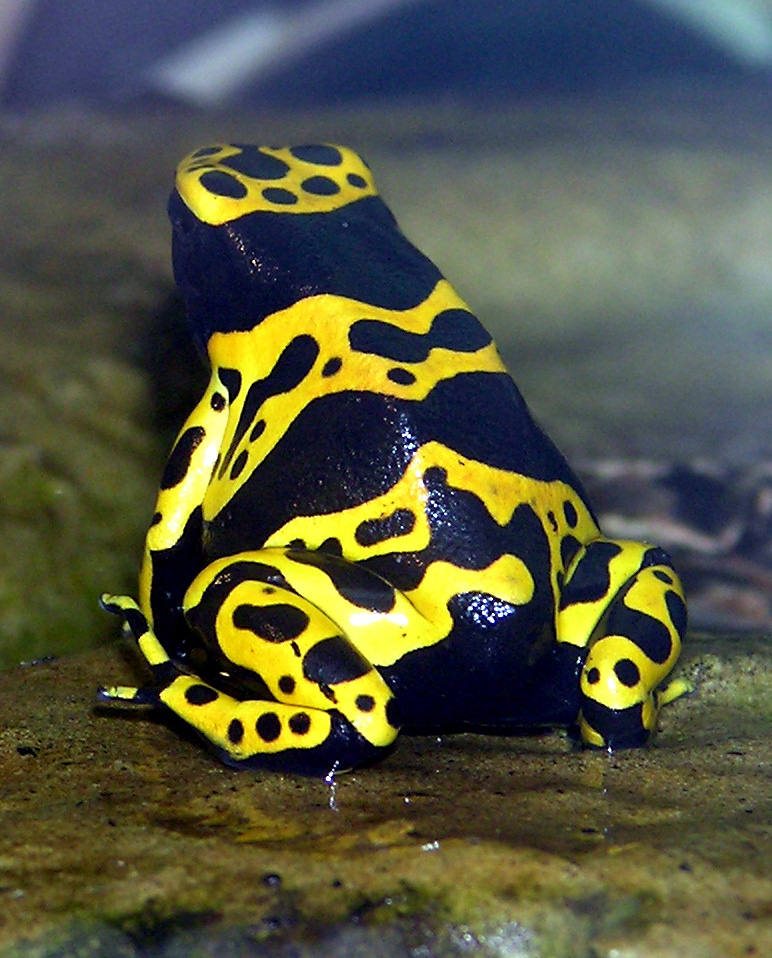
Yellow-banded Poison Dart Frog

Yellow-banded Poison Dart Frog

Dendrobates leucomelas

Arpingstone, Public domain, via Wikimedia Commons

Side by side

Green and Black Poison Dart FrogYellow-banded Poison Dart Frog
Scientific nameDendrobates auratus (Girard, 1855)Dendrobates leucomelas Steindachner, 1864
English nameGreen and Black Poison Dart FrogYellow-banded Poison Dart Frog
GroupAmphibiansAmphibians
ClassAmphibia AmphibiansAmphibia Amphibians
OrderAnura FrogsAnura Frogs
FamilyDendrobatidae Poison Dart FrogDendrobatidae Poison Dart Frog
GenusDendrobates Dart-poison FrogsDendrobates Dart-poison Frogs
Named in18551864
Red List categoryLeast ConcernLeast Concern
EnvironmentNot recordedfreshwater, terrestrial
Countries on record6 countries5 countries
GBIF occurrence records8,423 records288 records

Rows where the two agree are shown in grey.

Where each is found

Both recorded in 2 countries

Only Green and Black Poison Dart Frog (4)

Only Yellow-banded Poison Dart Frog (3)

From Catalogue of Life checklists and GBIF occurrence records. A country missing from a list means no record is held, which is not proof of absence.

Checked facts

Green and Black Poison Dart FrogYellow-banded Poison Dart Frog
Appearance
  • The species has predominantly bright yellow coloration with broad black stripes or spots across its body. English Wikipedia
  • Some individuals have orange coloration rather than the predominant yellow coloration. English Wikipedia
  • The black bands frequently break into spots as individuals age. animaldiversity.org
  • Each individual has distinctive markings. henryvilaszoo.gov
  • Females are generally larger and more robust than males. animaldiversity.org
  • The species has adhesive glandular pads on its toes and fingertips that assist climbing. henryvilaszoo.gov
  • The species has a short, protrudable, unnotched, sticky tongue used to capture prey. English Wikipedia
SizeNo checked fact yet
Habitat
  • Adults inhabit the floors of rain forests and prefer locations near small streams or pools. animaldiversity.org
  • The species inhabits humid lowland and submontane forests at elevations between 0 and 1,000 metres. English Wikipedia
  • Tadpoles develop in small pools or streams. animaldiversity.org
  • In populated Hawaiian areas, females sometimes deposit eggs in discarded beer bottles and old cans. animaldiversity.org
  • The species inhabits humid tropical rainforests, particularly areas close to freshwater. English Wikipedia
  • Individuals inhabit rainforest floors, wet stones, tree trunks, and exposed roots. animaldiversity.org
  • The species occurs at elevations between 50 and 800 metres above sea level. animaldiversity.org
  • The species can also inhabit seasonally drier forest islands within its natural range. English Wikipedia
  • During dry periods, individuals congregate beneath rocks and fallen tree trunks. English Wikipedia
  • Tadpoles develop in water-holding plants, particularly bromeliads. animaldiversity.org
Diet
  • The species feeds on small invertebrates, particularly ants containing high concentrations of alkaloids. animaldiversity.org
  • Its natural diet includes arthropods, primarily ants and mites. English Wikipedia
  • Captive individuals fed insects without alkaloids lose their toxicity. animaldiversity.org
  • The species captures prey using its sticky, retractable tongue and eyesight. animaldiversity.org
Behaviour
  • The species is semi-arboreal and hunts, courts, and sleeps in trees. English Wikipedia
  • Individuals spend considerable time in shallow water pools that collect in bromeliad leaves. English Wikipedia
  • Individuals return to the ground to travel between locations. English Wikipedia
  • Ground-travelling individuals may cover several miles while searching for breeding sites, feeding grounds, or tadpole-care locations. English Wikipedia
  • Small sucker-like discs on the toes help individuals climb by creating slight suction. English Wikipedia
  • The species is active during daylight hours. animaldiversity.org
  • Males produce trilling vocalizations to attract females. animaldiversity.org
  • Males use vocalizations to attract mates and advertise territories. animaldiversity.org
  • The species is active during daylight hours. English Wikipedia
  • The species lives in small groups. English Wikipedia
  • The species is territorial and males can behave aggressively when defending breeding territories. animaldiversity.org
  • Individuals can climb trees as well as move primarily on the ground. animaldiversity.org
  • The species is the only poison dart frog documented in the source as estivating during dry periods. English Wikipedia
  • Males attract females using chirps, buzzes, trills, and humming vocalizations. animaldiversity.org
  • Male calling is most intense during the first one or two hours after sunrise and before sunset. animaldiversity.org
Reproduction
  • Males establish territories by fighting among themselves during the mating season. animaldiversity.org
  • Females deposit as many as six eggs in small pools of water. animaldiversity.org
  • Eggs are protected by a gelatinous covering. animaldiversity.org
  • The mating season extends throughout the rainy season, from mid-July through mid-September. animaldiversity.org
  • Eggs hatch into tadpoles after approximately two weeks. English Wikipedia
  • Males periodically return to check on eggs during their two-week development period. animaldiversity.org
  • Males carry newly hatched tadpoles on their backs using a mucus secretion. animaldiversity.org
  • Tadpoles require an additional six weeks to develop into adult frogs after reaching their destination. animaldiversity.org
Distribution
  • The native range includes southeastern Nicaragua, eastern Costa Rica, Panama, and far northwestern Colombia. English Wikipedia
  • The species has an introduced population on Oahu, Hawaii. English Wikipedia
  • The introduced Hawaiian population was established through an intentional introduction in 1932 for mosquito control. English Wikipedia
  • The introduced species also appears to have become established on Maui. English Wikipedia
  • The species is also reported from Central and South America, including southeastern Brazil and Bolivia. animaldiversity.org
  • The species occurs in northern South America, including Venezuela, northern Brazil, Guyana, and southeastern Colombia. animaldiversity.org
Conservation
  • The species is classified as being of least concern by the International Union for Conservation of Nature. English Wikipedia
  • The species is classified as Least Concern on the IUCN conservation red list. English Wikipedia
  • Habitat loss and deforestation associated with timber and agricultural industries are identified as primary threats. henryvilaszoo.gov
  • Wild individuals have been harvested for the exotic pet trade. English Wikipedia
  • Captive breeding has contributed to reduced market prices and may alleviate pressure from wild collection. English Wikipedia
Uses
  • Local peoples have historically used the species to obtain poison for their weapons. animaldiversity.org
  • The species is bred in captivity and sold in the exotic pet trade. animaldiversity.org
  • Pharmaceutical companies have investigated epibatidine from this species as a potential source for pain medication. animaldiversity.org
  • The species is kept in the exotic pet trade and is readily bred in captivity. henryvilaszoo.gov
Other
  • The species obtains its toxicity by accumulating alkaloid compounds from its diet rather than producing them innately. English Wikipedia
  • Captive individuals maintained in settings where their diet lacks alkaloid-containing prey are non-toxic. English Wikipedia
No checked fact yet

In brief

Green and Black Poison Dart Frog

The native range includes southeastern Nicaragua, eastern Costa Rica, Panama, and far northwestern Colombia. Full profile

Yellow-banded Poison Dart Frog

The species occurs in northern South America, including Venezuela, northern Brazil, Guyana, and southeastern Colombia. It is characterized by predominantly bright yellow coloration with broad black stripes or spots across its body. Full profile

Compare something else

Page built on 26 November 2026 from the data on the two species pages, where every source is listed.

Cite this page

ScientificNames.org. (2026). Green and Black Poison Dart Frog vs Yellow-banded Poison Dart Frog. Retrieved November 26, 2026, from https://scientificnames.org/compare/green-and-black-poison-dart-frog-vs-yellow-banded-poison-dart-frog