Comparison

Diamondback Terrapin vs Pond Slider

Diamondback Terrapin (Malaclemys terrapin) and Pond Slider (Trachemys scripta) both belong to the family Emydidae (terrapins) and part ways below it. Both are recorded in 2 countries.
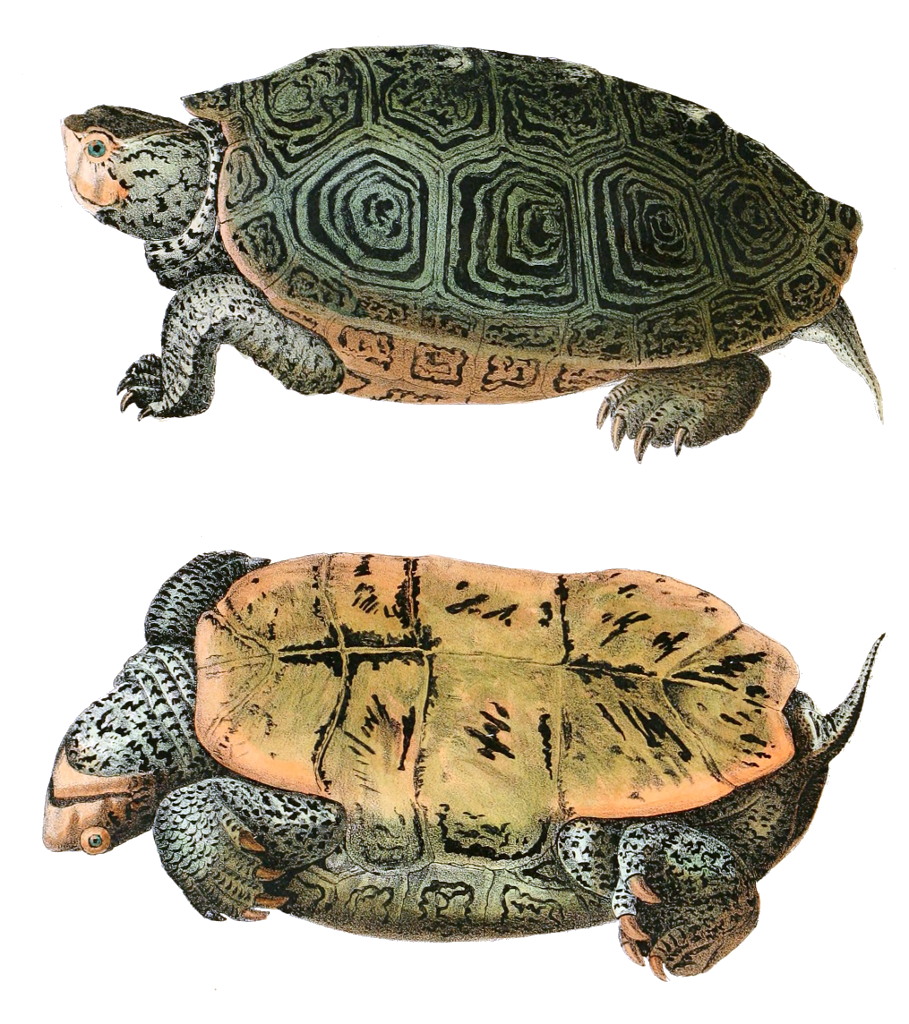
Diamondback Terrapin

Diamondback Terrapin

Malaclemys terrapin

Holbrook, John Edwards, 1794-1871 (English Wikipedia), Public domain, via Wikimedia Commons

Pond Slider

Pond Slider

Trachemys scripta

Happyswissman, CC BY 3.0, via Wikimedia Commons

Side by side

Diamondback TerrapinPond Slider
Scientific nameMalaclemys terrapin (Schoepff, 1793)Trachemys scripta (Thunberg, 1792)
English nameDiamondback TerrapinPond Slider
GroupReptilesReptiles
ClassReptilia ReptileReptilia Reptile
OrderTestudines TurtleTestudines Turtle
FamilyEmydidae TerrapinsEmydidae Terrapins
GenusMalaclemys Diamondback TerrapinsTrachemys Sliders
Named in17931792
Red List categoryVulnerableLeast Concern
EnvironmentNot recordedfreshwater
Countries on record2 countries95 countries
GBIF occurrence records12,957 records258,934 records

Rows where the two agree are shown in grey.

Where each is found

Both recorded in 2 countries

Only Pond Slider (93)

From Catalogue of Life checklists and GBIF occurrence records. A country missing from a list means no record is held, which is not proof of absence.

Checked facts

Diamondback TerrapinPond Slider
Appearance
  • The species has a diamond-shaped pattern on the upper surface of its shell, although its overall coloration and pattern vary considerably. English Wikipedia
  • Its carapace is generally wider at the rear than at the front and has a longitudinal central ridge. English Wikipedia
  • Its carapace ranges from brown to grey, while its plastron is lighter in coloration. English Wikipedia
  • Its body coloration can be grey, brown, yellow, or white. English Wikipedia
  • Almost all individuals have distinctive irregular black markings or spots on their heads and bodies. English Wikipedia
  • The species has large webbed feet. English Wikipedia
  • The species has an oval-shaped upper shell with a central crest and knobs that become less prominent with age. English Wikipedia
  • Juveniles have green upper shells, yellow lower shells, and green and yellow skin markings. English Wikipedia
  • The shell and skin markings generally become less distinct as individuals age. English Wikipedia
  • Older individuals may develop nearly black coloration with few visible markings. English Wikipedia
  • Adult males typically have longer front claws than adult females. English Wikipedia
  • Females generally have shorter and more slender tails than males. English Wikipedia
  • The species has dark green and brown skin. animaldiversity.org
  • The species has oblong heads with upward-pointing snouts. animaldiversity.org
  • Each limb has five digits and webbed feet adapted for swimming. animaldiversity.org
Size
Habitat
  • The species inhabits brackish coastal tidal marshes. English Wikipedia
  • In most of its range, the species inhabits Spartina marshes that flood during high tides. English Wikipedia
  • In Florida, the species also inhabits mangrove swamps. English Wikipedia
  • South Florida diamondback terrapins use subtropical mangrove creek and island habitats in Everglades National Park. pubs.usgs.gov
  • The species can tolerate freshwater and full-strength ocean water, although adults prefer intermediate salinities. English Wikipedia
  • The species is exclusively estuarine. pubs.usgs.gov
Diet
  • The species feeds on fish, crustaceans, marine worms, snails, clams, barnacles, mussels, other mollusks, insects, and carrion. English Wikipedia
  • The species sometimes consumes small quantities of plant material, including algae. English Wikipedia
  • Gastropods, crabs, and bivalves are the dominant food categories of diamondback terrapins in South Florida mangrove habitats. pubs.usgs.gov
  • Food sources in South Florida terrapins differ more according to habitat than to body size class. pubs.usgs.gov
  • Decapod crustacean remains occurred in all 13 fecal samples examined from the Florida East Coast subspecies. digitalcommons.fau.edu
  • Decapod crustaceans accounted for 96.3% of the fecal mass in the examined Florida East Coast terrapins. digitalcommons.fau.edu
  • The examined Florida East Coast terrapins also consumed small quantities of vegetation, bivalves, gastropods, and insects. digitalcommons.fau.edu
No checked fact yet
Behaviour
  • The species is a strong swimmer. English Wikipedia
  • The species can remain in full-strength salt water for extended periods. English Wikipedia
  • Terrapins can obtain freshwater by drinking the surface layer that accumulates over salt water after rainfall. English Wikipedia
  • Terrapins can raise their heads and open their mouths to catch falling raindrops. English Wikipedia
  • Individuals tend to remain in the same areas for most or all of their lives rather than undertaking long-distance migrations. English Wikipedia
  • The species generally hibernates during colder months in the mud of creeks and marshes. English Wikipedia
  • Individuals commonly bask on logs, branches, and vegetation at or above the water surface. English Wikipedia
  • When startled, individuals quickly enter the water and swim away to safety. English Wikipedia
  • Both sexes use their foreclaws during courtship. animaldiversity.org
Reproduction
  • Adults mate in early spring. English Wikipedia
  • Females lay clutches containing 4–22 eggs in sand dunes during early summer. English Wikipedia
  • Eggs generally hatch 60–85 days after being laid, depending on incubation temperature and nest depth. English Wikipedia
  • Females can produce up to three egg clutches annually in the wild. English Wikipedia
  • Females can produce up to five egg clutches annually in captivity. English Wikipedia
  • Female terrapins can mate with multiple males and retain sperm for years. English Wikipedia
  • The sex of hatchlings depends on incubation temperature. English Wikipedia
  • Male terrapins generally reach sexual maturity at 2–3 years of age. English Wikipedia
  • Female terrapins generally reach sexual maturity at 6–7 years, while northern populations may take 8–10 years. English Wikipedia
LifespanNo checked fact yet
Distribution
  • The species occurs along the Atlantic and Gulf coasts of the United States, from Cape Cod to Texas. English Wikipedia
  • The species also has a naturally established population in Bermuda. English Wikipedia
No checked fact yet
Conservation
  • The IUCN classifies the species as Vulnerable because its population numbers are decreasing across most of its range. English Wikipedia
  • The species is listed as endangered in Rhode Island. English Wikipedia
  • The species is listed as threatened in Massachusetts. English Wikipedia
  • Crab traps cause substantial mortality among diamondback terrapins along the New Jersey coast. English Wikipedia
  • Coastal development has destroyed or altered more than 75% of the salt marshes historically inhabited by the species. English Wikipedia
  • Rising ocean levels threaten the remaining salt marsh habitat. English Wikipedia
  • The species is listed as an invasive alien species of Union concern in the European Union. English Wikipedia
  • European Union regulations prohibit importing, breeding, transporting, commercializing, and intentionally releasing the species. English Wikipedia
  • Introduced sliders can compete with native species for food, habitat, and other resources. English Wikipedia
  • Introduced sliders can displace native species from basking sites. English Wikipedia
  • Captive-raised individuals may carry diseases unfamiliar to native species. English Wikipedia
Uses
  • Diamondback terrapins were historically consumed as a delicacy in the early twentieth century. English Wikipedia
  • The red-eared slider subspecies is popular in the pet trade. English Wikipedia
  • Pond sliders were extensively farmed and exported for the international pet trade during the 1950s. English Wikipedia
Similar speciesNo checked fact yet
  • Slider turtles are sometimes confused with chicken turtles and painted turtles. animaldiversity.org
  • Chicken turtles differ from sliders in having smooth shells. animaldiversity.org
  • Painted turtles have two yellow patches behind each eye, whereas sliders have one yellow or red patch. animaldiversity.org

In brief

Diamondback Terrapin

Malaclemys terrapin inhabits brackish coastal tidal marshes along the Atlantic and Gulf coasts of the United States, from Cape Cod to Texas, and has a naturally established population in Bermuda. It is distinguished by a diamond-shaped pattern on the upper surface of its shell and distinctive irregular black markings or spots on almost all individuals. Full profile

Pond Slider

Trachemys scripta inhabits freshwater and brackish aquatic environments, including ponds, lakes, rivers, swamps, lagoons, and streams. It has an oval-shaped upper shell with a central crest and knobs that become less prominent with age. Full profile

Compare something else

Page built on 26 November 2026 from the data on the two species pages, where every source is listed.

Cite this page

ScientificNames.org. (2026). Diamondback Terrapin vs Pond Slider. Retrieved November 26, 2026, from https://scientificnames.org/compare/diamondback-terrapin-vs-pond-slider