Comparison
Burningbush vs Lemon
Burningbush (Dictamnus albus) and Lemon (Citrus × limon) both belong to the family Rutaceae (rue family) and part ways below it. Both are recorded in 23 countries.


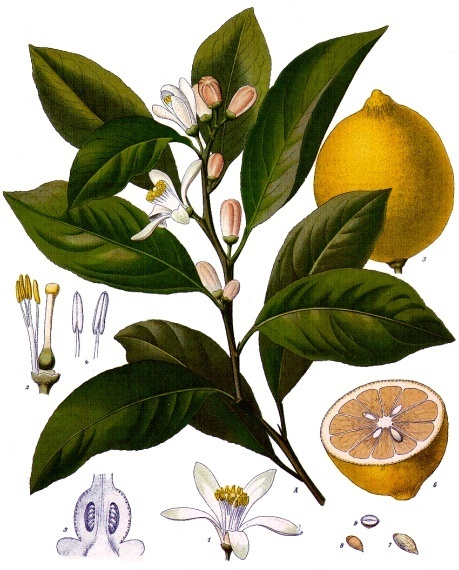
Lemon
Citrus × limon
Franz Eugen Köhler, Köhler's Medizinal-Pflanzen, Public domain, via Wikimedia Commons

Side by side
| Burningbush | Lemon | |
|---|---|---|
| Scientific name | Dictamnus albus L. | Citrus × limon (L.) Osbeck |
| English name | Burningbush | Lemon |
| Group | Flowering plants | Flowering plants |
| Class | Magnoliopsida | Magnoliopsida |
| Order | Sapindales | Sapindales |
| Family | Rutaceae Rue Family | Rutaceae Rue Family |
| Genus | Dictamnus | Citrus Kumquat |
| Countries on record | 46 countries | 110 countries |
| GBIF occurrence records | 23,107 records | 4,748 records |
Rows where the two agree are shown in grey.
Where each is found
Both recorded in 23 countries
- Afghanistan
- Albania
- Azerbaijan
- China
- Croatia
- Finland
- France
- Georgia
- Germany
- Greece
- India
- Iran
- Italy
- Japan
- Pakistan
- Russia
- South Korea
- Spain
- Sweden
- Tajikistan
- The Netherlands
- Turkey
- United States
Only Burningbush (23)
- Armenia
- Austria
- Belgium
- Bosnia and Herzegovina
- Bulgaria
- Czechia
- Estonia
- Hungary
- Kazakhstan
- Kosovo
- Kyrgyzstan
- Montenegro
- North Korea
- North Macedonia
- Poland
- Romania
- Serbia
- Slovakia
- Slovenia
- Switzerland
- Syria
- Ukraine
- Uzbekistan
Only Lemon (87)
- Algeria
- Argentina
- Australia
- Bahamas
- Bangladesh
- Belarus
- Belize
- Benin
- Bermuda
- Bolivia
- Brazil
- Burkina Faso
- Cabo Verde
- Cambodia
- Cameroon
- Central African Republic
- Chad
- Chile
- Colombia
- Costa Rica
- Cuba
- Curacao
- Cyprus
- Democratic Republic of the Congo
- Dominican Republic
- Ecuador
- Egypt
- El Salvador
- Equatorial Guinea
- Ethiopia
- Fiji
- French Guiana
- French Polynesia
- Guadeloupe
- Guam
- Guatemala
- Guinea
- Haiti
- Honduras
- Hong Kong
- Indonesia
- Iraq
- Israel
- Ivory Coast
- Jamaica
- Kenya
- Lebanon
- Madagascar
- Malaysia
- Maldives
- Malta
- Martinique
- Mayotte
- Mexico
- Micronesia
- Morocco
- Mozambique
- Myanmar
- Nepal
- New Caledonia
- New Zealand
- Nicaragua
- Nigeria
- Niue
- Palau
- Panama
- Papua New Guinea
- Paraguay
- Peru
- Philippines
- Portugal
- Puerto Rico
- Reunion
- Seychelles
- Sierra Leone
- South Africa
- Sri Lanka
- Taiwan
- Tanzania
- Thailand
- Tokelau
- Trinidad and Tobago
- Tunisia
- United Kingdom
- Venezuela
- Vietnam
- Zimbabwe
From Catalogue of Life checklists and GBIF occurrence records. A country missing from a list means no record is held, which is not proof of absence.
Checked facts
| Burningbush | Lemon | |
|---|---|---|
| Appearance |
|
|
| Size |
|
|
| Habitat |
|
|
| Diet | No checked fact yet |
|
| Behaviour |
| No checked fact yet |
| Reproduction |
|
|
| Distribution |
| No checked fact yet |
| Uses | No checked fact yet |
|
| Similar species |
| No checked fact yet |
| Other |
|
|
In brief
Burningbush
The species is native to southern Europe, North Africa and much of Asia, where it occurs in warm, open woodland habitats. It produces volatile oils that can ignite readily during hot weather and has a lemon-like smell. Full profile
Lemon
Species of the genus Citrus naturally occur in regions with warm or mild climates, particularly the Mediterranean region. The lemon tree is a small evergreen tree that produces pointed, oval-shaped yellow fruits botanically classified as hesperidia. Full profile
Compare something else
Page built on 28 November 2026 from the data on the two species pages, where every source is listed.
Cite this page
ScientificNames.org. (2026). Burningbush vs Lemon. Retrieved November 28, 2026, from https://scientificnames.org/compare/dictamnus-albus-vs-lemon
“Burningbush vs Lemon.” ScientificNames.org, 2026, scientificnames.org/compare/dictamnus-albus-vs-lemon. Accessed 28 Nov. 2026.
ScientificNames.org. “Burningbush vs Lemon.” Accessed November 28, 2026. https://scientificnames.org/compare/dictamnus-albus-vs-lemon.
@misc{scientificnames_burningbush_vs_lemon,
  author = {{ScientificNames.org}},
  title = {Burningbush vs Lemon},
  year = {2026},
  url = {https://scientificnames.org/compare/dictamnus-albus-vs-lemon},
  note = {Accessed 2026-11-28}
}