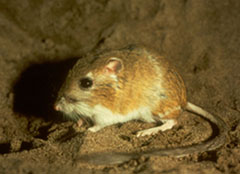
| Appearance | - Its dorsal hairs have dark tips that produce a blackish sheen. English Wikipedia
- Its cheeks are white, while its ears and upper and lower tail stripes are brown. English Wikipedia
- The species has shorter, coarser fur and a shorter, uncrested tail than Ord's kangaroo rat. English Wikipedia
- Its fur is short and fairly coarse, and all color phases have white cheek patches. animaldiversity.org
| - The species has conspicuous white markings on its feet, upper lip, above its eyes, and across its hips. animaldiversity.org
- Its tail is dark above, has two white bands along each side, and ends in a grey tuft of longer hairs. animaldiversity.org
- Ord's kangaroo rat has small forelimbs and long, strong hindlegs adapted for jumping. animaldiversity.org
- The species has five toes on its hind feet, distinguishing it from Dipodomys elator. English Wikipedia
- Juveniles have duller and darker fur than adults. depts.ttu.edu
|
|---|
| Size | No checked fact yet | |
|---|
| Habitat | - The species inhabits sparsely vegetated locations with sandy soils, particularly dunes. English Wikipedia
- Individuals are commonly found on the downwind slopes of dunes. English Wikipedia
- The species favors loose or disturbed sandy soils and open, sparsely vegetated dunes. animaldiversity.org
- Most captured individuals have been found on the sheltered or leeward sides of landforms. animaldiversity.org
- Very few individuals have been captured in undisturbed brush-covered areas. animaldiversity.org
- Plants growing near the species include sea oats, bluestem grass, saltgrass, fringe-rushes, sunflowers, and croton. English Wikipedia
- In Texas mesquite savannah, the species is associated with wiregrasses, hairy grama, hooded windmill grass, and prickly pear. English Wikipedia
| - The species inhabits arid environments with sparse vegetation on sandy ground. animaldiversity.org
- Ord's kangaroo rats occur in shifting sand dunes and can establish populations in these habitats. animaldiversity.org
- The species occurs along riverbanks and in the Great Sand Hills of Saskatchewan. animaldiversity.org
- Ord's kangaroo rats inhabit semiarid grasslands, mixed-grass prairie, shrublands, scrublands, and pinyon-juniper woodlands on sandy soils. English Wikipedia
- In Utah, the species is associated with open shrublands and grasslands on sandy soils. English Wikipedia
- Ord's kangaroo rats rarely inhabit hard or gravelly soils. depts.ttu.edu
- Their burrows are commonly dug into loose sand along natural sand dunes, riverbanks, and road cuts. English Wikipedia
- Ord's kangaroo rats construct burrows with openings approximately 7.6 cm in diameter. English Wikipedia
|
|---|
| Diet | - The species mainly feeds on seeds, which it gathers in its cheek pouches and transports to its burrow. English Wikipedia
- Its preferred foods include grasses, seeds, annual plants, and shrubs. animaldiversity.org
- Its diet also includes insects, fruits, buds, leaves, and stems. animaldiversity.org
| - The species primarily consumes seeds, green vegetation, and dry vegetation. English Wikipedia
- Ord's kangaroo rats occasionally consume animal material, particularly arthropods. English Wikipedia
- In summer, Ord's kangaroo rats also eat grasshoppers and moths. animaldiversity.org
- The species transports harvested seeds to its burrow in cheek pouches for consumption or storage. English Wikipedia
- Ord's kangaroo rats can obtain water physiologically from nearly dry seeds. depts.ttu.edu
|
|---|
| Behaviour | - The species is mainly nocturnal. English Wikipedia
- A laboratory study found that most activity occurs at night, with brief daytime activity associated with feeding or drinking. animaldiversity.org
- Individuals are solitary except during the breeding season. animaldiversity.org
- The species moves by hopping on its hind legs. animaldiversity.org
- A single hop can propel an individual more than two meters. animaldiversity.org
- The species constructs burrow systems containing multiple chambers and long tunnels. animaldiversity.org
- Members of the genus Dipodomys are highly solitary and territorial, with one adult occupying each burrow system. animaldiversity.org
- Members of the genus Dipodomys use hind-foot drumming to communicate territorial warnings. animaldiversity.org
- The species does not need to drink water, according to the account's description of its genus. animaldiversity.org
| - Ord's kangaroo rats are nocturnal and spend daylight hours in burrows. English Wikipedia
- The species is solitary outside breeding periods. animaldiversity.org
- Ord's kangaroo rats seal their burrow entrances with sand during the day. animaldiversity.org
- Individuals can make loud thumping noises with their hind legs when their burrow entrance is disturbed. animaldiversity.org
- Ord's kangaroo rats regularly bathe in sand to prevent their fur from becoming oily and matted. animaldiversity.org
- The species can evade predators with jumps reaching approximately 2 m. animaldiversity.org
|
|---|
| Reproduction | | No checked fact yet |
|---|
| Distribution | - The species occurs in southeastern Texas, including areas south of Bexar and Gonzales counties and in Zapata County. English Wikipedia
- Its range includes Mustang Island and Padre Island off the Texas coast. English Wikipedia
- The species occurs on barrier islands off the coast of Tamaulipas, Mexico. English Wikipedia
| - Ord's kangaroo rat occurs across western North America, from southern Canada to central Mexico. English Wikipedia
- Its documented range extends from southern Alberta and Saskatchewan to southern Hidalgo, Mexico. English Wikipedia
|
|---|
| Conservation | | - Ord's kangaroo rat is classified as a species of least concern by the IUCN. depts.ttu.edu
- The species is common throughout its range in Texas. depts.ttu.edu
- The Canadian population of Ord's kangaroo rat is considered endangered. English Wikipedia
|
|---|
| Uses | No checked fact yet | - In some sandy areas near San Antonio, Ord's kangaroo rats have been reported to consume seeds from watermelons and other cultivated row crops. depts.ttu.edu
|
|---|
| Similar species | - The Gulf Coast kangaroo rat has appearance and ecological characteristics very similar to those of Ord's kangaroo rat. English Wikipedia
| No checked fact yet |
|---|
| Other | No checked fact yet | - Ord's kangaroo rats have an oil-secreting gland located between their shoulders. animaldiversity.org
- Secretions from the shoulder gland help individuals distinguish other individuals and their sexes. animaldiversity.org
|
|---|