Comparison
Drosera capensis vs Common Sundew
Drosera capensis (Drosera capensis) and Common Sundew (Drosera rotundifolia) both belong to the genus Drosera (sundew) and part ways below it. Both are recorded in 1 country.
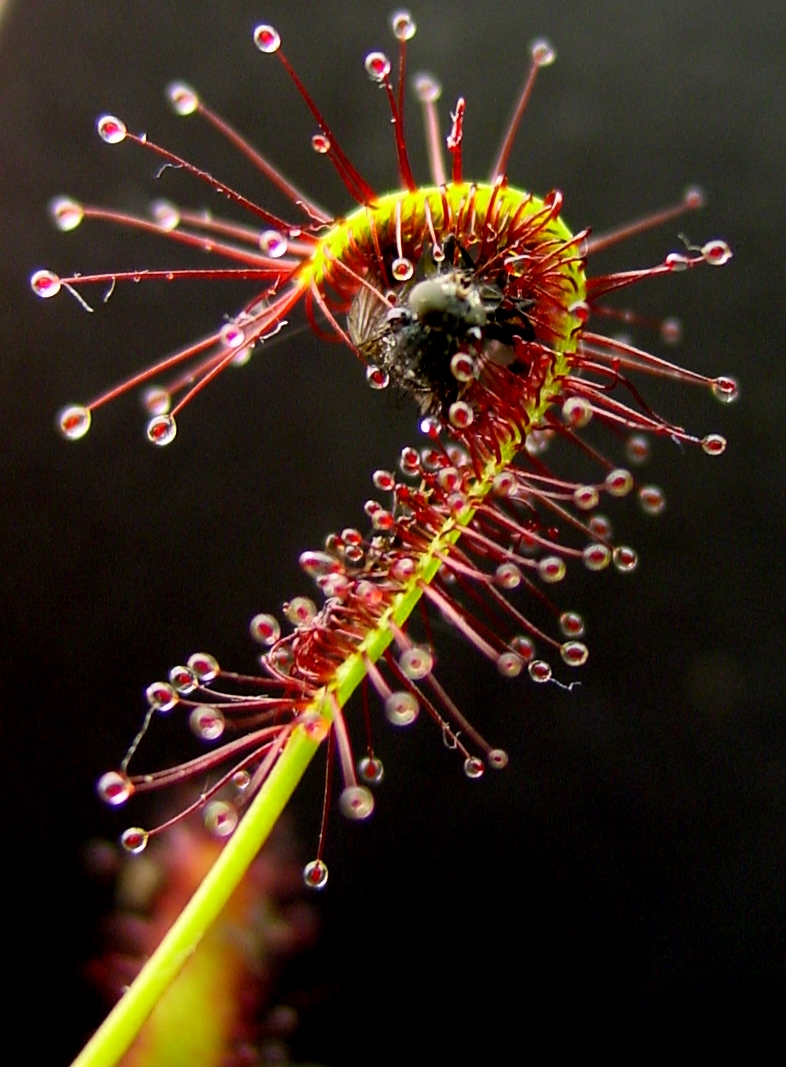


Side by side
| Drosera capensis | Common Sundew | |
|---|---|---|
| Scientific name | Drosera capensis L. | Drosera rotundifolia L. |
| English name | Not recorded | Common Sundew |
| Group | Flowering plants | Flowering plants |
| Class | Magnoliopsida | Magnoliopsida |
| Order | Caryophyllales | Caryophyllales |
| Family | Droseraceae Sundew Family | Droseraceae Sundew Family |
| Genus | Drosera Sundew | Drosera Sundew |
| Red List category | Not recorded | Least Concern |
| Countries on record | 3 countries | 57 countries |
| GBIF occurrence records | 1,364 records | 317,681 records |
Rows where the two agree are shown in grey.
Where each is found
Both recorded in 1 country
Only Drosera capensis (2)
Only Common Sundew (56)
- Aland Islands
- Andorra
- Austria
- Belarus
- Belgium
- Bulgaria
- Canada
- China
- Croatia
- Czechia
- Denmark
- Estonia
- Faroe Islands
- Finland
- France
- Georgia
- Germany
- Greece
- Greenland
- Hungary
- Iceland
- Indonesia
- Ireland
- Isle of Man
- Italy
- Japan
- Jersey
- Kazakhstan
- Kosovo
- Latvia
- Lebanon
- Liechtenstein
- Lithuania
- Luxembourg
- Mongolia
- North Korea
- North Macedonia
- Norway
- Papua New Guinea
- Philippines
- Poland
- Portugal
- Romania
- Russia
- Saint Pierre and Miquelon
- Serbia
- Slovakia
- Slovenia
- South Korea
- Spain
- Sweden
- Switzerland
- The Netherlands
- Turkey
- Ukraine
- United Kingdom
From Catalogue of Life checklists and GBIF occurrence records. A country missing from a list means no record is held, which is not proof of absence.
Checked facts
| Drosera capensis | Common Sundew | |
|---|---|---|
| Appearance |
|
|
| Size |
|
|
| Habitat |
|
|
| Diet |
|
|
| Behaviour |
|
|
| Reproduction |
|
|
| Lifespan | No checked fact yet |
|
| Conservation |
|
|
| Uses |
|
|
| Other |
| No checked fact yet |
In brief
Drosera capensis
Drosera capensis L. is a perennial flowering herb in the family Droseraceae, order Caryophyllales and class Magnoliopsida. It grows in permanently wet, nutrient-poor habitats, including wet seeps, creek margins and coastal wetlands. It captures and digests insects and other arthropods using leaves with stalked glands that produce sticky mucilage. Full profile
Common Sundew
Drosera rotundifolia grows in bogs, marshes, fens, wet stands of black spruce, and along silty and boggy shorelines and in wet sands. It is distinguished by round leaves covered with red glandular hairs that secrete sticky mucilage and trap insects. Full profile
Compare something else
Page built on 29 November 2026 from the data on the two species pages, where every source is listed.
Cite this page
ScientificNames.org. (2026). Drosera capensis vs Common Sundew. Retrieved November 29, 2026, from https://scientificnames.org/compare/drosera-capensis-vs-common-sundew
“Drosera capensis vs Common Sundew.” ScientificNames.org, 2026, scientificnames.org/compare/drosera-capensis-vs-common-sundew. Accessed 29 Nov. 2026.
ScientificNames.org. “Drosera capensis vs Common Sundew.” Accessed November 29, 2026. https://scientificnames.org/compare/drosera-capensis-vs-common-sundew.
@misc{scientificnames_drosera_capensis_vs_common_sundew,
  author = {{ScientificNames.org}},
  title = {Drosera capensis vs Common Sundew},
  year = {2026},
  url = {https://scientificnames.org/compare/drosera-capensis-vs-common-sundew},
  note = {Accessed 2026-11-29}
}