Comparison

Drosera capillaris vs Drosera capensis

Drosera capillaris (Drosera capillaris) and Drosera capensis (Drosera capensis) both belong to the genus Drosera (sundew) and part ways below it. Both are recorded in 1 country.

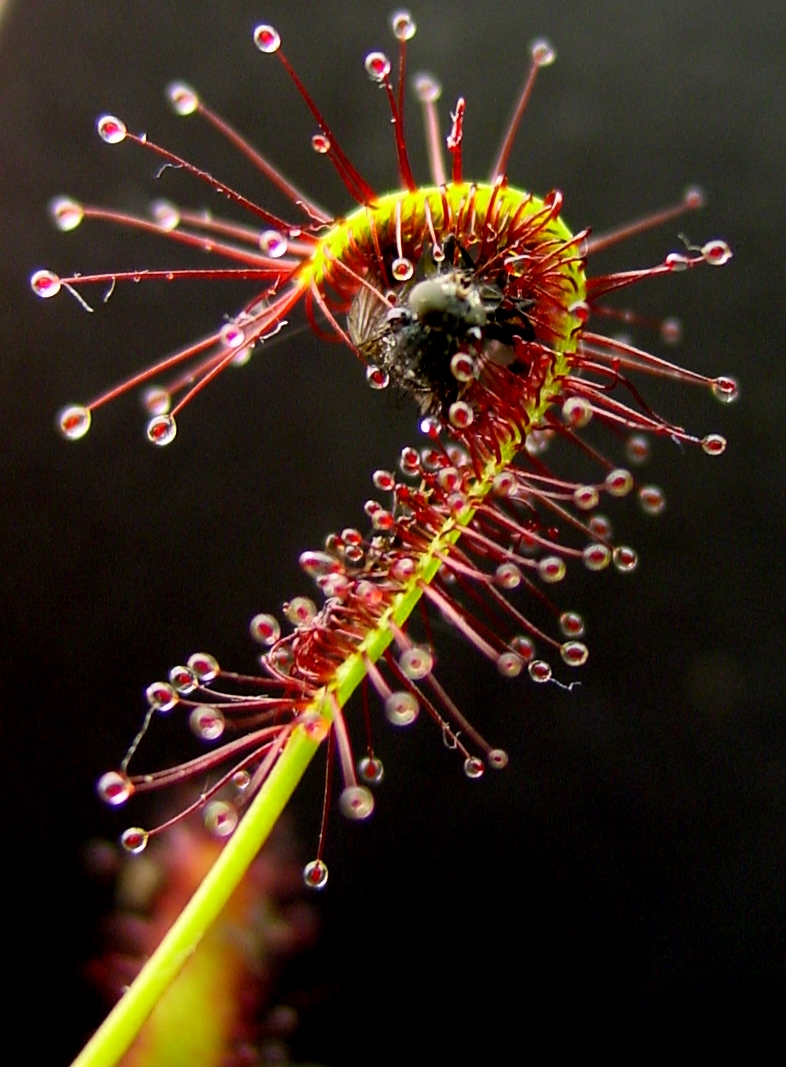
Drosera capillaris

Drosera capillaris

Petr Dlouhý, Public domain, via Wikimedia Commons

Drosera capensis

Drosera capensis

NoahElhardt, CC BY-SA 3.0, via Wikimedia Commons

Side by side

Drosera capillarisDrosera capensis
Scientific nameDrosera capillaris Poir.Drosera capensis L.
GroupFlowering plantsFlowering plants
ClassMagnoliopsidaMagnoliopsida
OrderCaryophyllalesCaryophyllales
FamilyDroseraceae Sundew FamilyDroseraceae Sundew Family
GenusDrosera SundewDrosera Sundew
Countries on record20 countries3 countries
GBIF occurrence records11,499 records1,364 records

Rows where the two agree are shown in grey.

Where each is found

Both recorded in 1 country

Only Drosera capillaris (19)

Only Drosera capensis (2)

From Catalogue of Life checklists and GBIF occurrence records. A country missing from a list means no record is held, which is not proof of absence.

Checked facts

Drosera capillarisDrosera capensis
Appearance
  • Drosera capillaris forms mostly prostrate rosettes, although its rosettes occasionally grow upright. English Wikipedia
  • The species produces pink flowers, with white flowers occurring rarely. English Wikipedia
  • Its leaf blades bear glandular trichomes that secrete sugary mucilage. English Wikipedia
  • Its petioles are sparsely covered with hairs. English Wikipedia
Size
Habitat
  • The species inhabits subtropical and tropical seepage bogs, savannas, and grasslands. English Wikipedia
  • Its habitats are often dominated by longleaf pine, slash pine, or Caribbean pine. English Wikipedia
  • The species grows in sunny, persistently wet habitats. English Wikipedia
  • Its habitats are highly acidic, sandy, and nutrient deficient. English Wikipedia
  • Thick clay deposits in its habitat retain water and prevent large trees and shrubs from becoming established. English Wikipedia
  • The species grows in permanently wet, nutrient-poor habitats. English Wikipedia
  • It occurs in wet seeps, creek margins and coastal wetlands. English Wikipedia
  • It can grow in peaty or sandy soils, on moss-covered rocks and in Sphagnum moss beds. English Wikipedia
  • The species occurs at elevations ranging from sea level to 1,800 m. English Wikipedia
Diet
  • The species captures small invertebrates using glandular leaf hairs and subsequently digests them with enzymes. English Wikipedia
  • Prey capture supplies the species with nutrients in nutrient-deficient environments. English Wikipedia
  • The plant captures and digests insects and other arthropods. English Wikipedia
  • The species obtains nutrients from captured arthropods in addition to nutrients absorbed from its growing substrate. English Wikipedia
  • Fruit flies (Drosophila melanogaster) have been used as prey in feeding experiments involving this species. pmc.ncbi.nlm.nih.gov
Behaviour
  • The glandular trichomes close around trapped organisms, helping to secure them. English Wikipedia
  • The species is adapted to fire, which reduces competing vegetation and facilitates seedling establishment. English Wikipedia
  • Marginal tentacles bend toward the centre of the leaf when potential prey contacts them. English Wikipedia
  • The leaf blade bends inward around captured prey and can roll through more than 180 degrees. English Wikipedia
  • The extent of leaf bending increases when prey is located closer to the leaf tip. English Wikipedia
  • Red tentacle coloration did not attract fruit flies in experimental trials. pmc.ncbi.nlm.nih.gov
  • Digestive phosphatase, phosphodiesterase and protease activities are induced within 24 hours of prey capture. pmc.ncbi.nlm.nih.gov
Reproduction
Distribution
  • The species is native to the southern United States, the Greater Antilles, western and southern Mexico, Central America, and northern South America. English Wikipedia
  • In Virginia, the species is listed as vulnerable. English Wikipedia
No checked fact yet
Conservation
  • The species is classified as critically imperiled in Arkansas, Maryland, and Tennessee. English Wikipedia
  • Pollution from fertilizers and nutrient additions can negatively affect the species. English Wikipedia
  • Human collection contributes to pressure on the species' survival. English Wikipedia
Uses
  • Drosera species are sought after for medicinal applications involving the respiratory system. English Wikipedia
  • Drosera plants are commonly purchased air-dried in some European areas. English Wikipedia
  • The species has been cultivated in Europe as a botanical curiosity since the mid-18th century. English Wikipedia
  • The species has been investigated as a potential source of pharmacologically interesting bioactive compounds. English Wikipedia
Similar species
  • Drosera capillaris can be confused with Drosera intermedia, particularly when the plants are young. English Wikipedia
  • Drosera capillaris and Drosera intermedia both form flat rosettes and occupy the same habitats. English Wikipedia
  • Drosera intermedia differs from Drosera capillaris in having glabrous rather than sparsely hairy petioles. English Wikipedia
No checked fact yet
OtherNo checked fact yet
  • Feeding on fruit flies increases the phosphorus and nitrogen content of the plant's leaf tissue. pmc.ncbi.nlm.nih.gov
  • Prey feeding increases aboveground biomass, leaf number and chlorophyll content in the species. pmc.ncbi.nlm.nih.gov

In brief

Drosera capillaris

Drosera capillaris inhabits subtropical and tropical seepage bogs, savannas, and grasslands across its native distribution. Its leaf blades bear glandular trichomes that secrete sugary mucilage and capture small invertebrates. Full profile

Drosera capensis

Drosera capensis L. is a perennial flowering herb in the family Droseraceae, order Caryophyllales and class Magnoliopsida. It grows in permanently wet, nutrient-poor habitats, including wet seeps, creek margins and coastal wetlands. It captures and digests insects and other arthropods using leaves with stalked glands that produce sticky mucilage. Full profile

Compare something else

Page built on 27 November 2026 from the data on the two species pages, where every source is listed.

Cite this page

ScientificNames.org. (2026). Drosera capillaris vs Drosera capensis. Retrieved November 27, 2026, from https://scientificnames.org/compare/drosera-capillaris-vs-drosera-capensis