Comparison

Dusky Swordtail vs Common Bluebottle

Dusky Swordtail (Graphium policenoides) and Common Bluebottle (Graphium sarpedon) both belong to the genus Graphium (swordtail butterfly) and part ways below it.

Dusky Swordtail

Graphium policenoides
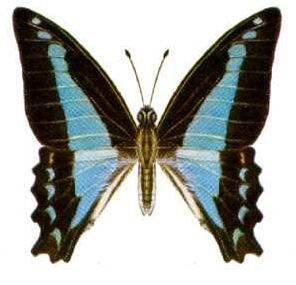
Common Bluebottle

Common Bluebottle

Graphium sarpedon

Commonwealth Scientific and Industrial Research Organisation (CSIRO), Public domain, via Wikimedia Commons

Side by side

Dusky SwordtailCommon Bluebottle
Scientific nameGraphium policenoides (Holland, 1892)Graphium sarpedon (Linnaeus, 1758)
English nameDusky SwordtailCommon Bluebottle
GroupInsectsInsects
ClassInsecta InsectInsecta Insect
OrderLepidopteraLepidoptera
FamilyPapilionidae Swallowtail ButterflyPapilionidae Swallowtail Butterfly
GenusGraphium Swordtail ButterflyGraphium Swordtail Butterfly
Named in18921758
Red List categoryNot recordedLeast Concern
Countries on recordNot recorded22 countries
GBIF occurrence recordsNot recorded19,260 records

Rows where the two agree are shown in grey.

Where each is found

Only Common Bluebottle (22)

From Catalogue of Life checklists and GBIF occurrence records. A country missing from a list means no record is held, which is not proof of absence.

Checked facts

Dusky SwordtailCommon Bluebottle
Appearance
  • The hindwing has a long, narrow tail of uniform width at vein 4. English Wikipedia
  • The upper wings have green or greenish-white markings. English Wikipedia
  • The forewing cell has five or six transverse bands or spots. English Wikipedia
  • Both wings bear submarginal spots. English Wikipedia
  • The underside of the hindwing has an ornamental band formed by red spots. English Wikipedia
  • The forewing has a spot at the base of cells 1a and 1b. English Wikipedia
  • The forewing has an oblique transverse streak in the basal part of cells 1a and 1b. English Wikipedia
  • The forewing has eight discal spots, located in cells 1a–6 and 8. English Wikipedia
  • The hindwing has a narrow transverse band at its base. English Wikipedia
  • The hindwing has a narrow median band consisting of three spots in the cell and cells 2 and 7. English Wikipedia
  • The hindwing usually has seven discal spots in cells 1c–7, with the spot in cell 1c being red. English Wikipedia
  • The apical quarter of the upper hindwing cell is uniformly black and lacks a light spot. English Wikipedia
  • The forewing cell has a light spot or dot near the costal margin, just before the apex. English Wikipedia
  • The upper wings are opaque black and crossed by a broad, pale blue medial band. English Wikipedia
  • The medial wing band is broadest in the middle and becomes greenish and spotted toward the front. English Wikipedia
  • The portion of the blue band crossing hindwing interspaces 6, 7 and 8 is white. English Wikipedia
  • The hindwings have a sub-terminal line of slender blue crescent-shaped markings. English Wikipedia
  • The underside has a dark brown ground colour. English Wikipedia
  • The hindwing underside has narrow crimson lines crossing its velvety black postdiscal area. English Wikipedia
  • A crimson spot near the hindwing's tornal angle is accompanied by an admarginal yellowish-white spot below it. English Wikipedia
  • The head and thorax are brown with a greenish-grey suffusion. English Wikipedia
SizeNo checked fact yet
Habitat
  • The species primarily inhabits moist, low-level rain forests below 1,600 m elevation. English Wikipedia
  • The butterfly is usually observed flying just above the tree canopy in its low-elevation habitat. English Wikipedia
  • The larvae have expanded their habitat to include cinnamon tree plantations. English Wikipedia
DietNo checked fact yet
  • Adult butterflies feed on nectar from various flowering herbs. English Wikipedia
  • The larvae primarily eat leaves of plants belonging to the Lauraceae, Myrtaceae, Sapotaceae and Rutaceae families. English Wikipedia
  • The subspecies G. s. sarpedon and G. s. teredon frequently feed on cinnamon bark tree and Indian laurel leaves. English Wikipedia
  • Camphor tree leaves are eaten by virtually all subspecies. English Wikipedia
BehaviourNo checked fact yet
  • Male butterflies commonly feed at the edges of roadside puddles. English Wikipedia
  • Groups of as many as eight males have been observed at one puddle. English Wikipedia
  • The species has also been observed visiting animal droppings, carcasses and rotting insects. English Wikipedia
  • The species has been recorded migrating in southern India. English Wikipedia
  • The species engages in mud-puddling during migration. English Wikipedia
  • The species has accounted for as much as five percent of migrating butterflies observed over a 72-hour period in the Nilgiri hills. English Wikipedia
  • The butterfly has rapid flight and quick reactions, making it difficult to catch. English Wikipedia
Reproduction
  • The larva has four pairs of spines situated on the first, second, third, and penultimate segments. English Wikipedia
  • The pupa has a strongly angular widening at the beginning of the abdomen. English Wikipedia
  • The pupa has a long hump on its mesothorax. English Wikipedia
  • Females lay yellowish eggs individually on host plant leaves. English Wikipedia
  • Young larvae are black or dark green and bear numerous spines. English Wikipedia
  • Mature larvae are green and have short spines on each thoracic segment and the anal segment. English Wikipedia
  • Mature larvae have a transverse yellow band on the fourth body segment and a lateral body band. English Wikipedia
  • Larvae generally rest on the upper surface near the centre of a leaf. English Wikipedia
  • Larvae are sluggish and pupate near their feeding location. English Wikipedia
  • The pupa is green and has a slender, pointed projection on the thorax. English Wikipedia
  • The pupa has yellowish wing cases and lateral bands. English Wikipedia
Distribution
  • Graphium policenoides occurs in Cameroon, Gabon, the Republic of the Congo, and the Democratic Republic of the Congo. English Wikipedia
Similar speciesNo checked fact yet
Other
  • Graphium policenoides belongs to the Graphium policenes species clade. English Wikipedia
No checked fact yet

In brief

Dusky Swordtail

Graphium policenoides occurs in Cameroon, Gabon, the Republic of the Congo, and the Democratic Republic of the Congo. It is distinguished by green or greenish-white wing markings, a long narrow hindwing tail, and red spots forming an ornamental band on the underside of the hindwing. Full profile

Common Bluebottle

The species occurs in East, South and Southeast Asia. Full profile

Compare something else

Page built on 28 November 2026 from the data on the two species pages, where every source is listed.

Cite this page

ScientificNames.org. (2026). Dusky Swordtail vs Common Bluebottle. Retrieved November 28, 2026, from https://scientificnames.org/compare/dusky-swordtail-vs-common-bluebottle