Species · Spiders and other arachnids
Black-legged Tick Ixodes scapularis
The scientific name of the Black-legged Tick is Ixodes scapularis. It is a species of arachnid in the family Ixodidae (hard ticks), order Ixodida. The name dates from 1821.
- Scientific name
- Ixodes scapularis Say, 1821
- Common name
- Black-legged Tick
- Genus
- Ixodes
- Family
- Ixodidae (Hard Ticks)
- Order
- Ixodida
- Class
- Arachnida
- Recorded in
- 3 countries
- Name status
- accepted in the Catalogue of Life

Overview
Ixodes scapularis occurs in forested areas containing leaf litter, brush and grasses. It lacks eyes and has a dark, unornamented scutum and no festoons.
Written 26 November 2026 from the sources listed below. Each statement was checked against the passage it cites; statements that could not be supported were removed.
Appearance
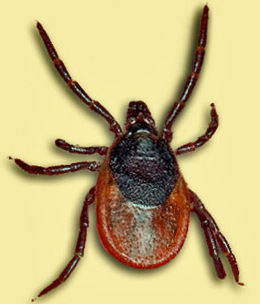
The Black-legged Tick has eight legs in its nymphal and adult stages, while its larvae have six legs. It lacks eyes, and its scutum is dark and unornamented.[1][2][3]
Unengorged individuals are flat, oval-shaped and dark reddish brown. Engorged individuals become rounder and develop a darker-looking abdomen.[4][5]
Adult females measure approximately 3–4 mm in length, while adult males measure approximately 2–3 mm. Unengorged adult ticks are approximately the size of a sesame seed.[6][7][8]
Adult males cannot engorge because their rigid scutum covers the entire body.[9]
Habitat
The Black-legged Tick occurs in forested areas containing leaf litter, brush and grasses. Its habitat distribution is associated with humidity, lower elevation and the presence of white-tailed deer.[10][11]
Diet
The Black-legged Tick feeds exclusively on host blood. Adult ticks feed primarily on white-tailed deer, while nymphs feed on mice and birds.[12][13][14]
Adult females feed on white-tailed deer for five to seven days. Adult males rarely feed.[15][16]
Behaviour
The Black-legged Tick completes its life cycle in approximately two years and passes through larval, nymphal and adult stages. Individuals require a blood meal at each life stage before progressing to the next stage.[17][18][19]
Adult females remain attached to a host and feed for four to five days. After becoming engorged, they drop off their hosts.[20][21]
Individuals use questing behaviour by waiting on vegetation and extending their front legs toward passing hosts. They seek hosts from ground level or nearby and move by crawling rather than flying or jumping.[22][23][24]
The species is most active from March through October. It can remain active after hard frost when daytime temperatures become sufficiently warm and can become active among invertebrates early in spring.[25][26][27]
Adult ticks may search for hosts during winter whenever temperatures are above freezing.[28]
Reproduction and life cycle
After overwintering, females lay several hundred to a few thousand eggs in clusters during the following spring. Vertical transmission of Borrelia from mother ticks to their eggs is uncommon.[29][30]
Conservation
Climate-change-associated warming is extending the species' distribution toward higher latitudes in Canada and the northern United States. Warming trends are also extending populations into central regions of the United States.[31][32]
Classification of the Black-legged Tick
| Kingdom | Animalia |
|---|---|
| Phylum | Arthropoda |
| Subphylum | Chelicerata |
| Class | Arachnida (Arachnid) |
| Superorder | Parasitiformes |
| Order | Ixodida (Tick) |
| Family | Ixodidae (Hard Ticks) |
| Genus | Ixodes |
| Species | Ixodes scapularis Say, 1821 |
Where the Black-legged Tick is found
Checklists and occurrence records place Ixodes scapularis in 3 countries across North America. GBIF holds 20,377 georeferenced records of it.
Countries
Regions and cities with the most records
- Massachusetts, United States 2,296
- Wisconsin, United States 2,263
- Virginia, United States 1,998
- Ontario, Canada 1,948
- West Virginia, United States 1,182
- Maryland, United States 1,080
- Front Royal, United States 1,072
- New York, United States 1,071
- Morgantown, United States 1,033
- Pennsylvania, United States 967
- Crofton, United States 847
- Bowie, United States 845
- Greater Upper Marlboro, United States 828
- Parole, United States 827
- Annapolis, United States 825
- Arnold, United States 825
- Michigan, United States 595
- Vermont, United States 545
- Ohio, United States 510
- Nova Scotia, Canada 501
- Tennessee, United States 477
- Quebec, Canada 467
- Severna Park, United States 420
- Farragut, United States 410
- Oak Ridge, United States 407
- Winchester, United States 372
- New Hampshire, United States 333
- Minnesota, United States 331
- Illinois, United States 273
- Florida, United States 272
- New Jersey, United States 259
- Connecticut, United States 258
- Waltham, United States 221
- Maine, United States 216
- Chestnut Hill, United States 214
- Newton, United States 214
1 more country has a few records outside this range
These countries hold a few records of Ixodes scapularis but lie outside the range the checklists give for it. Such records are often zoo or garden specimens, museum material or vagrants, so the species is not counted as occurring there.
Range as the checklists state it
Canada, Mexico, United States
A number beside a place is its count of GBIF occurrence records. A place without a number comes from a checklist alone. Records show where a species has been observed or collected, which can include escapes and vagrants.
Common names
English
- Black-legged Tick
- Bear Tick
- Black Legged Tick
- Deer Tick
- Eastern Black-legged Tick
- Northern Deer Tick
Names in 10 other languages
- Czech
- klíště jelení
- Dutch
- Amerikaanse hertenteek, Hertenteek
- French
- Tique aux pattes noires, Tique à pattes noires
- German
- Hirschzecke, Rehzecke, Schwarzbeiniger Holzbock
- Lithuanian
- Elninė erkė
- Russian
- Черноногий клещ
- Slovenian
- črnonogi klop
- Spanish
- Garrapata de los ciervos, Garrapata de patas negras, Garrapata transmisora de la enfermedad de Lyme
- akz
- Icho iⁿsatani
- oji
- Ezigaa
Synonyms
11 other scientific names have been used for this species and are now treated as synonyms of Ixodes scapularis.
- Ixodes (Ixodes) dammini Spielman et al., 1979
- Ixodes (Ixodes) scapularis Neumann, 1911
- Ixodes dammini Spielman et al., 1979
- Ixodes fuscous Say, 1821
- Ixodes fuscus Neumann, 1911
- Ixodes ozarkus Cooley, 1944
- Ixodes reduvius Neumann, 1899
- Ixodes ricinus scapularis Nuttall & Warburton, 1911
- Ixodes ricinus var. scapularis Nuttall & Warburton, 1911
- Ixodes muris Good, 1973 misapplied
- Ixodes pratti Banks, 1908 ambiguous synonym
Related species
-
 Australian Paralysis TickIxodes holocyclus
-
 Castor Bean TickIxodes ricinus
-
 Western Black-legged TickIxodes pacificus
-
 Taiga TickIxodes persulcatus
-
 Hedgehog TickIxodes hexagonus
-
 Seabird TickIxodes uriae
- American Castor Bean TickIxodes cookei
- Squirrel TickIxodes marxi
Compare
Questions and answers
What is the scientific name of the Black-legged Tick?
The scientific name of the Black-legged Tick is Ixodes scapularis. Written with its author, the full name is Ixodes scapularis Say, 1821.
Which family does the Black-legged Tick belong to?
Ixodes scapularis belongs to the family Ixodidae, in the order Ixodida and the class Arachnida.
Where is the Black-legged Tick found?
Checklists and occurrence records place Ixodes scapularis in 3 countries: United States, Canada and Mexico.
What other names does the Black-legged Tick have?
Ixodes scapularis is also known in English as Bear Tick, Black Legged Tick, Deer Tick, Eastern Black-legged Tick and Northern Deer Tick.
Sources
Passages the profile rests on
- The species has eight legs in its nymphal and adult stages, while its larvae have six legs. Source passage: “As a nymph and adult, Ixodes scapularis has eight legs, while larvae have six.” — English Wikipedia
- The species lacks eyes. Source passage: “black-legged ticks do not have eyes.” — English Wikipedia
- Its scutum is dark and unornamented. Source passage: “The scutum is dark, inornate (plain)” — English Wikipedia
- Unengorged individuals are flat, oval-shaped and dark reddish brown. Source passage: “Unengorged, they are small (adults are only about the size of a sesame seed) flat and oval shaped. They are dark reddish brown in color” — entomology.umn.edu
- Engorged individuals become rounder and develop a darker-looking abdomen. Source passage: “Engorged ticks are ticks that have recently taken a blood meal. These are round in shape and their abdomen appear darker in color.” — entomology.umn.edu
- Adult females measure approximately 3–4 mm in length. Source passage: “Adult female black-legged ticks are approximately 3 to 4 mm long” — English Wikipedia
- Adult males measure approximately 2–3 mm in length. Source passage: “adult males are 2 to 3 mm long” — English Wikipedia
- Adult ticks are approximately the size of a sesame seed when unengorged. Source passage: “adults are only about the size of a sesame seed” — entomology.umn.edu
- Adult males cannot engorge because their rigid scutum covers the entire body. Source passage: “cannot engorge due to the rigidity of their scutum, which covers the entire male body.” — English Wikipedia
- The species occurs in forested areas containing leaf litter, brush and grasses. Source passage: “They are found in forested areas with plenty of leaf litter, brush and grasses.” — entomology.umn.edu
- Its habitat distribution is associated with humidity, lower elevation and the presence of white-tailed deer. Source passage: “Its habitat distribution seems to be somewhat dependent on humidity, lower elevation and the presence of one of its hosts, the white tailed deer.” — entomology.umn.edu
- The species feeds exclusively on host blood. Source passage: “Ticks exclusively feed on blood from hosts such as deer, mice, birds or other mammals.” — entomology.umn.edu
- Adult ticks feed primarily on white-tailed deer. Source passage: “adults feed mostly on white tailed deer.” — entomology.umn.edu
- Nymphs feed on mice and birds. Source passage: “Nymphs will feed on a mice and birds” — entomology.umn.edu
- Adult females feed on white-tailed deer for five to seven days. Source passage: “Adult female ticks feed upon their definitive host, the white-tailed deer, for five to seven days” — animaldiversity.org
- Adult males rarely feed. Source passage: “while the male tick rarely feeds at all.” — animaldiversity.org
- The species completes its life cycle in approximately two years. Source passage: “Ixodes scapularis has a 2-year life cycle” — English Wikipedia
- The species passes through larval, nymphal and adult stages. Source passage: “during which time it passes through three stages: larva, nymph, and adult.” — English Wikipedia
- Individuals require a blood meal at each life stage before progressing to the next stage. Source passage: “The tick must take a blood meal at each stage before maturing to the next.” — English Wikipedia
- Adult females remain attached to a host and feed for four to five days. Source passage: “Black-legged tick females latch onto a host and drink its blood for 4–5 days.” — English Wikipedia
- Adult females drop off their hosts after becoming engorged. Source passage: “After she is engorged, the tick drops off” — English Wikipedia
- Individuals use questing behaviour by waiting on vegetation and extending their front legs toward passing hosts. Source passage: “adult ticks will engage in “questing” behavior by sitting on the tip of vegetation and reaching out their front legs until a host passes by.” — entomology.umn.edu
- The species moves by crawling rather than flying or jumping. Source passage: “Ticks do not fly or jump- they only crawl.” — entomology.umn.edu
- Individuals seek hosts from ground level or nearby. Source passage: “They will only seek hosts from ground level or close to it.” — entomology.umn.edu
- The species can remain active after hard frost when daytime temperatures become sufficiently warm. Source passage: “It can be active after a hard frost, as daytime temperatures can warm it enough to keep it actively searching for a host.” — English Wikipedia
- The species can become active among invertebrates early in spring. Source passage: “In the spring, it can be one of the first invertebrates to become active.” — English Wikipedia
- The species is most active from March through October. Source passage: “Ticks are most active March through October” — entomology.umn.edu
- Adult ticks may search for hosts during winter whenever temperatures are above freezing. Source passage: “adult ticks may be searching for a host any time winter temperatures are above freezing.” — cdc.gov
- After overwintering, females lay several hundred to a few thousand eggs in clusters during the following spring. Source passage: “The following spring, the female lays several hundred to a few thousand eggs in clusters.” — English Wikipedia
- Vertical transmission of Borrelia from mother ticks to their eggs is uncommon. Source passage: “Vertical passage (from mother to egg) of Borrelia is uncommon.” — English Wikipedia
- Climate-change-associated warming is extending its distribution toward higher latitudes in Canada and the northern United States. Source passage: “pushing the distribution of black-legged ticks to higher latitudes in Canada and the northern United States” — English Wikipedia
- Warming trends are also extending populations into central regions of the United States. Source passage: “extending populations in central regions of the United States.” — English Wikipedia
- The species is a vector of Lyme disease in North America. Source passage: “Ixodes scapularis is the main vector of Lyme disease in North America.” — English Wikipedia
- The species can transmit babesiosis, anaplasmosis and Powassan virus disease. Source passage: “The black-legged tick is a vector for several diseases: Lyme disease, babesiosis, anaplasmosis, and Powassan virus disease.” — English Wikipedia
Data
- Catalogue of Life, 2026-10-16 XR cc by
- Global Biodiversity Information Facility CC BY 4.0
- Wikidata CC0
- GeoNames CC BY 4.0
- Wikimedia Commons per image; credit shown with each image
- Within the Catalogue of Life, this name comes from TicksBase cc by
References
- Say, T. (1821) An account of the arachnides of the United States. Journal of the Academy of Natural Sciences of Philadelphia, 2, 59 - 82. where the name was published
This species in other databases
Page built on 27 November 2026. See how the catalog is made and all sources and licences.
Cite this page
ScientificNames.org. (2026). Ixodes scapularis (Black-legged Tick). Retrieved November 27, 2026, from https://scientificnames.org/species/ixodes-scapularis
“Ixodes scapularis (Black-legged Tick).” ScientificNames.org, 2026, scientificnames.org/species/ixodes-scapularis. Accessed 27 Nov. 2026.
ScientificNames.org. “Ixodes scapularis (Black-legged Tick).” Accessed November 27, 2026. https://scientificnames.org/species/ixodes-scapularis.
@misc{scientificnames_ixodes_scapularis_black_legged_tick,
  author = {{ScientificNames.org}},
  title = {Ixodes scapularis (Black-legged Tick)},
  year = {2026},
  url = {https://scientificnames.org/species/ixodes-scapularis},
  note = {Accessed 2026-11-27}
}